
It’s Christmas, and while I’m not Santa Claus, that will not stop me from making a list and checking it twice, all to find out who’s naughty or nice.
Eight teams remain in the College Football Playoff, and none are perfect. As far as fans are concerned, that’s a good thing. It leads to more uncertainty about how the final three rounds will play out, which is what every college football fan should want.
So think of this naughty and nice list as a way of describing why teams could win it all or what could cause them to come up short in their goal of winning the national championship.

Nice: Taking care of the football
Indiana does plenty of things well, which is how you become the No. 1 team in the country and remain the only undefeated team out there. One of the key reasons for its success on offense is that it doesn’t give the ball away. The team’s turnover rate of 5.5% is the best in the field and ranks sixth nationally, and it’s not just dumb luck. I track a stat I call Whoopsy Daisy Rate, which is essentially how many of your offensive snaps include an interception or a fumble (not a fumble lost), and Indiana’s WDR of 1.50% ranks third and is also the best in the field.
When you don’t give the ball away, that gives you more chances to put points on the board, so it’s no surprise that Indiana is also third nationally in points per drive (3.57) and third in percentage of possessions that result in points scored (57.2%). Those are the best marks in the remaining field as well. Who would’ve thought scoring points and taking care of the football could help a team be successful? First I’ve heard of such an idea!
Naughty: Not great in pass protection
Indiana’s offensive line has allowed pressure on 28.8% of its dropbacks this season. That’s not a terrible number, as it ranks 41st nationally, but Alabama is the only team left in the field that allows pressure at a higher rate (29.6%, 46th). Their sack rate allowed of 5.0% ranks 43rd as well, and their 2.53 seconds until pressure is allowed ranks 66th, which is the worst in the field.
The good news is they have a Heisman-winner at quarterback who doesn’t seem to mind. Fernando Mendoza has a passer efficiency of 150.5 when pressured this season, which ranks sixth nationally. He also has a touchdown rate of 11.0% when pressured, and that ranks second. Mendoza is not afraid to stand in the pocket and take a hit if it allows his receiver another step to get open.

Nice: Red Zone defense
Ohio State’s defense is the best in the country in a number of categories, but while it’s great at everything, the one thing it does at a historic level is crush teams in the red zone. Not only is the 3.00 points Ohio State has allowed on red zone possessions this season the best mark in the country, but it’s also the best mark any defense has put up since the 2021 Georgia defense that allowed 2.72. That defense was filled with a bunch of early-round NFL Draft picks, much like this year’s Ohio State unit is.
This is nothing new for the Buckeyes, though. Last year’s team allowed only 3.08 points per red zone possession, and that led the nation too. However, I do feel the need to point out that Ohio State’s defense allowed 4.33 points per red zone possession in the playoff, but that stat is a bit misleading. Oregon scored three red zone touchdowns against the Buckeyes after they’d already jumped out to a 34-0 lead in the Rose Bowl. In the final two rounds against Texas and Notre Dame, the Buckeyes allowed only 3.00 points per red zone possession.
Naughty: The margins
Listen, it’s hard to poke holes in the Buckeyes. They’ve been very good at most everything. However, there are two areas worth monitoring when it comes to the playoff, and you’re facing nothing but elite competition. I have a stat I use called “Margin EPA.” It’s a measurement of your EPA with penalties on both sides of the ball, as well as special teams. Ohio State’s margin EPA of -14.57 ranks 106th nationally, and is ahead of only its first opponent, Miami (-32.34, 127th) in the field.
The majority of the damage has been on special teams and defense. Ohio State’s defensive penalty EPA is -9.23 and ranks 119th nationally. Its special teams EPA of -9.43 ranks 95th.

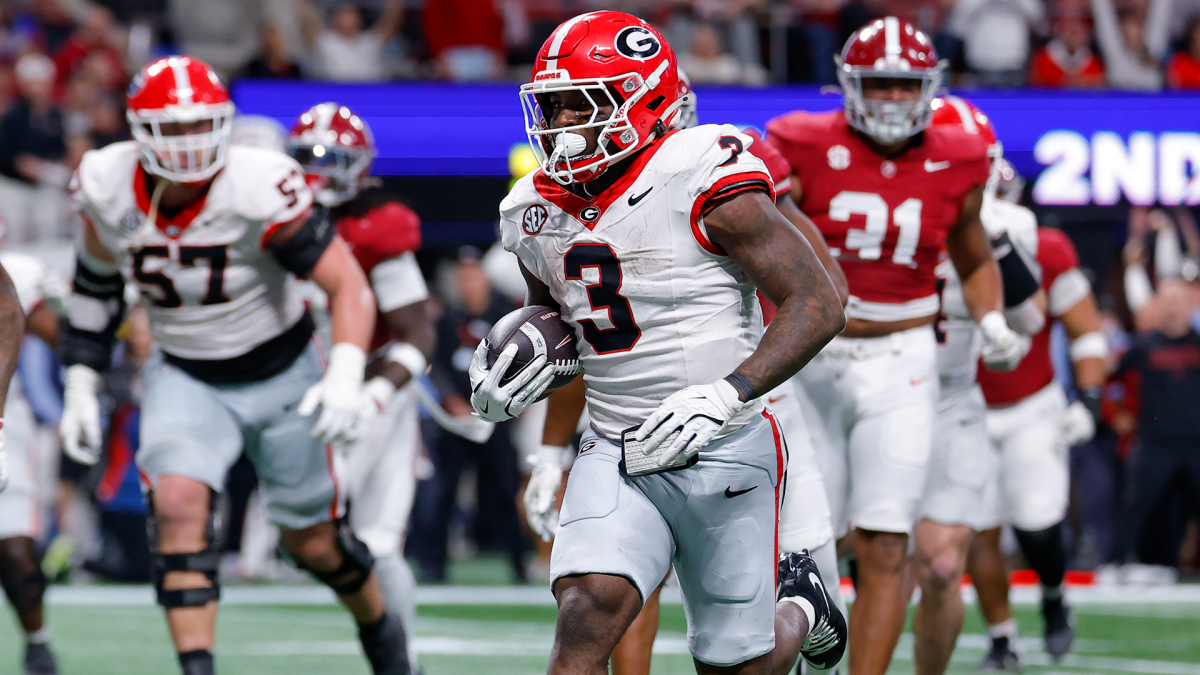
(3) GeorgiaNice: Finishing drives
There are a lot of things about the Georgia offense that aren’t great overall. The 2.90 points the Bulldogs score per possession ranks 22nd nationally but is sixth among the eight teams remaining. Their explosive play rate of 11.7% is the lowest among the field and 70th nationally. Furthermore, only 37.06% of their drives reach the red zone. That ranks 30th overall and seventh in the field, ahead of only Oregon. The difference is that Oregon scores from outside the red zone far more often.
All that said, when Georgia does cross that 20-yard line, good luck. The Dawgs have scored a touchdown on 79.2% of their red zone possessions. That ranks second nationally behind only NC State (bet you didn’t see that coming), and Georgia’s 5.09 points per red zone possession ranks third. That’s the highest mark in the CFP field, too.
Naughty: Lack of a pass rush
It’s a bit mindblowing considering all the talent we’ve seen come through Georgia’s front seven over the last decade, but this year’s Dawgs defense doesn’t do a good job of getting after the quarterback. The team’s pressure rate of 31.0% ranks 86th nationally and is dead last by a mile among the remaining field. Making matters worse, even when Georgia does get pressure, it does a terrible job of getting home.
The team’s sack rate is only 4.6%, which ranks 115th nationally. Oregon is the next worst at 6.3% (65th). Georgia doesn’t blitz at a remarkably high rate, but blitzing is its only effective way of getting home. Its pressure-to-blitz ratio of 1.06 ranks 94th nationally and is only better than Alabama’s (1.00, 110th).

Nice: The pass rush
The counting stats don’t tell the whole story, though they do tell quite a story. David Bailey is the superstar, as his 13.5 sacks rank second nationally (Western Michigan’s Nadame Tucker has 14.5) and his 17.5 tackles for loss are tied for third. He, along with Romello Height, Jacob Rodriguez and AJ Holmes, is the core of a defense that lives in opponents’ backfields. In a playoff field full of future NFL players on the defensive line, I say with confidence that Texas Tech has the best one from top to bottom.
As a team, the Red Raiders are second nationally in pressures with 202 (behind only Miami’s 203) and tied for sixth with 39 sacks. However, where they truly stand out is how little time they give you. Tech’s 2.3 seconds allowed before pressuring the opposing QB ranks third nationally (hundredths of a second behind Utah and Auburn), and the 2.64 seconds they let pass before the QB has to throw is the best in the playoff field by a wide margin. If you have a QB who doesn’t understand what he’s seeing before the snap and needs time to think things through afterward, you’re toast against this unit.
Naughty: Staying on schedule
It doesn’t matter what kind of offense a team runs; every offensive coordinator wants to avoid being in third-and-long situations. Those are the spots where a defense is put at an advantage because it has a very good idea of what you’re going to do and can bring extra blitzers or just drop into coverage if it wants to test your QB. Texas Tech has not done a good job avoiding these situations.
The average Texas Tech third down has seen the Red Raiders needing 7.1 yards to get a first down. That ranks 81st in the country and is the most of the remaining field. However, the Red Raiders are only in third-and-long (need 7 yards or more) 45.85% of the time (52nd nationally, 8th in field). The problem is that this team is rarely in third-and-short (3 yards or fewer) situations. Only 25.85% of Tech’s third-down spots are considered short, which ranks 83rd nationally. For context, not only is that the lowest in the field, but the next closest team is Miami at 29.49%. That ranks 43rd.

(5) OregonNice: A nuclear offense
Explosive play rate is a well-known stat at this point and measures the number of “explosive” plays an offense has, with explosive typically defined as rushes over 12 yards and passes over 16 (different places do use different standards). Oregon is very good at this metric. Its 15.9% explosive play rate on offense ranks eighth nationally and is the highest of the remaining field. What that stat doesn’t tell you is how explosive Oregon truly is.
I’ve created my own stat called nuclear rate. It’s a measurement of how many plays over 40 yards a team has. Oregon’s nuke rate of 2.62% ranks sixth nationally and is tops in this field. In fact, only two teams in the field are in the top 10 (Ohio State is ninth), and only four are in the top 25 (Ole Miss and Indiana). Everybody else is ranked outside the top 50. Hell, Georgia and Alabama are 130th and 131st, respectively. Bombs can shorten wars, but nuclear bombs end them.
Naughty: You can run on this team
It’s not a glaring weakness. Part of what makes Oregon an intriguing team to me in the postseason is that it doesn’t truly have one. That said, this team does have a tendency to let opponents move the ball on the ground. You only need to look back at the first-round win over James Madison. Even before the second half began, James Madison was moving the ball on the ground against the Ducks; it just couldn’t finish drives once it reached the end zone.
We also saw Washington, Penn State, Iowa, Northwestern and Indiana have success on the ground against this Ducks defense. Overall, the Ducks rank 41st nationally in success rate against the run at 61.3%. Only the Ole Miss defense has performed worse than the remaining teams. Its EPA per rush of 0.03 is 57th nationally and worst in the field. What the Ducks don’t do is allow explosive rushes. Their 5.28% explosive rush rate ranks fifth nationally. Still, if they run into a team that can consistently move the ball on the ground (Indiana is top 10 in rushing success rate and EPA per rush, and we saw how that went earlier this year), it will pose problems for this team.
(6) Ole MissNice: Fourth down decision-making
One of the areas I’m interested in tracking now that Lane Kiffin is gone is how Ole Miss approaches fourth down on offense. There are plenty of teams that have gone for it on fourth down more often than the Rebels this season (29 attempts, t-35th), but few have been as successful.
Ole Miss’ 68.97% conversion rate is 13th nationally, which is nice, but their real strength has been knowing when to go for it. Ole Miss’s 14.9 EPA gained on fourth downs ranks 11th nationally and is the best in the field. Their 0.17 EPA per fourth down decision ranks 10th nationally. It’s the combination of knowing when to go for it, when not to, and being successful when you do that that adds so much to this offense.
Naughty: Don’t take advantage of turnovers
Ole Miss has forced only 13 turnovers this season, which ranks 95th nationally, and their defensive turnover rate of 7.2% ranks only 114th. It’s part of the reason why Ole Miss’s 1.64 points allowed per possession is the worst of the remaining field (though only 31st nationally, so it isn’t bad).
This would be fine if Ole Miss did a better job of taking advantage of those turnovers, but they don’t. The Rebels have scored only 31 points off turnovers all season. That ranks 109th nationally. The craziest part: 21 of those 31 points came against Tulane last week. Yep, during the regular season, they managed only 10 points off turnovers in 12 games. As a whole, their defense has only scored two points, which ranks 117th. It hasn’t hurt them because their offense takes care of the football and is so potent, but it’s one of those things that could matter a lot now that they’re taking a step up in competition the rest of the way.
(9) AlabamaNice: Limit the damage on pass defense
If you look at the overall numbers of Alabama’s pass defense, they aren’t overly impressive. Their defensive pass efficiency ranks 31st, and completion rate allowed ranks 61st, but it’s somewhat by design. Alabama doesn’t mind if you complete passes, just so long as you’re not completing them behind the defense.
That’s why their yards per completion allowed of 10.16 ranks 13th nationally, and their average air yards per attempt of 6.8 ranks fourth. It’s not the sexiest approach out there, nor is it even the best among the playoff field, but it’s a big reason why the Tide defense ranks 12th nationally in defensive success rate and 14th in EPA per dropback.
Naughty: They don’t sustain drives
Alabama’s offense can be a roller coaster. Just look at what happened against Oklahoma in the first round for yet another example of the Jekyll and Hyde performances. On the season, 29.8% of Alabama’s offensive possessions have ended without a first down. That ranks 65th nationally and is far-and-away the highest rate in the field (Miami is 31st at 24.8%). The Tide have also gone “three and punt” (three-and-outs that end with a punt) on 23.2% of their possessions. That ranks 105th nationally. The next worst team in this category in the field? It’s Georgia at 14.7% (29th).
These numbers go a long way toward explaining why Alabama’s offense is the worst in the field when it comes to points per drive (2.76, 28th nationally), success rate (44.2%, 43rd), and EPA per snap (0.12, 35th). The most likely reason for this is Alabama’s inability to run the ball. When your run game is stuck in the mud (101st in rushing success rate), it affects the entire offense’s ability to get going. The good news for Alabama is that once they do get started, they tend to finish.

(10) MiamiNice: Pressuring the QB
Miami isn’t the best at everything when it comes to the pass rush, as Ohio State, Texas Tech and Indiana beat it in some categories, but nobody has gotten more pressures on opponents this season. Miami has 203 pressures this season, led by Rueben Bain Jr. (65) and Akheem Mesidor (55). Their team pressure rate of 40.4% ranks sixth nationally and second in the field, and their sack rate of 8.9% ranks 11th.
Pressure tends to play a significant role in Miami games. When their defense is getting it, they’re very hard to score against. However, when their own QB is pressured, they rank 100th nationally in EPA per drop back (-0.40), but there’s another area of worry with this Hurricanes team worth mentioning.
Naughty: Tackling
There are plenty of things to like about the Miami defense. We just talked about one of them! But the one thing that gets this unit in trouble is its tackling. According to TruMedia, the Canes’ defense has a missed tackle rate of 17.4%. That’s the worst of our eight remaining teams by far. It ranks 128th nationally! Nobody else in the field is worse than 58th (Ole Miss, 14.2%).
Miami has been able to overcome this deficiency thanks to its incredible pass rush and the way it limits explosive plays, but it’s a legitimate concern in the playoffs. Once you get this far, you’re facing elite competition, and elite competition typically has elite skill position players. The kind that will make you pay if you miss a tackle in the open field.