
There are still a few players left in the portal but for the most part, we have reached the end of the road for roster changes for the upcoming 2025 season. That means it’s time to assess who has done the best job of improving their performance in the transfer portal.
The rankings here are entirely pulled from my own transfer portal player rankings system which puts every player on a 1 to 100 scale with my own formula taking into account the player’s recruiting ranking out of high school, how much they’ve played since getting to college, and how well they’ve played when on the field.
I didn’t manage to put out an initial ranking after the winter portal period closed but fortunately I record the portal entry dates. That means I went back and ran the formula including only players who entered the portal before March 1st so you have a point of comparison for how much things changed in the spring period.
A few notes when it comes to the actual team rankings below:
The rankings take into account the portal as a whole and not just the additions. The teams that finished at the top usually get there in part because they don’t lose key pieces via the portal. Pure roster churn usually puts you in the middle or bottom.
Starting last year, I began adjusting the totals for teams that lost more players in the portal than they gained. This means that teams aren’t overly punished for losing a chunk of the bottom portion of their roster. Teams with a net player loss get credited for adding a redshirt freshman who didn’t play based on their average recruit. That stays closer to reality where the really good teams can replace any gaps in the portal more easily than those towards the bottom. This means Oregon makes up for any gaps with a player worth 34.6 points and Purdue’s is worth 19.5 on the other end of the spectrum.
In order to try to only capture scholarship players, I excluded any player who had a score of less than 16. That’s generally the cutoff for a player who was unranked out of high school and hasn’t seen the field yet. Teams had more walk-ons than normal enter the portal this year because of the uncertainty around roster limits with the House settlement. Some walk-ons may have been above that threshold but only if they were ranked out of high school or had seen playing time which makes them more fair game for evaluation.
I do not consider class of 2025 early enrollees switching programs as a transfer but instead part of the recruiting class. UCLA doesn’t get credit for Nico Iamaleava’s younger brother transferring from Arkansas after being a spring early enrollee.
18. Maryland Terrapins, -134.3 points (Pre-Spring Rank: 17th)
Additions: 12 with average grade of 50.1; Highest: WR Jalil Farooq (from Oklahoma), 82 points
Departures: 26 with average grade of 43.3; Highest: RB Roman Hemby (to Indiana), 72 points
The fact that Maryland is in last place here is generally a pretty good sign for the Big Ten as a whole that they fared well in the portal. Only one team in the entire conference had an average departing recruit with a higher score than their average incoming transfer. And that one team wasn’t Maryland. The reason Maryland ranks last is the sheer volume with 15 more departures than additions via the portal.
Those 26 total departures contain 4 quarterbacks including both their starter and their backup from last season who are headed to Wisconsin and Coastal Carolina respectively. Their top 2 rated departures are both intra-conference transfers and are at Indiana now. Another pair are headed to Auburn plus there are losses to Central Florida, Kentucky, Texas, Ole Miss, and Arkansas.
The final count is 10 transfers lost to other power conference schools. Six of those players have double digit career starts at the power conference level.
The additions don’t make up for the gap but it helps that they have at least one premium incoming transfer in Oklahoma WR Jalil Farooq. He missed almost all of last year due to injury but had nearly 1200 yards and 7 TDs over the previous 2 seasons and projects as a clear starter when healthy. Pass catchers and defensive line were the priority though. Three of Maryland’s four highest rated incoming transfers were either WRs or TEs and 5 of the 11 came on the defensive line with additions there from Florida State, Alabama A&M, North Carolina, Ohio, and Saint Francis.
The only quarterback addition via the portal is UCLA backup Justyn Martin and he appears to be the presumptive starter.
17. USC Trojans, -132.5 points (Pre-Spring Rank: 18th)
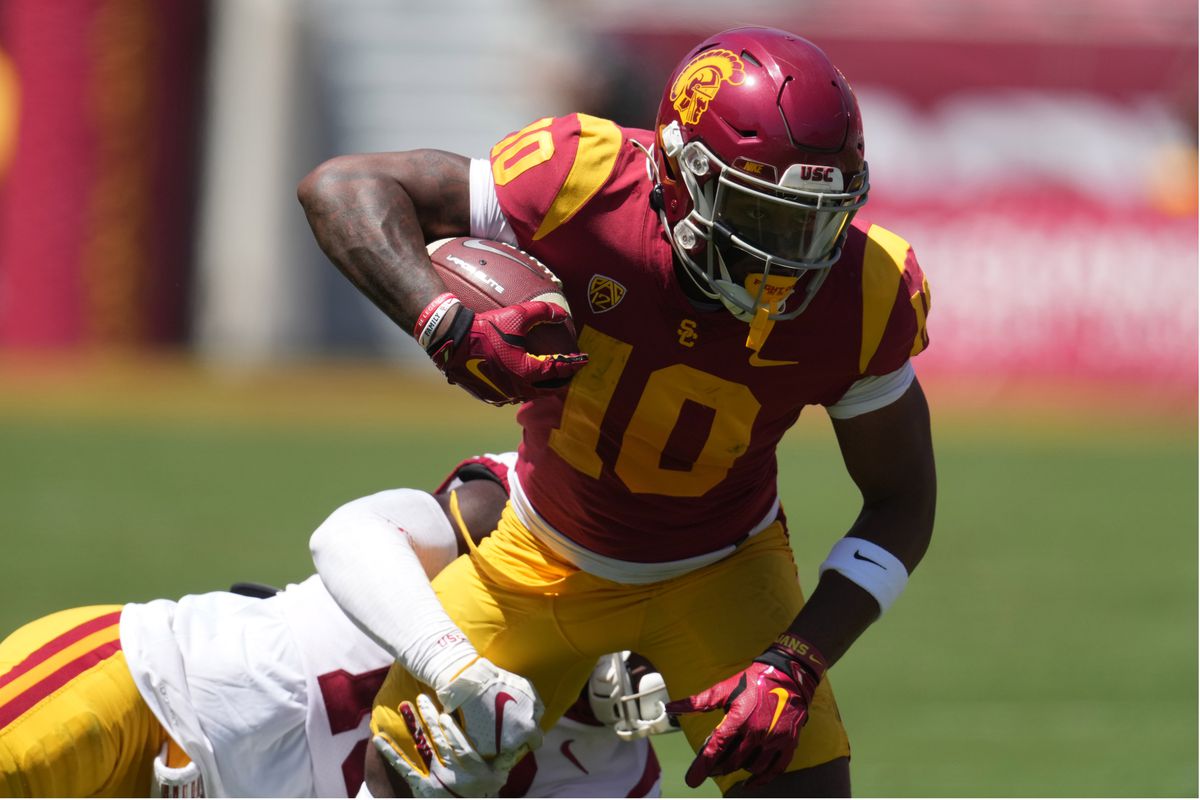
Additions: 14 with average grade of 64.5; Highest: CB DJ Harvey (from San Jose State), 86 points
Departures: 23 with average grade of 57.3; Highest: QB Miller Moss (to Louisville), 88 points
I’m sure there are plenty of Trojan fans who would question this ranking based on who USC added but this ranking system also takes into account the losses. USC had the 2nd highest average incoming transfer grade (behind Oregon) but also had the very highest average departing transfer which offsets those gains.
We’re likely to find out based on the performance of many of those departures at their new schools whether USC has been struggling with evaluation or development (or both). Eight of the players leaving USC were a 0.94+ in the 247 Sports Composite and clear top-150 players in their high school class. That includes former 5-star pass catchers Duce Robinson (85 pts to Florida State) and Zachariah Branch (85 pts to Georgia). Fully 13 of the departures had started at least 1 game at the power conference level and 6 of them had started double digits. 17 of the 23 departing transfers transferred to another power conference school.
Lincoln Riley did his best to replenish the talent. The top rated additions are both in the secondary with DJ Harvey and Bishop Fitzgerald (83 pts from NC State). They each pencil in as above average starters. The lines were a focus with 3 players added who had started at least 12 games at the power conference level. But those players came from Kentucky, Purdue, and Syracuse and two of them are now on their 3rd school.
Last year USC added UNLV starting QB Jaiden Maiava to be the backup to Miller Moss. Riley benched Moss after his performance against UW and Moss transferred out to Louisville. Now the Trojans have brought in former Husky Sam Huard (77 pts from Utah) to be Maiava’s backup. We’ll see if Riley can regain his quarterback whisperer ways with this crew.
Kirby Lee-Imagn Images
16. Penn State Nittany Lions, -42.9 points (Pre-Spring Rank 16th)
Additions: 8 with average grade of 63,6; Highest: WR Kyron Ware-Hudson (from USC), 76 points
Departures: 13 with average grade of 54.6; Highest: CB Cam Miller (to Rutgers), 80.8 points
Penn State may be the presumptive title favorites but they still took some losses in the portal this offseason. There’s a lot of similarities between their portal haul and USC as they rank just below USC in both average incoming and outgoing transfer grade.
There were some good players who left but it’s reasonable to think that part of the reason for their departures was the lack of path to a starting job on a team that is stacked for next season. Starting slot corner Cam Miller is the highest ranked departure after he tied for the team lead in PBUs but is headed to Rutgers. Backup QB Beau Pribula (76.2 pts to Missouri) was a great changeup option as a dynamic runner in short yardage situations but was blocked by Drew Allar returning. Wide receivers Harrison Wallace (76 pts to Ole Miss) and Omari Evans (61 pts to Washington) were starter level players last year but will be part of the test to see if the issue with PSU’s WRs was the WR talent or the QB/system.
The Nittany Lions replaced that WR duo with a trio of additions in Kyron Ware-Hudson, Devonte Ross (70 pts from Kentucky), and Trebor Pena (68 pts from Syracuse). This grading system views those as only slight upgrades but we’ll see how it plays out. The only other notable additions were LB Amare Campbell (72 pts from North Carolina) who has started 14 games and S King Mack (70 pts from Alabama). Mack is a high 4-star boomerang transfer who played as a freshman at Penn State, transferred to Alabama, last offseason, and now is back at Penn State.
15. Nebraska Cornhuskers, +23.9 points (Pre-Spring Rank 12th)
Additions: 15 with average grade of 58.2; Highest: WR Dane Key (from Kentucky), 92 points
Departures: 26 with average grade of 45.8; Highest: RB Dante Dowdell (to Kentucky), 81 points
There was quite a bit of roster churn at Nebraska this offseason but a good chunk of it came from the back-end of the roster. 19 of the 26 departures had a grade below 60.0 and didn’t project as clear starters. The highest rated loss was former Oregon RB Dante Dowdell who ran for 600 yards for Nebraska as their part-time starter this past year. Five of the players leaving have started double-digit games at the P4 level but only one ranked among Nebraska’s top 6 losses which suggests they may have started due to the lack of other options on the roster rather than being Big Ten starter-level talents.
Nebraska traded skill position players with Kentucky for their top-ranked addition and departure. I have the Cornhuskers coming out on top of that exchange with 6’3 former four-star Dane Key who was my system’s top-ranked WR this offseason after putting up 500+ receiving yards each of the last 3 seasons. They also added my top-ranked interior offensive lineman in 23-game starter Rocco Spindler (84.9 pts from Notre Dame). Throw in Indiana edge rusher Dasan McCullough (81.0 pts from Indiana) and that’s 3 of the top-80 overall transfers.
Photo by Brian Murphy/Icon Sportswire via Getty Images
14. Washington Huskies, +25.5 points (Pre-Spring Rank: 11th)
Additions: 16 with average grade of 56.9; Highest: LB Taariq Al-Uqdah (from Washington State), 85 points
Departures: 22 with average grade of 47.8; Highest: CB Thaddeus Dixon (to North Carolina), 78 points
It’s not a huge surprise to see Washington here given they finished 9th in average incoming recruit score and 14th in average departing recruit score. Combine that with a lot of transfers out and that’s how you end up clearly in the bottom-third.
The defense suffered heavy losses in the portal. 14 of the 22 departures were on that side of the ball including 7 of the top 8 overall. Both CB Thad Dixon and LB Khmori House (70 pts) followed DC Steve Belichick to North Carolina and might be regretting that decision right about now. Cornerbacks Elijah Jackson (72 pts to TCU) and Jordan Shaw (72 pts to Texas A&M) both started double digit games at the power conference level and are headed to P4 programs in the state of Texas. In total, 14 of the departures are headed to P4 schools, 5 to G5 schools, 2 to FCS, and only 1 remains uncommitted.
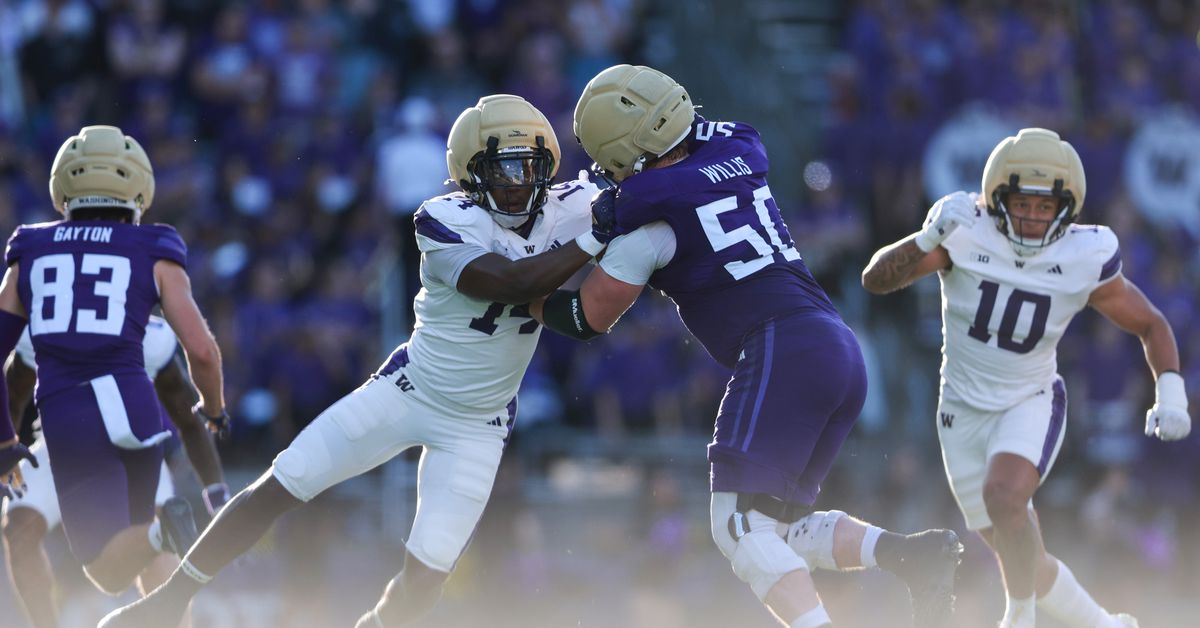
It isn’t a shock that the additions were also focused on the defensive side of the ball to make up for the departures. 9 of the top 11 new transfers in for Washington are on defense with only OL Carver Willis (68 pts from Kansas State) and WR Omari Evans (61 pts from Penn State) breaking things up from a clean sweep.
I generally consider anyone with over a 60.0 score to be a realistic potential starter on a P4 team and anyone over an 80.0 to be a near lock to start with all-conference upside. Washington ultimately finished +1 (1 to 0) on 80+ players and +2 (8 to 6) on players in the 60-79 range. Based on spring practices it looks like 7 of those incoming transfers will wind up starting on the opening day depth chart which isn’t bad but is pretty close to what they lost. This ranking reflects that Washington is mostly counting on development from returners more so than impact transfers to take a leap to the next level under Jedd Fisch.
13. Wisconsin Badgers, +34.8 points (Pre-Spring Rank: 14th)
Additions: 17 with average grade of 55.4; Highest: QB Danny O’Neil (from San Diego State), 79 points
Departures: 27 with average grade of 44.2; Highest: QB Tyler Van Dyke (to SMU), 90 points
The first thing to notice with Wisconsin in the portal is the upheaval at quarterback. Week 1 starter last year, Tyler Van Dyke, is on the move again after suffering a season-ending injury in Wisconsin’s 3rd game against Alabama. Also gone is backup Braedyn Locke (58 pts to Arizona) who finished out the rest of the year.
That duo is replaced with Wisconsin’s 2 highest additions: San Diego State starter Danny O’Neil and Maryland starter Billy Edwards (67 pts). It seems right now like Edwards, the more experienced option, may be in line to start right away but it wouldn’t shock me if O’Neil is the one taking snaps by the time we get to the end of the season.
Beyond the quarterback position, Wisconsin really prioritized upgrading their secondary and their defensive line. The next 7 highest rated additions after the 2 quarterbacks are all non-LBs on the defensive side of the ball. Most of them are moving up from lower levels with adds from Western Michigan, Jacksonville State, Richmond, and Tennessee Tech.
There are also plenty of faces moving on. Nine different double-digit P4 starters are departing Wisconsin this season including three along the defensive front and five among the offensive skill positions. That doesn’t include Wisconsin’s 2nd highest rated departure S Xavier Lucas (84 pts to Miami) who has been the subject of an offseason saga with Wisconsin trying in vain to enforce a multi-year NIL contract to keep him in Madison.
*****
We’ll be back later this week with teams 12 through 7 in the rankings.