
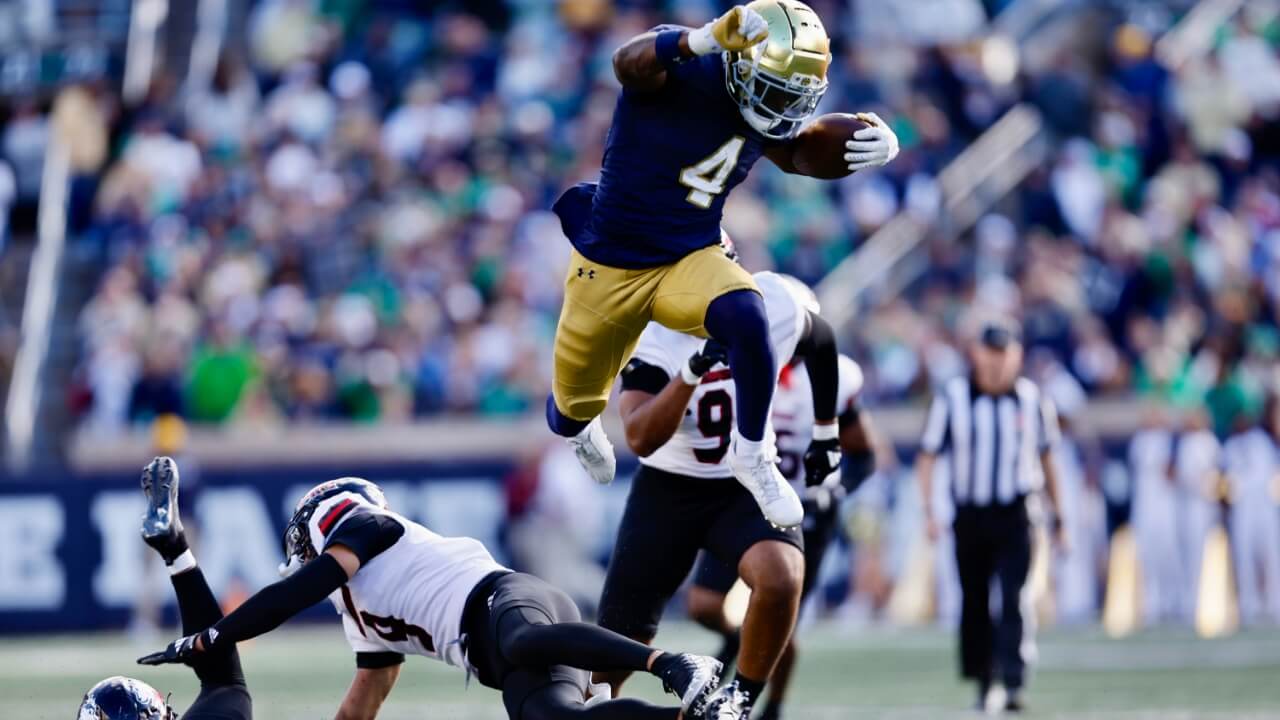
The Las Vegas Raiders and Notre Dame in round 1 of the NFL draft doesn’t happen often. In fact, it hasn’t happened since Tim Brown in 1988. Well, 2026 presents a chance to break the dry spell. That’s only if general manager John Spytek has the testicular fortitude to do so.
Spytek’s first draft class was headlined by Ashton Jeanty. The first-round running back has been a divisive topic among Raider Nation—however, it’s often a debate missing some context. The offensive line has largely been a disaster, though some promising signs have shown lately. Well, maybe it’s despite Brennan Carroll’s inept coaching. As it turns out, the Raiders had some promising rookies who just needed the coaching staff to get out of the way and let them play. So, what does that mean for next year’s draft?
If you truly want to build a run-heavy, powerhouse offense that’ll plow through the AFC West, you go with the following scenario. Oh, and by the way, you have to make sure to load up on more offensive linemen on Days 2 and 3 of the draft. Keep some names such as Gennings Dunker, Trevor Goosby, and Emmanuel Pregnon in mind when the time comes off.
Round 1: Jeremiyah Love, RB, Notre Dame
Jeremiyah Love is the kind of prospect who forces front offices to confront their own convictions. If the Raiders are serious about modernizing their offense, this is the type of player who accelerates that process overnight. With many scouts grading him in the same range as Jeanty and just a shade below Bijan Robinson—Love enters the 2026 cycle as RB1 and the No. 6 overall player on most boards. That is not running-back hype-it’s impact player territory.
The appeal is straightforward. Love pairs track-tested explosiveness with a 6-foot, 214-pound frame and production that goes beyond his 1,125 yards, 17 touchdowns and 6.9 yards per carry. His touchdown streak underscores his consistency, but the real story is in the traits: elite acceleration, smooth deceleration and re-acceleration, and lateral agility that borders on elastic.
He also brings route-running polish that makes him more than a backfield option. Whether aligned at running back, in the slot or in motion, he forces defenses to adjust before the ball is snapped.
That versatility is exactly what the Raiders lack. The offense has been slow, predictable and reliant on individual heroics. Love alters the geometry. He creates horizontal stress, widens pursuit angles, and forces linebackers to play on their heels. For a Raiders team trying to dig out of an era defined by stagnant offensive identities, a player with Love’s burst and creative instincts is not a luxury; it is a structural correction.
MORE: Catch up on all of our NFL draft content!
Why should the Raiders draft Love?
With all of the above said, the projection is not risk-free. His lean frame invites questions about long-term durability, and his pass protection—in both technique and effort—still needs work. Notre Dame often limited those snaps for a reason. His vision is generally sound, but he can drift, bounce runs unnecessarily or hesitate behind traffic, all of which become drive-killers at the next level.
Still, the upside is the headline. Love is a home-run threat with top-tier long speed, legitimate receiving chops, and the kind of balance and post-contact recalibration that translates to Sundays. He plays more physically than his frame suggests and competes with the kind of urgency that has defined his rise.
If the Raiders want to build around a young quarterback—or simply add explosiveness to a sputtering system—Love forces the conversation. Passing on that level of dynamism requires conviction. Drafting him requires vision. The question is whether Las Vegas has either.
*Top Photo: Getty Images
Join The Ramble Email List