
For those aching for Fernando Mendoza tape, please accept my sincerest apologies in advance. For those wanting to know why Dante Moore or Ty Simpson are much closer to the Heisman Trophy winner than most people think, well, again … I apologize.
As much as I cannot wait to break down the tape of the quarterback prospects, it’ll have to wait—for now. Not even a miracle breakthrough in scientific experimentation that regenerates prime Joe Namath could save the New York Jets as the franchise currently stands.
Future Jets’ potential success begins with a particular mindset. Let’s repeat this line …
Future Jets’ potential success begins with a particular mindset. And no single quarterback could possibly save them from showcasing an incorrect mindset.
What makes this tricky is that football coaches, by nature, tend to be stubborn.
Conviction works both ways
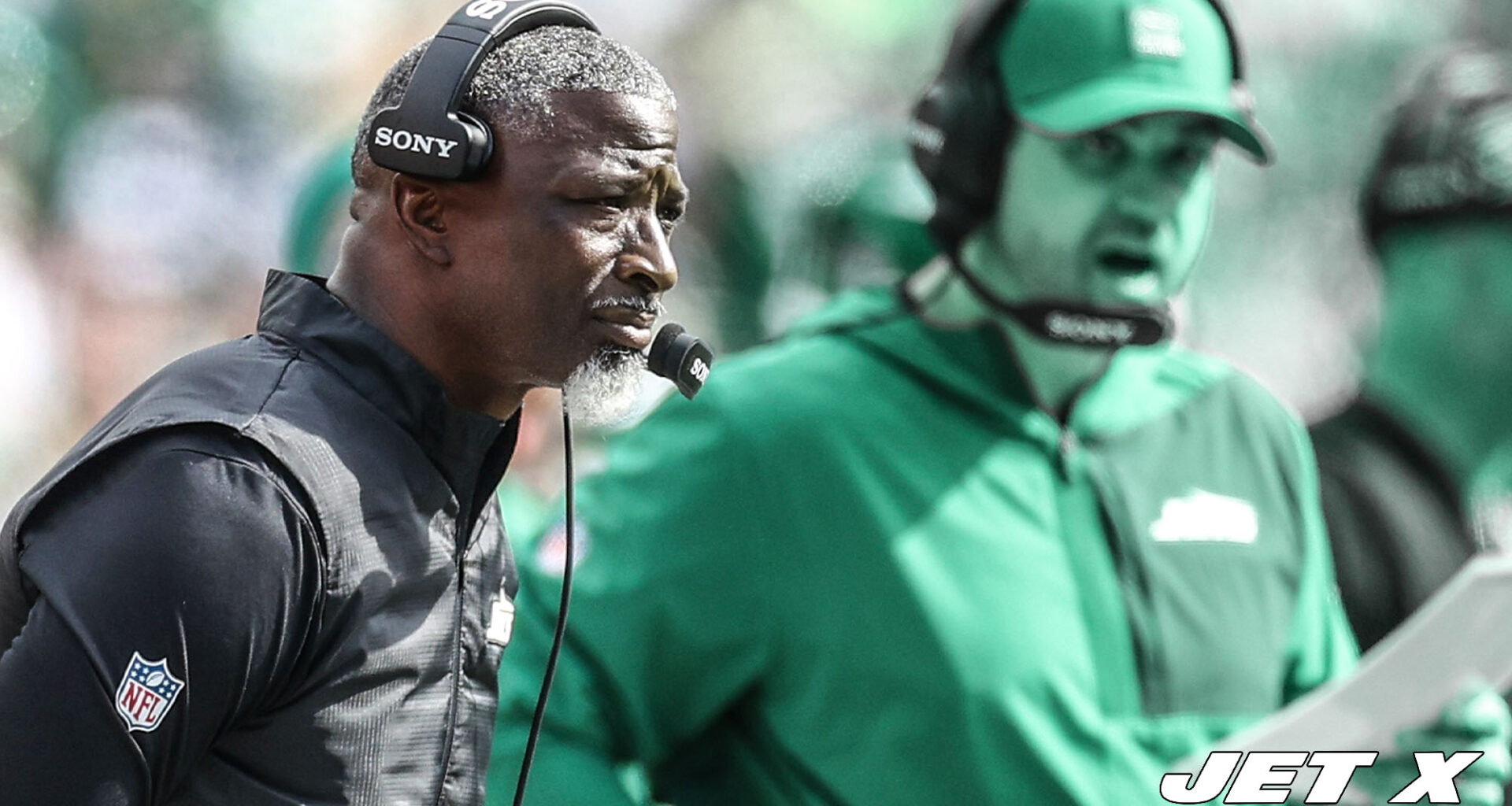
Aaron Glenn’s words have pretty much taken on a similar and familiar tone. Despite a few fluctuations here and there—mainly based on the team’s real-time performance—the Jets’ sideline boss has been defiant since taking the job nearly a year ago.
That’s fine.
Public defiance really doesn’t skyrocket or sink a football team. Granted, the instances in which Glenn may have crossed a line don’t do much for a squad (i.e., referencing ESPN’s Rich Cimini when another media member innocently asked a mundane injury question). Still, this is small potatoes in the grand scheme of things.
It’s Glenn’s defiance that allows us a sneak peek under the hood, and what’s been spotted doesn’t equate to anything overly promising. Much of what Glenn has had to say this season features many of the old-school principles the Jets need to shed—not embrace.
He has continuously preached about field position, special teams, physicality, penalties, and deploying a rushing attack down the opponent’s throat. Naturally, there’s nothing wrong with any of those items in a vacuum, but they serve as a death knell if focused on too harshly.
We have entered a new brand of football that awards the most offensively efficient teams, by far, the most.
Logic must lead the way
When looking at the teams that consistently win games, they’re usually dominating the categories that correlate with the short-passing efficiency this game has morphed into.
For those unaware, the fortunate souls who may have missed me typing this in any of the previous articles I’ve written, the 2025 season features yet another historically low pass yards per completion number: 11.0.
That 11.0 number firmly puts the 2025 season in the lowest five in NFL history—along with 2024, 2023, 2022, and 2021. And guess what? That doesn’t mean teams should abandon the rushing game; not by a long shot.
Pass completion percentage features some of the better teams in the league:
New England Patriots: 70.77%
Buffalo Bills: 69.37%
San Francisco 49ers: 69.07%
Detroit Lions: 67.96%
Miami Dolphins: 67.59%
Mike McDaniel’s offense included in the top five makes sense, even if they’re not a great squad, but how are the disappointing 8-8 Detroit Lions No. 4? Better asked, “How are the Lions 8-8 if ranking fourth in this category?”
Humility must result in an offensive lede
Look, we feel for Lions fans around here, for obvious reasons. Much like Lions fans, Jets fans have been put through the wringer. The two fanbases are firmly entrenched in an unspoken brotherhood of sorts, bound by a shared pain.
Moving from 15-2 a year ago to 8-8 this year makes the world think Ben Johnson is the guy who moved the needle most. Many fans refute that idea due to the team’s offensive rankings, particularly its sixth-place ranking in yards per game and fourth-place ranking in points per game.
What those fans are overlooking is what matters most: Time of possession and efficiency.
Yes, the rules have allowed offensive football to dictate terms in a way previously unimaginable. At the same time, there are only so many yards a team can gain.
A football field is only 100 yards. That’s it.
Therefore, when the rules make it so incredibly easy within a restrictive playing field, offensive mastery then moves into the efficiency category. Without Ben Johnson, the Lions moved from second in time of possession in 2024 (31:46) to 16th this season (30:12).
By most efficiency metrics, the Lions are calling plays to gain yards and score, without nearly as much attention to covering for/helping the other two units as they did with Johnson. (Oh yeah, guess who led the NFL in time of possession in 2024? The eventual champion Philadelphia Eagles.)
This season, the top-five time of possession leaders are as follows:
Los Angeles Chargers: 33:09
Buffalo Bills: 32:39
Houston Texans: 32.08
Chicago Bears: 31.38
Tampa Bay Buccaneers: 31.30
There they are, those pesky Chicago Bears, led by a certain somebody whose existence, at this point, should prove just how different today’s NFL actually is.
Tanner Engstrand holds the cards—if Glenn allows it
Aaron Glenn’s best chance to win games with the New York Jets is pretty simple: Offensive coordinator Tanner Engstrand must be the real deal. Where it gets complicated is how Glenn views his post.
The old-school football mind would have you believe that offense, defense, and special teams each make up 33.33% of a team. While that was true two decades ago, that mindset is destructive to organizations today.
Not only does Engstrand have to be one of the top offensive minds in today’s game—for Glenn’s Jets tenure to have any semblance of promise—but Glenn must allow Engstrand to shine well beyond the head coach.
In far too many troubling ways (yet it’s true), a team’s offensive play caller is the most crucial person in the building.
Back when Paul Hackett was carefully calling games for Herm Edwards’s Jets, fans were out for blood. “Why in the world would he call so many draws? Why does he limit Chad Pennington so much?”
For the most part, the criticism was unwarranted. Not only did he call the right offense for the quarterback’s limitations, but play-calling in those days was mainly overrated. Honestly, fans scream about play-calling to a scary degree, yet it’s understood why (it feels like something anybody could do).
Since the NFL shifted towards an emphasis on offensive football, while reducing physicality to an extreme degree, play-calling has actually become underrated. This is especially true on the offensive side of the ball.
Thanks to the rules, the best play-callers not only score and gain yards, but they do so in the most efficient way.
They must use the rushing attack to the point it comes together, yet they can’t force the rushing attack where and when it doesn’t fit. They must use the short-passing game in order to seal the time of possession advantage, yet they can’t rely on it—as never taking deep shots allows the defense to sit and drive on everything.
The current landscape speaks volumes
Look around the league. My goodness, man … the rookie head coaches who are also offensive play-callers haven’t just turned around their teams in one year; they have done so in dominating fashions (Ben Johnson, Liam Coen).
Of the 14 current playoff teams (if the playoffs began today), nine feature offensive-minded head coaches:
Liam Coen (JAX)
Sean Payton (DEN)
John Harbaugh (LAC)
Nick Sirianni (PHI)
Ben Johnson (CHI)
Matt LaFleur (GB)
Dave Canales (CAR)
Kyle Shanahan (SF)
Sean McVay (LAR)
The five head coaches who are defensive-minded are as follows:
Mike Vrabel (NE)
Sean McDermott (BUF)
Mike Tomlin (PIT)
DeMeco Ryans (HOU)
Mike Macdonald (SEA)
Yet, here are those five head coaches’ offensive coordinators (the play-callers):
Josh McDaniels (NE)
Joe Brady (BUF)
Arthur Smith (PIT)
Nick Caley (HOU)
Klint Kubiak (SEA)
Josh McDaniels is one of the greatest offensive coordinators in the history of the game. Arthur Smith is a former head coach, Joe Brady is rising fast, and Klintn Kubiak comes from tremendous stock.
Of the last eight Super Bowl head coaches (four winners and four losers), all eight are offensive-minded.
If Aaron Glenn’s Jets assemble an incredibly talented team this offseason, and their offensive play-caller doesn’t have the goods, then nothing good will come from it.
Can Engstrand be that guy? We already know Chris Banjo is that guy, but unfortunately, his unit doesn’t move the needle enough. Neither will the Jets’ defense, regardless of who runs it next season.
Does Tanner Engstrand have the goods? If he does, can Aaron Glenn recognize what needs to be done, and can he step aside so his offense can take center stage?
Anything short of that, a situation where the offense isn’t treated as the most valuable unit and game-plan item, will have the New York Jets continue to be stuck in the mud. Allow the offense to dictate the terms of the game plan, while complementing it with the defense and special teams (not in any other variety).
Drop the vision for what you believe your football team should look like—a physical, no-nonsense squad that must rush the ball—and let your offensive coordinator do his thing.
That’s quite literally the only mindset Aaron Glenn needs to recognize and implement. Once that occurs, it’s time to get to the fun stuff.