
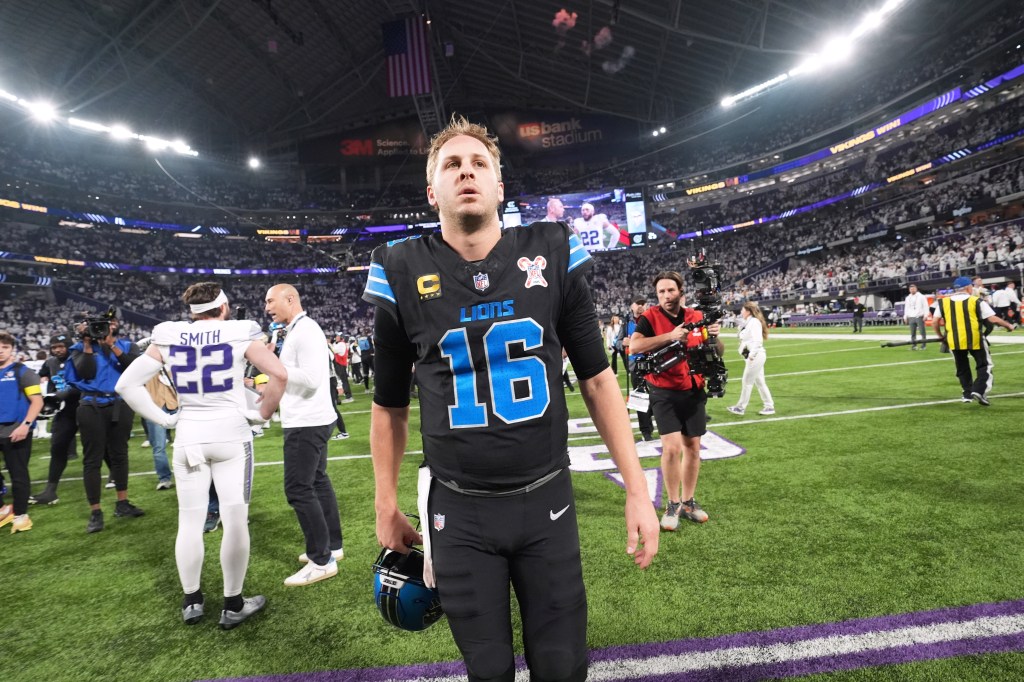
MINNEAPOLIS — Here lie the 2025 Detroit Lions.
They were a team with high expectations that endured crushing lows in what eventually became another lost season.
The Lions believed, after a 15-2 campaign, that they could run it back. In fact, it feels like some part of them felt like they owed it to themselves to see this thing through in its current form.
But they failed to prepare for the retirement of All-Pro center Frank Ragnow and the departure of right guard Kevin Zeitler. They never found an adequate running mate for Aidan Hutchinson and flippantly dismissed the idea that they even needed to. The offensive and defensive coordinator hires did not positively affect the team and, in some cases, actively hurt it.
Changes are coming. Lions coach Dan Campbell promised to make a sweeping assessment of the organization alongside general manager Brad Holmes.
“I’m gonna be looking at a lot of things, because I do not like being home for the playoffs, and I know our guys don’t either,” Campbell said after Thursday’s 23-10 loss to the Minnesota Vikings at U.S. Bank Stadium in Minneapolis.
“Brad and I will have a lot of decisions to make, a lot of things to look at — the whats, the whys, how do we improve?
As we close the chapter on this team’s playoff hopes, let’s take a look at how we got here.
Brain drain
A few days after the Lions’ 2024 season ended with playoff heartbreak, offensive coordinator Ben Johnson and defensive coordinator Aaron Glenn left for head coaching jobs, each of them taking several assistants on the way out. Their departures, coupled with the Lions’ abrupt playoff loss, all seemed to happen in the blink of an eye.
All offseason, the rest of the NFL looked at Detroit with an eyebrow raised, wondering how this regime would handle the adversity — wondering just how much credit belonged to coach Dan Campbell for what had been built.
Fast forward to training camp, when the Lions’ defense outplayed the offense for most of the summer. It was hard to tell whether that was because the defense had taken a step forward or because the Lions’ offense was hitting some bumps under new offensive coordinator John Morton.
During the beginning of the 2024 season, before their rash of defensive injuries reached a critical mass, the Lions’ defense was actually playing pretty well. It was realistic to think that it had become the dominant unit on a team with Super Bowl aspirations. All of its starters returned except cornerback Carlton Davis III, who was replaced by a similar caliber player in D.J. Reed. It was filled with several young players looking to take individual leaps.
As we now know, the Lions did not have a championship-level defense. As we also now know, the offensive woes were merely a sign of things to come.
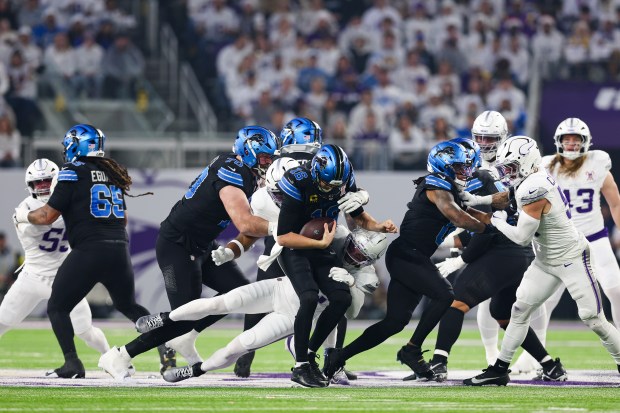 Detroit Lions quarterback Jared Goff (16) is stopped by Minnesota Vikings safety Harrison Smith (22) during the first half of an NFL football game Thursday, Dec. 25, 2025 in Minneapolis. Minnesota won 23-10. (AP Photo/Stacy Bengs)
Starting with the offense: Campbell whiffed on his hire of Morton. The Lions’ offense was a trainwreck in their Week 1 loss to the Green Bay Packers, and even as they began to put up points during the first half of the season, things just looked and felt off. Morton never publicly held himself accountable for the issues plaguing his unit, and you could feel the tension rising just before Campbell decided to take over play-calling in Week 10.
Still, the details were severely lacking even after Campbell took over. While the Lions’ offense was still a top-five unit, it completely fell apart for long stretches in must-win games and couldn’t run the ball for the entirety of too many contests, putting the defense in binds it couldn’t overcome.
And then there were the game-management aspects, which took a hit because of Campbell’s play-calling role, such as when he wasted a timeout by challenging a 1-yard difference in ball position against the Rams. So the offense still lacked detail, and the other, more general aspects of Campbell’s job also took a hit.
As for the defense, I still think defensive coordinator Kelvin Sheppard can one day direct a great unit. He’s a smart guy, his players love him, and he inherited the personnel and scheme, so I’m willing to be open-minded about his future in Detroit. But regardless of whether Sheppard is in charge of the defense next season, the Lions need an overhaul of their man-heavy approach. It’s just not working. They’re overcommitted to stopping the run, which hangs the corners out to dry in the passing game because the slow, pocket-crushing pass rush can’t get home against quality offensive lines.
Outside of the aforementioned stretch to begin the 2024 season, there has never been a sustained period when the scheme has truly worked. The Lions’ pass coverage has been their weakest link throughout the Campbell era, and this offseason needs to bring ample change. Given that Detroit’s secondary is actually tied for first in average separation across the league, that change should probably start up front.
Linebacker Alex Anzalone, several defensive tackles, and all of the Lions’ defensive ends, aside from Aidan Hutchinson, are free agents this offseason, allowing Detroit the opportunity to re-envision how it wants this defense to look.
Injuries to safeties Kerby Joseph and Brian Branch, plus cornerbacks Reed and Terrion Arnold, made life difficult, to be sure. But for the most part, Detroit’s reserves (outside of cornerback Amik Robertson, who was lit up over this final stretch) held their own when thrust into bigger roles.
So while the Lions were unfortunate to have all their key injuries hit one position group, the idea that a defense with that much talent would have to choose between sacrificing run or pass defense in the wake of a few injuries is mind-numbing. You don’t get to blame your shortcomings on injuries two seasons in a row after Lions president Rod Wood said the number of injuries this team has suffered is a result of their “violent, aggressive style of defense.” They need to find better answers for things they can control.
Ragnow retires
The next crack in Detroit’s 2025 season started to form when Ragnow abruptly announced his retirement in June. The Lions were caught with their pants down. They had already let Zeitler, a veteran right guard, walk in free agency, and it was clear that Campbell was not projecting a significant role for veteran Graham Glasgow back at owners’ meetings, when the first thing he said in response to a question about the soon-to-be-33-year-old was that he’s another year older.
By the start of training camp, Glasgow had become the most critical player on Detroit’s offensive line, the impromptu captain of a ship that would be relying on a pair of first-time starters, second-year left guard Christian Mahogany and rookie right guard Tate Ratledge, to supplement Glasgow’s declining play. In an ideal world, Ratledge could have manned the center duties this season, but after three training camp practices, that idea was nixed entirely.
From start to finish, the Lions’ offensive line was a disaster. Its performance on Christmas Day, in which quarterback Jared Goff was sacked five times and hit eight, was an extremely fitting bookend to Detroit’s playoff pursuit. The Lions looked no closer to figuring things out in Week 17 than they did in Week 1, and as the season went on, it became clearer they would never be a legitimate threat under those circumstances.
Goff already has set a new career-high in sacks taken (36) with one game remaining, and the Lions’ rushing offense has failed to reach 100 yards in seven of their 17 games after only having four such performances in 2023 and 2024 combined.
Whether the Lions could have reeled Zeitler back in free agency is up for debate — some reports said he signed with the Tennessee Titans because he wanted to be near family — and the timing of Ragnow’s retirement certainly put Detroit in a challenging position.
I might be a little more sympathetic to these circumstances, however, had Ragnow’s retirement come entirely out of nowhere. He was believed to be pondering retirement for years, and the truth of the matter is that Holmes largely ignored that position group in the draft until selecting Ratledge, who had a good rookie season, with a second-round pick last April. They had no succession plan for a player who was battling chronic injuries from the time he was in his mid-20s. They didn’t even have a drafted player who could play the center position at all.
After selecting Penei Sewell with his first pick as GM of the Lions, Holmes did not choose another offensive lineman until the fifth round of the 2023 draft, when he picked Colby Sorsdal. His only other offensive line picks have been Giovanni Manu (Round 4, 2023), an uber-raw tackle prospect who was always unlikely to be a plus player at this stage of his career, Mahogany (Round 6, 2024), and guard Miles Frazier (Round 5, 2025). Sewell and Ratledge are the only offensive linemen to be drafted by Holmes before Day 3 during the Holmes era.
Making matters even more urgent is that 32-year-old left tackle Taylor Decker, who barely practiced this season because of a lingering shoulder injury, could be nearing a similar end as Ragnow. The Lions’ only in-house prospect who could potentially take over for Decker is Manu, who has not yet proved to be an NFL player. It would be downright negligent to make it through free agency and the draft without adding to that position in a meaningful way.
They’ve still got a ton of work to do on the interior as well. Given the inconsistencies Mahogany displayed before he broke his leg in Week 9, he can’t be penciled in as a starter. And after Glasgow watched Thursday’s game from the bench — Campbell said his knee was still bothering him despite him being completely off the injury report — I have a hard time imagining he’ll be back next season.
To be clear, I’m not all the way out on Mahogany, and I remain intrigued by the future of Frazier. But after watching the Lions completely fall apart at the hands of their offensive line, their strategy cannot be to simply hope that one of those late-round picks will eventually become a great player. They need to be proactive in finding a high-floor succession plan for Decker and Glasgow, with a more immediate focus on the latter, based on what we currently know.
‘We’re good’ (and other pass-rushing business)
The pass rush was at the forefront of Detroit’s rocky stretch in the back half of the season.
It started back in the summer, when the Lions brought back Marcus Davenport after a season-ending injury in 2024. As a depth move, it was fine. Detroit still had Za’Darius Smith on the roster, and by the numbers, Smith and Aidan Hutchinson had the potential to be a top-five tandem.
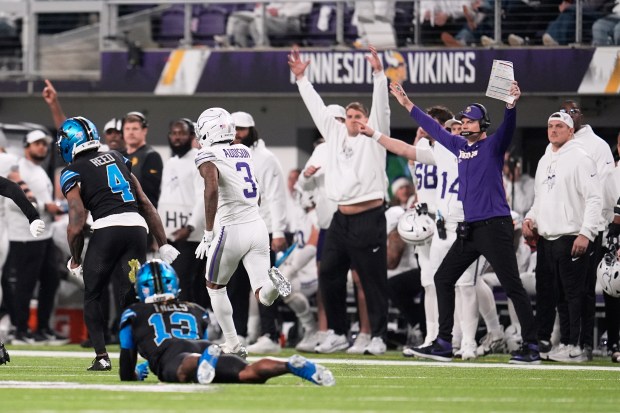 Minnesota Vikings wide receiver Jordan Addison (3) runs past Detroit Lions cornerback D.J. Reed (4), and safety Jalen Mills to score a touchdown during the second half of an NFL football game, Thursday, Dec. 25, 2025, in Minneapolis. (AP Photo/Abbie Parr)
The Lions then cut Smith in early March, opting out of $5.7 million in salary cap commitments. It seemed like the two were destined to reunite all summer, but with the season approaching, it still hadn’t happened. Campbell, after receiving countless questions about Smith’s possible return, said in an interview with 97.1 in early September, “We’re good right now. I mean, we’re pretty good here.”
That phrase — later shortened to simply “We’re good” — would go on to take on a life of its own and be a rallying cry for swaths of angry fans expressing anger at the front office’s approach to every deficiency on the roster, including the offensive line. Smith wound up signing with the Philadelphia Eagles but retired after five games, so in a twist of irony, Campbell’s feelings about Smith that day proved to be correct. However, his quote is still being weaponized (and often wrongly attributed to Holmes) by fans to this day.
Regardless, the Lions did not adequately address their need at edge rusher before the season. Davenport was the top choice to play opposite Hutchinson entering training camp. For a player whose last two seasons were limited because of injury, the Lions put too much faith in his ability to stay on the field. He ultimately missed nine games with a shoulder injury, leaving waiver claims such as Tyler Lacy and Tyrus Wheat to hold down the fort on the outside until defensive tackle Alim McNeill could return to play the big end.
Were they counting on Levi Onwuzurike to eat up some of those snaps? Maybe. He missed the entire season because of a knee injury, which apparently popped up shortly after he signed his one-year extension. Considering the contract he received — a measly $4 million for a player coming off a breakout, 47-pressure campaign — one can’t help but wonder when the knee issue first started to reveal itself.
Holmes was unnecessarily combative when discussing the edge rusher position at multiple points during the offseason, including after the NFL Draft.
“I feel like, ever since we acquired Aidan Hutchinson, as great of a player as he is, I have always felt like the fanbase is almost mad,” Holmes quipped in an April interview with 97.1 The Ticket. “Like, they’re mad because we have Aidan Hutchinson. Because now, he’s so good — well, why don’t you have two of them?”
This is, of course, a ridiculous shot to take at a fanbase that’s been plenty grateful for the success that Holmes has brought. And can you imagine if he said that when discussing, say, the tackle position? We already have Penei Sewell. Why should we spend more than $1.65 million on a left tackle? The whole thing has become a weird point of stubbornness for a man who’s made many good decisions. The bottom line is that defensive end, arguably the most important defensive position, lacked depth. He basically admitted as such on Day 2 of the draft, when pressed about not taking an edge rusher.
“You keep asking the question because we had injuries last year, right? I just want to make that clear, right?” Holmes said, scanning the room. “Because we had injuries last year, that’s why you guys keep (asking)?”
A reporter answered that it was because “we don’t see as much depth at that position.”
“That’s fair,” Holmes responded, ending the weird hostility of the exchange.
And to be clear: It was never realistic to expect a Myles Garrett-esque move. But to go into the season relying on the oft-injured Davenport, who wasn’t even productive when healthy, as the No. 2 option at that position was confusing at best and malpractice at worst. To their credit, they hit on bringing back Al-Quadin Muhammad, a career journeyman who’s now tallied 11 sacks on the season. But they did not trust him to defend the run, and he was used on just 43% of defensive snaps entering Thursday. Had something happened to Hutchinson, who was coming off a significant injury, that group would have been in contention for the worst in the league.
The Lions had plenty of sack outbursts, even ranking tied-seventh overall in the department (41 sacks) entering this week. But when the chips were down in games against the Philadelphia Eagles, New York Giants, Green Bay Packers, Los Angeles Rams, and others, the pass rush was a non-factor.
The defense completely fell apart in the biggest five-game stretch of the season, resulting in a 2-3 record during that span (excluding Thursday’s dominant performance against third-string quarterback Max Brosmer in a loss, which dropped them to 2-4 in their last six) as the Lions were hit with countless explosive plays.
As Detroit desperately tried to get its pass rush and coverage back on track, it abandoned its ability to stop the run. The Rams and Steelers rushed for a combined 389 yards (6.9 yards per carry) as the Lions were all but officially dismissed from playoff contention.
“The rush and the coverage always go together, and we have not worked in unison for a number of plays,” Campbell said last week when asked how to explain how the defense fell apart so dramatically. “Some of that is — we play a certain style, right? And then if you feel like you’re not executing there, then you try to give help in areas. … When you do that, then you expose yourself to others.”
Considering the team’s pending free agents, Holmes will have to rebuild the edge group one way or another. He cannot show complacency with this approach, and he’d be wise not to make disingenuous statements about the fanbase as he puts the pieces back together.
Closing thoughts
In saying all this, I’m still optimistic about the road ahead. The Lions’ season feels somewhat similar to that of the 2023 Eagles, which completely cratered after a Super Bowl run because it failed to make the correct coordinator hires. Eagles coach Nick Sirianni made coaching changes on both sides of the ball, and a year later, Philadelphia was world champion.
The Lions have nobody to blame but themselves for the situation they found themselves in, but all of it is correctable. They added Zeitler to patch up the offensive line instead of re-signing Jonah Jackson to a new deal during the 2024 offseason, which worked to perfection. They also made the tough decision to do a wholesale change at running back during the 2023 offseason that elevated the ceiling of the entire offense. They successfully turned their linebacking and receiving cores from lackluster groups to genuine strengths.
But doing this the right way is a high-wire act. The Lions must carefully assess where coaching changes are necessary, which I believe Campbell will. He was quick to pull the trigger on parting ways with Anthony Lynn, his offensive coordinator in 2021, and quickly took over the play-calling duties this past season when it became clear that the offense needed something different. On the flip side, I am a little concerned that two of Campbell’s three selections for offensive coordinator have not gotten it done.
From a personnel standpoint, the margin for error is just as thin. With waves of new contracts set to kick in every offseason in the immediate future, the Lions are projected to have around $55 million in cap space for the 2027 season with just 27 players signed to the roster through that year. A few missteps on intermediate acquisitions can put this team in a serious bind.
Holmes still has one of the league’s best draft resumes, which can help this team retool quickly with cheap, cost-controlled labor. And to his credit, most of his notable free-agent and trade acquisitions, outside of perhaps cornerback Cam Sutton, have worked out.
Regarding Campbell, I still don’t buy that anybody but him was responsible for the NFC Championship run in 2023 and the 15-2 season last year.
And as a tandem, I still have complete faith that these two are the right men for the job. They made some mistakes, as every team does, and it cost them in an important season.
Still, the pressure is officially on, and they’re the only ones who can alleviate it.