
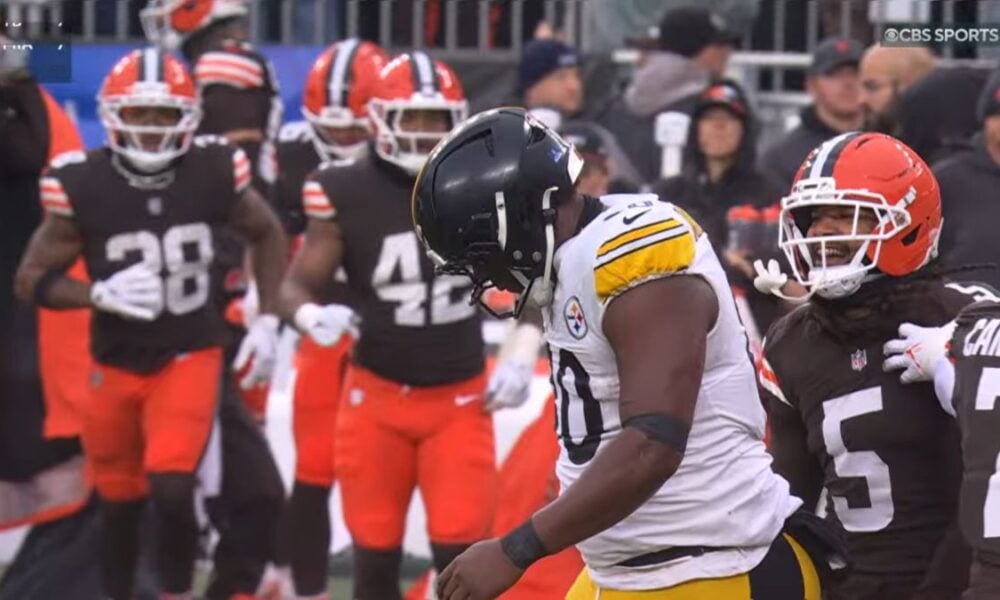
Heading into the regular-season finale, a clash with the Baltimore Ravens that will determine the AFC North champion, the Pittsburgh Steelers got bad news. TE Darnell Washington, who suffered a forearm fracture Sunday against the Cleveland Browns, underwent surgery Tuesday morning and will be out the rest of the season. The Steelers were already missing their top wide receiver, with DK Metcalf serving a suspension. They will now be without their massive tight end, who has been a valuable part of the running and passing game this season.
Washington was most likely injured on his second reception of the Browns game:
As Washington gets up and heads to the huddle, you can see him grab for his left wrist with his right hand. To his credit, he stayed in for the next play, even throwing a solid block to help spring Connor Heyward for a 29-yard run. After the play, he reaches for his left wrist again.
Washington sat out the rest of the series until the end of drive. Even with his injury, he played his role on the field goal unit. As soon as the kick was made, he doubled over in pain and ran off the field, holding his wrist:
Washington left for the locker room, presumably to undergo X-rays. He was eventually ruled out to return. According to several reporters, Washington was seen with his left arm wrapped and in a sling, but he left the locker room as the media entered for post-game interviews.
Darnell Washington’s left wrist was wrapped from his hand to his bicep and his arm was in a sling. Didn’t look good.
— Mike DeFabo (@MikeDeFabo) December 28, 2025
Speaking to the media on Tuesday, Mike Tomlin confirmed that Washington underwent surgery. When asked about potential recovery time, Tomlin replied bluntly that, “This is a one week season”. While Tomlin did not rule out a return for Washington if the team makes a playoff run, he had no further comments on his status.
So let’s take a look at Darnell Washington’s injury and expected recovery. As always, all information is based on public reporting. I have no access to his medical records or radiology images.
ANATOMY OF THE FOREARM
The forearm is the distal portion of the upper extremity between the wrist and the elbow. Two long bones, the radius and the ulna, run parallel between those two joints and are connected by a fibrous membrane. Based on the way the bones are connected, they allow for rotation of the forearm (pronation and supination):

www.wikism.org

www.wikism.org
A forearm fracture may involve the radius, the ulna, or both. A distal radius or ulnar fracture is often referred to as a wrist fracture when the broken portion is close to that joint, as with the injury that Aaron Rodgers had. A break in the middle portion of the bones in adults requires such a strong force that both bones are often involved. This was the case in 2014 for CB Ike Taylor, who sustained a fracture of both bones of his right forearm, resulting in obvious deformity.
The most common mechanism of injury when a forearm fracture occurs in sports is a fall on an outstretched hand, a direct blow to the forearm, or a severe twisting motion of the forearm.
Other than minimal hairline fractures, plain X-ray can make the diagnosis, and an MRI is not necessary. Here is an example:

www.radiopaedia.org
There are a variety of fracture types, defined by the orientation of the break to the bone as well as the number of fragments and the presence of displacement. While this schematic depicts a femur (thigh bone), it shows the range of common fracture types, as described on the Scientific Animations site:

https://www.scientificanimations.com
Stable fracture is one in which the broken ends of the bone are still in line.
Closed fracture is also called a simple fracture. The skin is not affected by the damaged bone.
Open fracture is one in which the skin is pierced by the bone.
Transverse is when the fracture travels across the bone.
Oblique fracture is the kind of fracture that occurs at an angle.
Comminuted fracture is when the bone is shattered into a minimum of three pieces.
Spiral fracture is when the fracture goes down the length of the bone.
TREATMENT
Initial treatment includes stabilizing the forearm. If the bones are displaced, traction can be used to realign the bones, and a splint is placed. A sling is often used to limit motion and prevent misalignment. Movement of the bones at the fracture site can cause further damage to the broken bone or injury to nearby nerves or blood vessels.
Ice can be applied to reduce swelling and pain medication is often needed.
If only one bone is fractured and there is no displacement or fragmentation, a cast or brace may be sufficient treatment.
If there are multiple fragments of bone, the bone is displaced, or both bones are fractured, surgical treatment is needed. In the case of an open fracture, where the broken bone has punctured the skin, surgery is performed as soon as possible to limit the risk of further injury. The goal of surgery is to realign the bones and provide stabilization so that the bones can heal in the proper position.
Open reduction and internal fixation: An incision is made to expose the fracture. The bones can be stabilized by metal plates and screws applied to the surface of the bones bridging the point of the fracture or a rod placed lengthwise down the center or marrow portion of the bone.

https://orthoinfo.aaos.org
External fixation: If there is significant damage to the skin and muscles, any plates or screws could be exposed and result in a higher risk of re-injury. In this case, pins are placed in the bones on either side of the fracture and held in place with a frame that provides stabilization.

When plates, screws or rods are used for internal fixation, they can be left in the arm indefinitely. In some cases, surgery to remove some or all of the hardware is done after the fracture has healed if there is pain from the metal implants or if they are prominent under the skin.
RECOVERY
In the first few weeks following surgery, a splint is used for support and protection. Early mobility is important to maintain range of motion. Physical therapy is recommended to strengthen muscles and prevent stiffness. By six weeks after surgery, the bone is healed, and most patients are able to use the arm comfortably. Return to full physical activity depends on the severity and type of fracture and ranges from two months to as long as eight months.
The NFL Orthopaedic Surgery Outcomes Database was reviewed for all orthopaedic procedures performed from October 2003 to October 2013 and the findings were published in The American Journal of Sports Medicine. This included 27 forearm fracture ORIF procedures. The average recovery time for forearm ORIF and sports hernia repair was shorter than for all other procedures. There was a 96.3-percent return to play rate for players after forearm ORIF, with no change in performance-based outcomes through three seasons after surgery.
In 2017, an orthopaedic group based in Houston published a review of NFL players undergoing forearm ORIF from 1987 through 2016 in Hand, the journal of the American Association of Hand Surgery. Of the 34 players who underwent 36 surgeries, 91.1 percent returned to play in the NFL. The mean time to return was about five months but there was a large variability, ranging from 27 days all the way up to 321 days.
When Ike Taylor broke both forearm bones in his right arm, he underwent surgery and was able to return to play 10 weeks later.
SPECULATION TIME
Based on the lack of visible significant deformity in Washington’s arm (as compared to Ike Taylor), he did not appear to have significant displacement due to the fracture on the broadcast. It’s particularly impressive that he not only stayed on the field for the following play but also blocked for the field goal at the end of the drive. He was clearly in pain after that effort. His ability to block on those two plays also suggests that it was not a displaced or comminuted fracture, which would have made his arm essentially useless.
While we don’t know whether it was one or both of the forearm bones that were fractured, the more common scenario is that both bones were involved. There was no evidence of an open fracture, so the overwhelming likelihood is that Washington underwent an open fixation with plates and screws, rather than a rod placement or external fixator.
With the Steelers preparing for the final game of the regular season, the postseason is not guaranteed. And even if they win the division and make a deep run in the playoffs, it’s hard to imagine that Darnell Washington could recover quickly enough to rejoin the team. However this season ends, the tight end who has become so important to the Steelers’ offense should be fully recovered in time to participate in OTAs next spring.
“Melanie H. Friedlander, M.D., F.A.C.S. is a doctor at Association of South Bay Surgeons in Torrance, California. Dr. Friedlander enjoys all aspects of general surgery, but her primary areas of focus are breast surgery and advanced laparoscopic surgery. She recently adopted an advanced, minimally invasive technique that reduces scar size in thyroid surgery. Dr. Friedlander is a member of the Society of American Gastrointestinal Endoscopic Surgeons (SAGES) and the Society of Laparoscopic Surgeons. She developed and published many scientific studies in highly esteemed medical journals.”