
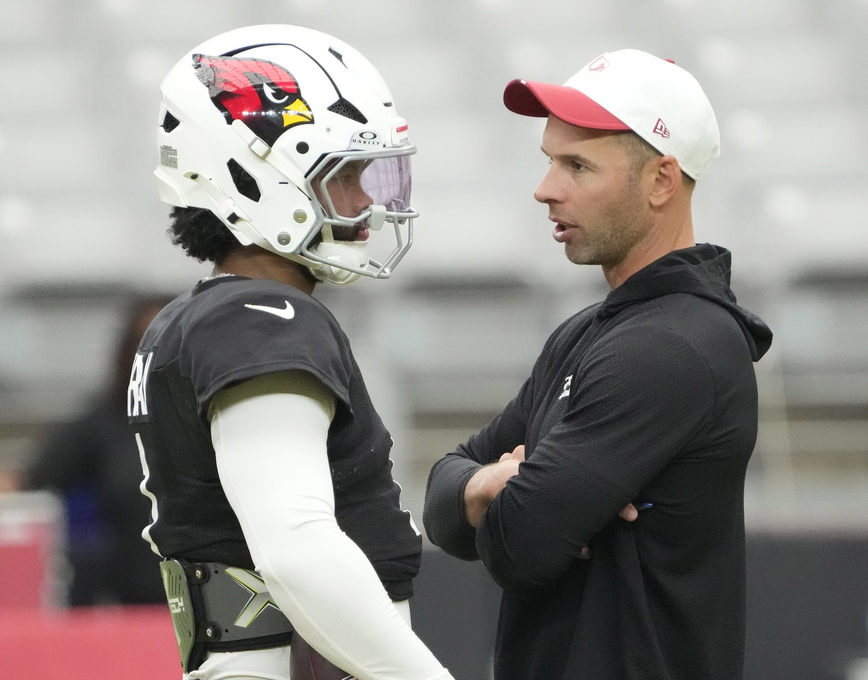
Deep in the final throes of another lost season, the winds of change are picking up in the desert. While last week’s team looks to have found an answer at the quarterback position, this team has spent the better part of this season erasing theirs. We’ve got much to discuss on the Arizona Cardinals, so let’s hop to it.
2025 Arizona Cardinals
Through Week 17
Record: 3-13
Head Coach: Jonathan Gannon, third season (15-35 record, 0-0 postseason)
Offensive Coordinator: Drew Petzing, third season
Total Offense: 19th
Passing: 7th
Rushing: 29th
Scoring: 23rd
Defensive Coordinator: Nick Rallis, third season
Total Defense: 26th
Passing: 24th
Rushing: 25th
Scoring: 29th
Should they fire the coach?: Toss-up
Will they fire the coach?: Toss-up
Should they fire the GM?: Probably not
Will they fire the GM?: No… ?
Although it wouldn’t be fair to say the Cardinals carried big expectations into 2025 as it pertained to wins and losses, there was certainly a lot of anticipation surrounding what this offense could be. With Trey McBride having cemented himself as one of the two best at his position in the NFC, Marvin Harrison entering his first full NFL offseason and James Conner still chugging along as one of the most underrated do-it-all backs in the league, the table was finally set for Kyler Murray to capitalize on the game-changing potential he teased at the start of the decade. That, as you are very likely already aware, did not materialize.
How was it that an offense with talent all over the field went so wrong? To understand that we will need to do some scene-setting.
In a lot of ways, the 2022 iteration of the Cardinals were in an eerily similar spot to this year’s team: Stacked division, established (and freshly extended) quasi-superstar QB, one bonafide superstar receiver (replace McBride with just post-peak DeAndre Hopkins), good enough defense – James Conner. And even more than this year’s team, the ’22 squad desperately needed to prove something… like, anything. After a strong 6-3 start in 2020 followed by a scorching 10-2 open in Kliff Kingsbury’s second and third seasons on the job netted a grand total of one playoff games played, the Cardinals needed to finally pair a hot start to the season with a similarly strong late game. Instead of doing both, that team would manage neither: Dog walked by the defending champs in their home opener, Arizona would fight tooth and nail to peel wins off of teams with eventual double-digit losses to eke out a 4-6 record through mid-November. The bottom of the Kingsbury era fell out for good the next week in a Monday night hatchet job at the hands of eventual NFC runners-up San Francisco. Finally, at 4-8 and with Kingsbury trying to head to the gallows with his head held high, Murray scrambled early in a Week 14 Monday nighter against New England only for his knee to buckle in dreaded non-contact fashion. After two figurative December collapses, Murray crumpling to the State Farm turf at least allowed this one to be more literal.
It was a full reset the following month: Kingsbury was canned and longtime general manager Steve Keim “stepped aside”, making way for the hiring of Monti Ossenfort, who had tagged along with Mike Vrabel to Tennessee after 15 years as a scout for New England. With both of Philadelphia’s coordinators hot commodities, Ossenfort would poach DC Jonathan Gannon to be his head coach. With Kyler Murray destined to miss a large portion of the upcoming season and a roster bad enough to come by the 3rd overall pick honestly, Arizona going 4-13 again in 2023 didn’t set off any alarm bells. The following season was hardly an unqualified success, but improving to 8-9 in 2024 against an NFC West schedule was still progress.
After an offseason of tepid praise for their quarterback, Arizona opened 2025 with less than convincing wins against Spencer Rattler and a then-struggling Carolina Panthers team, both of which featured less than tremendous output from Murray. Their following two losses were actually more impressive; one a hardscrabble game at San Francisco, the other a comeback attempt that came up just shy against Seattle. But still, Murray had needed all of September to throw for 740 yards and lead seven touchdown drives. At 2-2, Arizona headed home for another layup win against a winless opponent that stood to prove absolutely nothing about who the 2025 Cardinals actually were.
That was the Tennessee game, and it was the straw that looks to have silently broken the Kyler Murray era’s back. Emari Demercado’s fumble got all the attention, but it was Murray that led an offense that was shut out in the second half of that devastating home loss. Nobody could have known it at the time, but that was almost definitely Kyler Murray’s final start with the team: Held out with a very real, not at all made up foot injury in the weeks that followed, Arizona’s temporary pivot to journeyman Jacoby Brissett rather quickly escalated into the most shocking example yet of the new shadow-benching trend. The Cardinals may not have explicitly benched Kyler Murray, but laboring through what will very likely be a 1-11 finish rather than turning back to him at any point is a louder condemnation than any they could have made publicly.
What’s Next?
This is our first team with genuine uncertainty in the front office, under center and all the way down the sideline. As seen above, the Ossenfort-Gannon partnership will likely finish year 3 with a win percentage under .300 — that’s obviously not acceptable. Normally, the head coach’s fate would be a foregone conclusion and the GM’s wouldn’t be much rosier. Normally.
We’re veering into a bit of tea leaf reading now, but the sequence of events that have played out in Glendale probably do matter. When Michael Bidwill and Steve Keim did the infamous, clause-heavy contract extension with Kyler Murray it telegraphed their concerns about him going forward; certainly his 14-22 record across parts of the three seasons that followed did very little to assuage those. The dismissal of the Keim-Kingsbury regime may or may not have been a commentary from second generation team owner Michael Bidwill on the Murray extension, but either way, Ossenfort-Gannon were asked to make Thanksgiving dinner with somebody else’s turkey. Coaches and executives have taken the fall for the last guy’s mistakes before, but even Brian Daboll technically outlasted Daniel Jones in New York; it is plausible that a very large portion of what ownership perceives to have been the problem was Murray.
If you accept the almost inescapable truth that Murray’s foot injury was exaggerated to the outer limits of believability, then what you have is one of two possible scenarios: Either ownership (it’s been rumored that Bidwill had soured on Murray) sent down word that Murray was not to play another game, which would not in and of itself telegraph anything in particular about the fates of Ossenfort or Gannon. Or, that Ossenfort-Gannon did have input on that decision, which strongly implies at least Ossenfort and probably both of them will survive the Murray plug-pull. I wouldn’t bet the house either way on either of them, but Jonathan Gannon doesn’t sound like a guy who’s expecting to be back in the job market imminently.
Owed almost $40 million in guarantees in 2026, Murray’s got another $19.5 million in 2027 that will become guaranteed on the fifth day of the new league year if he’s still on the roster; for the last several weeks, it’s been clear that Arizona’s plan is for him to be gone by then.
Ahh, but we must never discount Bidwillian fickleness. Presumably fully onboard with the decision to mothball Arizona’s longtime quarterback a couple months ago, there are late whispers emerging that nobody is safe from the consequences of this 1-13 stretch that somehow has the Cardinals – the Cardinals! – one loss away from their worst record in 65 years. Come Monday, we’ll need to be prepared for just about anything.
Quarterback
Week 2, 2024. After letting a 17-3 lead in the season opener in Buffalo slip through their fingers, the criticism was immediate and pointed: Why in the world did Marvin Harrison, who was drafted explicitly to be the route-winning, deep sideline maestro that Murray never had, see just three targets in his NFL debut? It was a valid question, one with which Murray himself took some umbrage.
Murray and the Cardinals would head home to purge demons on the unsuspecting Rams in a 41-10 smackdown. Ripping up first-year DC Chris Shula’s defense, Murray needed just 17 completions for a whopping 266 yards passing and needed less than half a quarter to find Harrison for two long touchdowns. A true statement game: At the time Murray’s 98.0 Week 2 QBR was the second-best of the decade. Suddenly, the Cardinals were looking scary again.
It didn’t last. Arizona would drop three of their next four, failing to score more than 14 points in all three losses. But the Cards caught a bit of a break after a tough opening schedule, and against a string of beatable opponents were able to cobble together four wins, including blowouts over Chicago and the Jets. Having scraped their way back out of the cellar, at 6-4 the Cardinals were in 1st place in the vaunted NFC West. With two divisional matchups over the next three weeks, it was time for Murray to play winning football in the latter half of the season for the first time. The following sequence ensues:
Week 12: Arizona 6, Seattle 16; Cardinals outscored 16-3 over final 32 minutes
Week 13: Minnesota 23, Arizona 22; Cardinals outscored 17-3 over final 17 minutes
Week 14: Seattle 30, Arizona 18; Cardinals led 7-0 midway through 1st quarter
Week 15: New England 17, Arizona 30
Week 16: Arizona 30, Carolina 36 (OT); Cardinals never lead in must-win game against 3-11 Panthers
Week 17: Arizona 9, L.A. Rams 13
It’s certainly not fair to say that all of the Cardinals’ problems this decade have had to do with Murray – perhaps not even most of them. But last winter made it three times in as many chances that a Kyler Murray team that was in the hunt took the express lane right back out (yes, they made a brief cameo in the 2021 postseason despite dropping 5 of their last 6). Murray was excellent at times last year – he had seven top 7 QBR finishes in Arizona’s first 10 games. But the lack of week-to-week consistency that has dogged him throughout his career remained entrenched; those seven games were also the only ones he finished better than 15th.
Having given him two full bore coaching staffs and 1-plus seasons with his current talent complement, the sensible decision would be to find the least painful escape hatch here and not look back. Rumored cold feet and all, we’ll proceed under the assumption that that is what happens here.
With one weekend left, there’s less drama in the Arizona draft slot than what appears at first glance. Yes, with one more loss and a deluge of improbable wins ahead of them, Arizona could climb all the way to number one. But that’s unlikely: Las Vegas plays the Chiefs, who presumably will want Travis Kelce to go out on a high note, and are starting Kenny Pickett; the Giants have Dallas, who it sounds like will play to win; the Jets will start Brady Cook at Buffalo and against the starters (although Josh Allen might call it a day early); the Titans play a Jacksonville team that needs to win to secure the division. There might be a bogey in there – Week 18 has been full of them in recent years – but on paper those all look like losses.
The team that’s the likeliest to ding their draft position this weekend might be the Cardinals, who get a Rams team locked into either the 5 or 6 seed either way. Gannon and his staff need this win, and a second half against the Rams’ second string could deliver it.
All that aside, there are only six teams that can still finish with a higher pick than Arizona, and three of them (Tennessee, Washington, and the football Giants) will not be taking quarterbacks. In a draft class with three quarterbacks trending toward first round draft grades, Arizona really just needs to finish ahead of one of Las Vegas (impossible), the Jets (unlikely), or Cleveland (likely). But a loss by the Browns in Sunday’s early slate would put the Cardinals in a tricky spot.
Tricky, because Arizona’s best shot at a top quarterback this year may be Ty Simpson, to whom they’ve reportedly taken a shine. Dante Moore and certainly Fernando Mendoza presumably would also be of interest but barring a huge draft order shakeup this weekend they both figure to be gone by Arizona’s pick. Cleveland’s offseason plans at quarterback (and beyond) are currently every bit as murky as Arizona’s, so letting Cleveland squeeze past them with a win could infuriate ownership just as much as a loss. Assuming Arizona doesn’t win their way out of the quarterback sweepstakes at the last second, tentatively projecting Ty Simpson to the Cardinals makes sense. Tentatively.
While Simpson just turned 23 and is the son of a college football coach, being stuck behind Bryce Young and Jalen Milroe his first two years in Tuscaloosa would deliver him to the NFL as the dreaded one-year starter (Simpson has not yet officially declared for next year’s draft). That means a pairing with a capable veteran would be wise, and luckily the Cardinals have one on hand and under contract. Whether the Cardinals draft Simpson, luck into Moore, or strike out on both, Jacoby Brissett figures to return as the starting quarterback in the fall – that is, so long as the head coach isn’t canned.
Wide Receiver & Tight End
Michael, we weren’t really familiar with your game. Uncorked by prodigal son Marvin Harrison’s various injury and intestinal issues of late, Michael Wilson has gone from being mired in ‘hidden in plain sight’ anonymity to operating as one of the league’s foremost volume dealers, soaking up an eye-popping 80 targets over the last seven weeks – more than he had in either of his first two seasons. After totaling just 52 yards in Murray’s five starts, he needs 93 in the finale to crack 1,000. Sensational stuff. Heading into a contract year, an extension is presumably in order sooner rather than later. As for that prodigy, well… the junior Harrison will head into 2026 with much still to prove. Few young wide receivers can overcome subpar quarterback play, which Arizona has tacitly admitted was a problem, but when you draft a wide receiver as ballyhooed as Harrison was you rightfully expect more than five 75-yard games through year 2, regardless of who’s passing the rock. We know the talent is there, so hopefully an offseason installing with a new quarterback can unlock the potential here.
Harrison and Wilson headlining looks somewhat promising, but the Cardinals need to add some quality depth. Greg Dortch and Zay Jones logged significant snaps, but Jones ruptured his Achilles in October and will be 31, and both are unrestricted free agents. Arizona will finish the season giving significant run to Xavier Weaver and Jalen Brooks, two former UDFAs. Brooks had 18 career receptions before Week 10; Weaver had none. Maybe Arizona re-ups with Dortch (who’s also a plus return man), but the depth chart desperately needs more meat on its bones than just him.
Trey McBride: Very good! McBride’s one of relatively few every down players at the position, and will remain an Arizona Cardinal for many, many moons. Blocking specialist Tip Reiman suffered a season-ender in the Tennessee game but is expected to be ready to resume jumbo package duties in the fall.
Running Back
There will be a lot of chatter about OC Drew Petzing needing to go, and that may well be the case – Arizona’s about to finish outside the top 20 in scoring for the second time in his three years on the job. But on top of the quarterback controversy, on top of the losses of both starting tackles to injured reserve since Halloween, the Cardinals also suffered the brutal 1-2 injury combo platter of stalwart James Conner and upstart Trey Benson both going down for good in September. Playing three-quarters of the season with a medley of special teamers and guys off the street is a surefire way to wind up with the No. 29 run offense in the league. But Petzing’s offenses placed top 8 in the run in his first two years – Murray-assisted numbers, sure, but still a far cry from what we’ve seen this year. If he’s to be dismissed, that certainly shouldn’t be the why.
Conner is under contract through 2026 but coming off of a serious injury and owed $8 million in cash, he’s got a ‘pay cut or hit the bricks’ conversation in his future. Arizona spent an early 3rd round pick on Trey Benson two years ago and have only gotten 92 carries for their trouble. That’s not quite Marshawn Lloyd territory, but it’s not good. Considering his now extensive history of knee issues, the Cardinals will surely look to either retain Conner at a discount or add talent through the draft (or free agency, but given the cap hit that would come with the likely Murray divorce that’s less likely). Whatever happens, a repeat scenario of running out guys from the Jets discard pile cannot happen.
Offensive Line
It took some doing, but Paris Johnson has ascended to ‘franchise left tackle’ status; he’s one of the better blindside protectors in the league. It’s a bit of a mishegoss at the other end: Signed away from Cincinnati when they wouldn’t let him stick at the more lucrative left side, Jonah Williams only managed to play 15 games over two seasons for Arizona. He’s a free agent and won’t be asked back. Kelvin Beachum stepped in for Williams when he was lost to injured reserve, but the year 14 version was quite diminished. He’s also free agency bound. Hjalte Froholdt continues to provide quiet competence in the middle of the Cardinals’ front five; they should look to get a new deal done with him over the summer.
Defense
There’s a case to be made for retaining Jonathan Gannon, but for that to happen at least one head’s absolutely gotta roll. It hasn’t all been bad under DC Nick Rallis, but the fact of the matter is Ossenfort has poured five top-50 picks into this defense only for it to finish near the bottom of the league in scoring twice, giving up at least 120 yards per game on the ground three years running. With that being his native side of the ball, this defense being generally bad is certainly the biggest point in favor of pink slipping Gannon. If he’s given a reprieve, it will almost definitely be on the condition that he replaces Rallis.
If this is really it, living legend Calais Campbell went out with his boots on. Even in year 18, Campbell turned in a Pro Bowl-worthy performance, particularly as a pass rusher. Somebody call Canton and tell them to get a gold jacket on the way, size woolly mammoth. Walter Nolen, the latest early draft pick along this defensive line, missed most of his rookie season with a couple different lower leg injuries, but the six games worth of rotational snaps they got out of the 22-year-old were encouraging; he can be a guy here.
And that’s a relief, because it’s been nothing but bad luck with Ossenfort’s other major investments up front. Darius Robinson was Arizona’s second Day 1 pick in 2024, and he’s alternated between injury and ineffectiveness. BJ Ojulari showed promise off the edge as a rookie, but last August’s catastrophic left knee injury wiped out his entire 2024 and half of this season. The Cardinals will hope for big things from him in his contract year.
Big fish free agency signing Josh Sweat has paid off, delivering 11 sacks over 16 games as the team’s best pass rusher. Combined with big Zaven Collins, Arizona has two very capable and reasonably young OLB/EDGE chess pieces through at least 2026. Eight-year vet Budda Baker remains the captain of the ship on the backend, but at 29 he’s firmly on the back nine. The injury-driven discount the Cardinals got on Michigan corner big Will Johnson has paid off, as he earned midseason All-Rookie honors and was named to ESPN’s All-Rookie team earlier this week. He had your typical rookie struggles, but 10 pass breakups in 11 games as a rookie is a big number. He can be a fixture on the outside for a long time. Fellow rookie Denzel Burke has also more than held his own. Last year’s second rounder Max Melton has mostly been a liability, so Arizona could stand to bring in competition for him in the slot.
On the whole, this is a defense where the talent outstripped the results by an unacceptably large margin. Somebody’s getting fired.
On paper, the Cardinals aren’t near as bad off as a 3-13 record usually suggests. This is really not a bad roster at all – certainly one of the best drafting at the top of the board in the spring. If the general manager’s primary responsibility is to put talent on the roster, then Ossenfort has irrefutably done a solid job. If that is equal in importance to putting the right guy on the sideline, though, then his evaluation gets less clear. Whether Arizona’s (pretty crappy!) ownership lets Ossenfort-Gannon have another crack at it with a quarterback of their choosing or opts for the full, top-to-bottom reset, the people running the show will inherit a roster that should be expected to play competent football in 2026 – hopefully free of the specter of Kyler Murray.
Organizational Outlook
Roster: B-
Vision: C
Culture: F
2026 Schedule: D- (NFC East, AFC West, Saints OR Falcons, Lions OR Vikings, Jets)
2026 Outlook: Neutral
—Luke Wilson
Up Next: Cleveland Browns
Previously:
New Orleans Saints
Las Vegas Raiders