
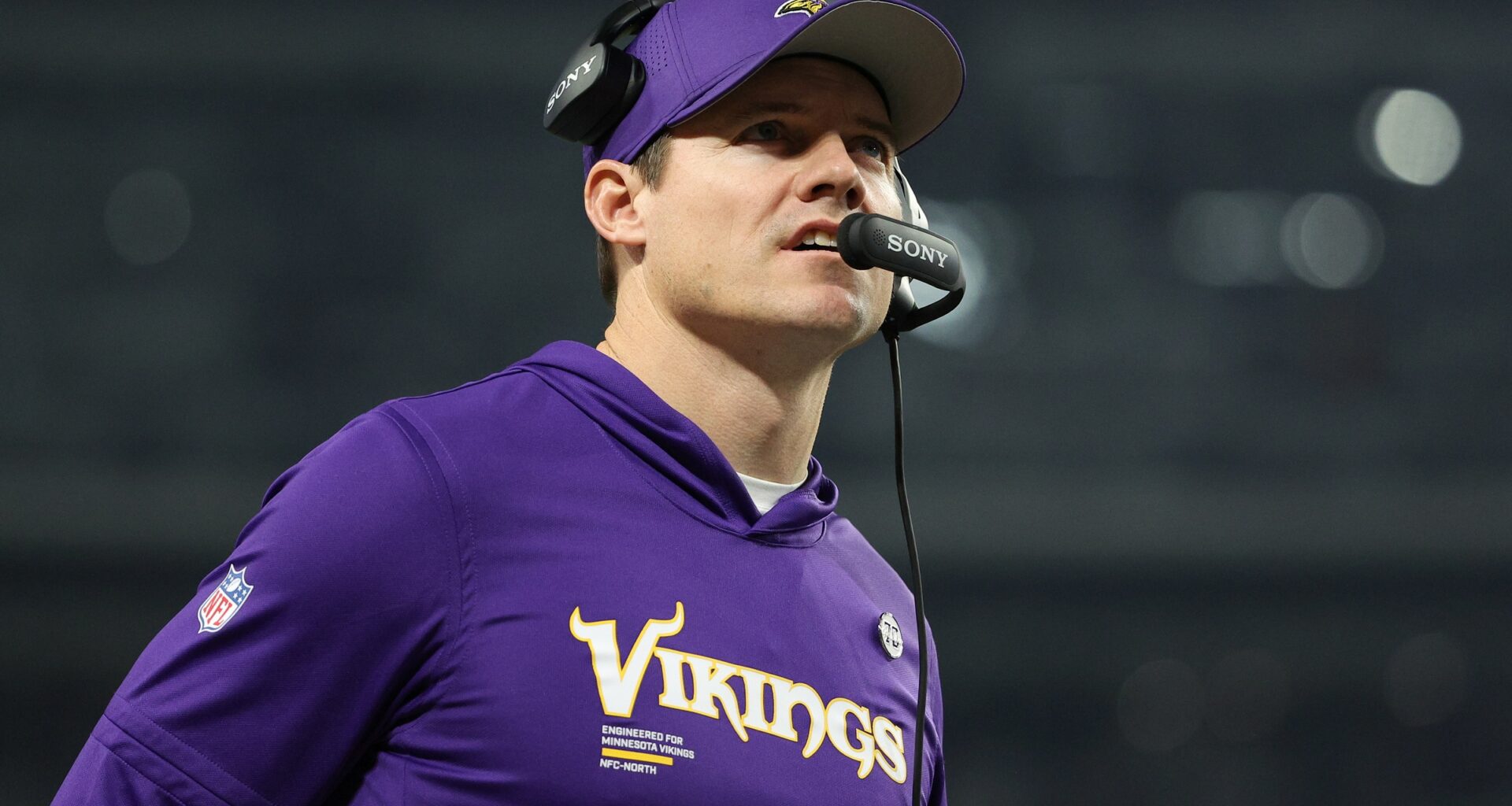
Time moves fast in the NFL. Sunday will mark the conclusion of Kevin O’Connell’s fourth season with the Minnesota Vikings. He enters Week 18 with a .627 win percentage, tied with Mike Tomlin for 25th-highest among head coaches with at least 50 games coached.
Yet playoff success has eluded O’Connell. The Vikings lost in both the 2022 and 2024 Wild Card rounds despite being favored. And because Minnesota dug itself into a 4-8 hole, they have been eliminated from the postseason since Week 15.
At 8-8, the Vikings can point to several reasons for the lost season. Early-season injuries to Harrison Smith, Blake Cashman, and Andrew Van Ginkel hurt the defense during the first seven weeks.
Penalties and discipline in kickoff coverage and return directly contributed to losses in the middle of the season. Kick returner Myles Price fumbled on back-to-back kickoffs against the Baltimore Ravens, losing one that resulted in a short touchdown drive.
One week later, several members of the kickoff team abandoned their assignments with 50 seconds remaining against the Chicago Bears, allowing returner Devin Duvernay to return a crucial kick 56 yards to the Vikings’ 40-yard line. Four plays later, a walk-off field goal dealt Minnesota a devastating 19-17 loss.
But the most pressing issue has been quarterback play. A miscalculated belief in J.J. McCarthy’s short-term viability backfired. His inconsistent play has been disappointing, but not as much as his inability to stay healthy. He has missed seven games, and he was limited in practice on Wednesday, raising questions about his availability for Sunday.
Yet McCarthy hasn’t been the only Vikings quarterback to struggle this season. Carson Wentz was effective in five starts but was lost for the season after undergoing shoulder surgery following Minnesota’s Week 8 loss to the Los Angeles Chargers.
That has meant that undrafted rookie Max Brosmer has started two games in McCarthy’s place. He threw four interceptions in the 26-0 loss to the Seattle Seahawks in Week 13 and was under center when the Vikings netted a franchise-worst three passing yards against the Detroit Lions on Christmas.
Therefore, Year 5 is pivotal for O’Connell. Brad Childress and Mike Zimmer’s tenures took turns for the worse in their fifth seasons.
Childress sent a veteran committee consisting of kicker Ryan Longwell, guard Steve Hutchinson, and defensive end Jared Allen to Hattiesburg, Miss., in August 2010 to recruit Brett Favre to return. The Vikings had narrowly lost 31-28 in the NFC Championship game seven months earlier and felt like they could rekindle the magic of 2009 to make another run at the Super Bowl.
Minnesota would instead finish 6-10, and they fired Childress on November 22.
Zimmer’s ouster wasn’t as sudden, but his tenure in Minnesota could be attributed to the “Pre-Kirk” and “Post-Kirk” eras. In his fourth season, the Philadelphia Eagles throttled Zimmer’s Vikings, 38-7, in the 2017 NFC Championship game.
In Year 5, Minnesota signed Kirk Cousins in a move that signaled the team was “all in” for 2018. They believed Cousins was the missing piece on a championship-ready roster.
But the Vikings finished 8-7-1, missing the playoffs after a brutal Week 17 loss to the Bears. Minnesota returned to the playoffs in 2019, but Zimmer never made it back. The Vikings fired him after the 2021 season.
Kevin O’Connell enters this offseason with his own quarterback dilemma, needing to improve the league’s 31st-ranked passing attack. But, in a way, this isn’t uncharted territory for the so-called “quarterback whisperer.”
In all the ways that the Vikings miscalculated their quarterback situation in 2025, they navigated their 2024 offseason nearly perfectly. They signed Sam Darnold to a one-year, $12 million deal, believing that O’Connell and the coaching staff could maximize his skill set.
Darnold was selected to the Pro Bowl after throwing for 4,319 yards and 35 touchdowns, leading the Vikings to a 14-3 record.
They also drafted McCarthy 10th overall and didn’t have to trade much to move up and get him. A torn meniscus ended his rookie season before it started, and the loss affected his development.
If 2024 represented the best-case scenario at quarterback, 2025 may have been the worst. But does that mean fixing the sport’s most important position is an insurmountable task?
That doesn’t mean that figuring out the quarterback situation is any easier for O’Connell. It just means he already has experience with this, knowing that, as bad as things were at quarterback, the Vikings could be playing for the postseason if they had won one of their close midseason losses.
Will the Vikings bring in a quarterback to push for the starting spot in 2026, believing that McCarthy can continue to ascend with game experience under his belt this offseason? Or will they find someone who will have an upper hand in the competition, forcing McCarthy to earn his spot back with noticeable improvement?
Or will Minnesota actually go for a Hail Mary attempt, believing O’Connell can maximize that caliber of quarterback this time around? Rumors of Joe Burrow, Lamar Jackson, and Justin Herbert feel like pipe dreams, but what happens when the season ends and all three of their teams also fall short of expectations?
It’s another crucial offseason for the Vikings, placing pressure squarely on O’Connell and raising questions about his long-term security as 2026 creeps closer.
Will the pressure force him to take a smart approach at quarterback to right the ship? Or will the Vikings again get aggressive, signaling that they are all in on this current roster, knowing that failure to capitalize in the postseason could lead to consequences?