
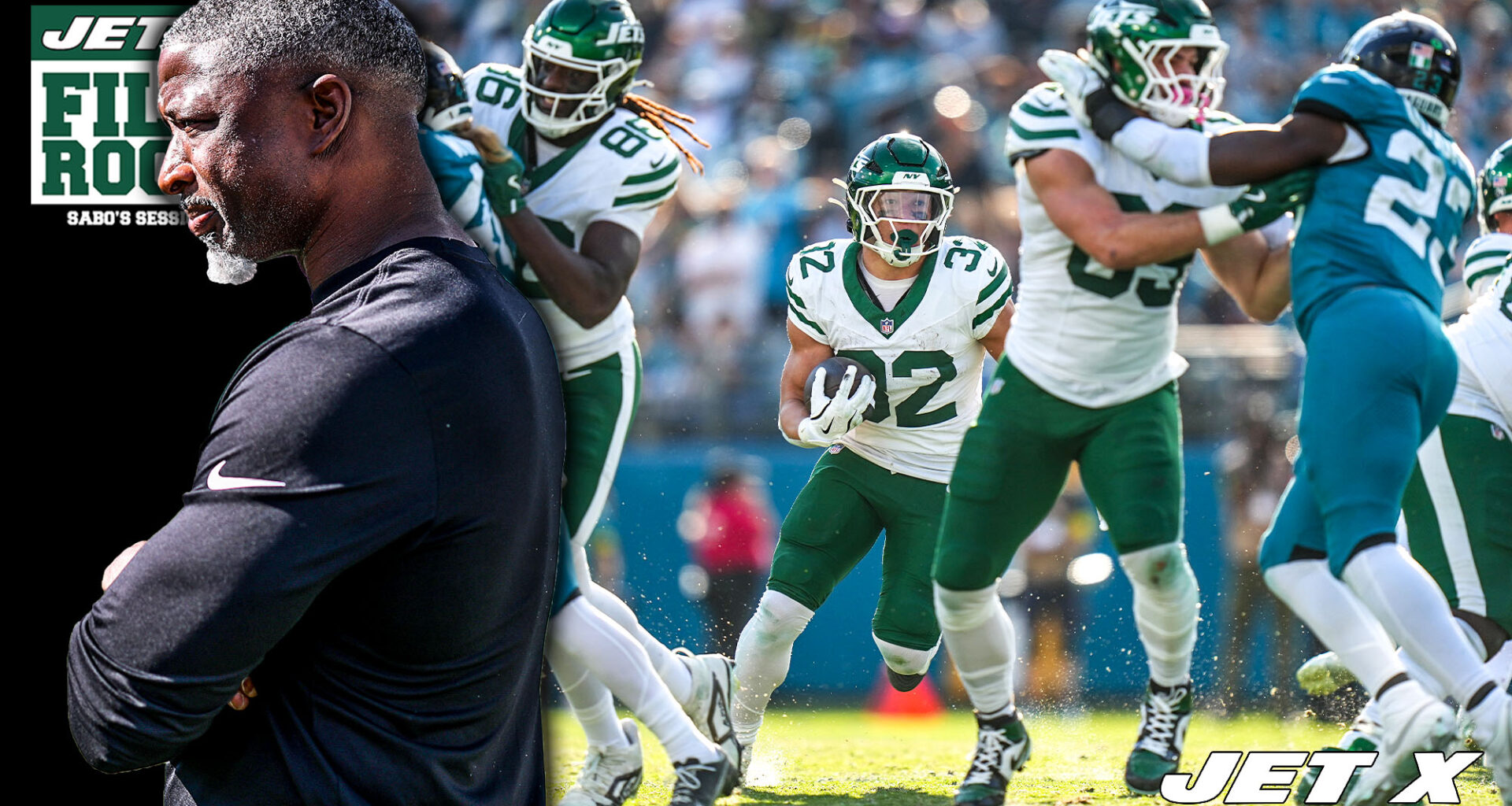
Violence. Physicality. Smashing the opponent in the mouth after a shoving match.
It’s these ideas that appeal to New York Jets head coach Aaron Glenn, as evidenced by his “brand of football” example.
“Yeah, well, we were playing Jacksonville, and I showed the team this (example),” Glenn said. “I thought it was very impressive [in regards to how we controlled] the line of scrimmage, us running the ball and being physical, being violent.”
Not only is it troublesome to hear a head coach’s repeated insistence on playing a certain way—which has been the case since taking the job last year—but it’s even more disappointing to realize that many of the brand’s features align much more closely with football of yesteryear.
The disappointment smacks everybody in the face while reading Glenn’s quote on his cited brand of ball.
There are those words again: violent and physical. Glenn even mentioned the “shoving match” that took place before his Brady Cook-led offense rushed the ball down the field, ultimately culminating in a 24-yard touchdown.
The Jets-Jags shoving match
The following is how the rest of his drive unfolded:
Isaiah Davis 3-yard rush (the play above, leading to the funny business and 15-yard personal foul on JAX).
Isaiah Davis 5-yard rush.
Isaiah Davis 24-yard rushing touchdown.
Look, it makes total sense for a football man to adore the way his team responded in a challenging situation. Here’s his team, down 41-13 late in the third quarter, and the offensive line gets mixed up with the opposition’s big heavies.
The two ensuing plays were smashmouth running plays, the latter of which resulted in six. It’s the type of emotional answer a football coach loves to see, and it’s something that will stick in a head coach’s mind.
It’s genuinely good stuff.
That is when it is judged in isolation.
Emotion is fool’s gold on today’s field
When judged in the modern landscape that produces proper context, however, citing an emotional response as the team’s brand of football misses the mark as badly as possible.
How could “violence” be a key brand point when this league features perfectly fine football tackles as personal fouls? Seriously. How often do we watch traditional football tackles draw a 15-yard penalty for any one of the number of safety points the NFL has entrenched in the rulebook?
A defense could literally square up the opposing quarterback to perfect standards, even for the 2025 rulebook, and still draw a flag—if his hand simply glances the opposition’s head. An official could throw a flag on a cornerback whose press tactics would both make Mel Blount proud and Darrelle Revis blush, and be considered wholly legal in 2005 play.
Yet, Glenn makes no bones about the idea that he envisions his Jets taking on a physical mantra. Not only does physicality not fit today’s league, but staunchly supporting any specific team identity as a baseline contrasts with this brandless league that awards strategists who move like thieves in the night.
The only “brand” that works in today’s cookie-cutter league is week-to-week originality.
Courtesy of just how simple it is to complete passes, offensive deception drives all team success—with anything and everything else (defense, special teams, physicality, and even emotion) playing a complementary role.
Besides, the Jets’ head coach didn’t even point out the most valuable moment on this specific scoring drive.
The strategically logical example
Forget about the idea that Jacksonville’s defense may have been playing softer while preserving a 41-13 lead late in the third quarter. Forget about the fact that Glenn chose an emotional response from his team in a sport that now favors logic and deception.
The telltale sign that something is amiss is that the very play before the shoving match is what truly kick-started the scoring drive. Thus, it should have been this play, and the details and execution involved in this play, that should firmly be planted in a head coach’s mind:
The Jets offense, led by a UDFA quarterback, is facing a brutal situation late in the third quarter. Liam Coen’s team is up 41-13, so his defense will naturally play softer.
Despite allowing a free runner through, Brady Cook stood firm in the pocket and delivered a fluttering ball to AD Mitchell on the comeback. I mean, how anything else can stand out in one’s mind over this singular play, which kick-started the drive, is beyond me.
The shoving-match play followed this chunk completion, which then led to the final two plays of the drive, a five-yard rush by Isaiah Davis, and a 24-yard touchdown run by the same man (who really let his vision take center stage on the play, as the truest difference-maker):
Aaron Glenn’s first mistake is believing the emotions of football still hold as much weight as they did two decades ago. His more unforgivable mistake is to stubbornly believe that the New York Jets must play a certain way in this current iteration of the NFL.
A specific brand of ball, or team identities, are only organically formed—and are never preconceived.
It truly is a chicken-or-egg conversation: A coach who believes he needs a specific type of personnel to fit his team vision will never match wits with the coach who can mold a vision around whatever roster he’s provided.