
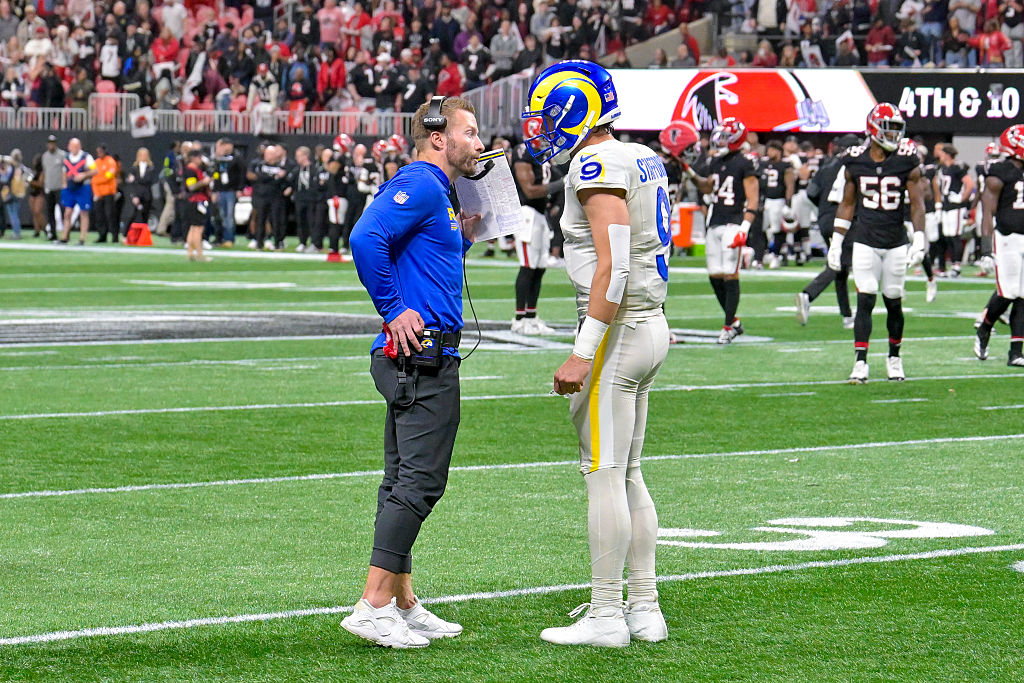
Dan Johnson takes you through his preview, prediction, and pick for NFL Week 18’s game between the Los Angeles Rams and the Arizona Cardinals.
Los Angeles sits at 11–5 and already punched a ticket, but December left a bruise on the brand. The Rams wanted a cleaner path and a louder seed, and they let it slip. Sunday still matters, because a win grabs the five seed and a loss drops them to six. That result ripples straight into San Francisco’s slot and reshapes the Wild Card travel map. The mood feels like urgency, not celebration, because this team needs proof again. Below is my prediction for NFL Week 18’s game between the Los Angeles Rams and the Arizona Cardinals.
Here’s how I’ll play it. I’ll be pumping out these predictions for individual games all season, with plenty of coverage here on DraftKings Network. Follow my handle @dansby_edits for more betting plays.
The numbers say the Rams still own the efficiency gap, even with the recent wobble. Season-long, Los Angeles sits at +0.088 offensive EPA per play and -0.102 defensive EPA allowed, while Arizona lives at -0.019 and 0.000. Over the last five weeks, the Rams offense spikes to +0.199, and the Cardinals defense bleeds 0.255 EPA per play allowed. MVP-hopeful Matthew Stafford (QB) carries 0.22 EPA per dropback and punishes pressure windows when protection holds, living at 0.43 EPA per dropback from a clean pocket. That clean-pocket ceiling is not theory, because the line has held at a 3.8% sack rate allowed with a 27.7% pressure rate, even with key bodies missing. That’s the difference between “pretty play design” and a quarterback actually getting to hitch, reset, and hit the second window.
Arizona can blitz at 28.9% and still feel late, because Stafford’s trigger stays calm when the first read is capped. Arizona’s protection loses far more often, allowing 53 sacks with a 7.5% sack rate and a 38.1% pressure rate, and that’s where the Rams’ front can tilt the day. That kind of pressure environment turns every dropback into a survival drill, because routes never get to full depth and the checkdown becomes the offense.
Jacoby Brissett (QB) sits at 0.00 EPA per dropback, then drops to -0.51 EPA under pressure, and he’s been forced to live in that discomfort at a 36.9% pressure rate faced. That’s where the game gets stolen, because sacks and throwaways don’t just end drives, they tilt field position and play-calling. Kyren Williams (RB) being active gives Los Angeles a stable engine, and the recent workload is still sharp at 77 carries for 396 yards with a 5.1 clip and 3.2 yards after contact per attempt. Blake Corum (RB) being out narrows the rotation, but it also concentrates the carry and red-zone equity on Kyren. That matters in a double-digit spread, because condensed usage turns “protect the lead” into real first downs instead of empty runs.
Tyler Higbee (TE) being active keeps the middle honest and protects the line with real in-line answers when Arizona heats up. He’s also the chain-mover that punishes soft spots in zone, the exact area Arizona has to live in when the blitz doesn’t land. Supernova Puka Nacua (WR) is the real separator, with 57 targets turning into 692 yards and five touchdowns over the last five, plus a 35.9% explosive-catch rate and 280 yards after the catch. That explosive rate changes coverages, because safeties stop squatting and corners stop jumping short routes. Davante Adams (WR) being unlikely changes the shape, but it does not remove the punch, because Nacua has been the explosive engine and the volume winner. It simply tilts the Rams toward more middle-of-field volume and more “win with spacing” drives instead of pure isolation throws.
Arizona’s best counters live through Trey McBride (TE) and Michael Wilson (WR), with McBride at 52 targets and 212 yards after the catch lately and Wilson flashing five touchdowns, but Marvin Harrison Jr. being out removes the clean perimeter bailout that keeps blitz looks honest. When the outside win isn’t there, the offense tightens, and that’s how a game turns into McBride catches that feel productive but never flip the scoreboard.
Cardinals vs. Rams pick, best bet
The Arizona cover case is real enough to respect, because the Rams have absolutely stunk lately as a favorite and they’ve turned double-digit spreads into sweatshops. Arizona also blitzes harder than most at 28.9% over the last six, and Stafford has had ugly moments when he’s forced into long-developing drops. Budda Baker (S) being active helps that plan, and a late-game Rams throttle is always the backdoor oxygen. That’s the exact recipe for the “down, but annoying” fourth quarter, where Arizona plays like it has nothing to lose and the Rams play like they’re protecting ankles. If the Cardinals can steal two or three early downs with pressure looks, the game can feel muddy even while the scoreboard tilts. I still fade that case because the matchup math keeps giving Los Angeles clean ways to create separation without living on fragile explosives. This is where Stafford’s veteran cadence matters, because he can identify the heat, get the ball out, and punish the vacated grass. Stafford actually punishes blitzing defenses at 0.28 EPA per play versus the blitz, while Brissett sits at 0.02 EPA versus the blitz and loses value when the pocket caves. That split is the difference between a blitz creating panic and a blitz creating space. Los Angeles also creates downfield damage at a different rate, with a 14.7% explosive pass rate over the last six compared to Arizona’s 7.8%. Even when the Rams get conservative, their ground game still finds chunk carries more often, with an 11.0% explosive rush rate versus Arizona’s 7.8%, and that’s how big favorites keep the chains moving. Those explosives on the ground are the quiet cover path, because they flip field position without asking Stafford to hold the ball.
Los Angeles should live in heavier personnel because Adams is unlikely and Higbee is active, and that structure gives Stafford quick answers into pressure. Arizona’s blitz rate sits at 28.9% lately, so the Rams should build the day on play-action, tight splits, and middle-of-field throws that turn the rush into a step late. Kyren should own the first-half volume, because his recent 5.1 per carry and 3.2 after contact per attempt can keep second down manageable. That early Kyren weight also forces Arizona to tackle in space for four quarters, which is how late-game runs turn from four yards to twelve. Nacua should stay the stress point, because his 35.9% explosive-catch rate forces safeties to widen and creates easier windows underneath. Defensively, Los Angeles should rush with four and lean into zone, because the unit already lives in zone coverage at 76.7% lately and still produces a 43.6% pressure rate. That plan forces Brissett to hold the ball behind a line that has already allowed a 38.1% pressure rate, and it invites the exact -0.51 EPA pressure split that kills drives. If the Rams keep him in third-and-long, Arizona’s whole offense turns into McBride catches that move chains but rarely move the scoreboard. If the Rams keep their fourth-down aggression and treat this like a seed game, the margin can finally match the talent.
I’m still laying the 14 with Los Angeles, and the angle is less romance and more arithmetic. The line shows Rams -14 with a 47.5 total, and the fear is obvious, because late-season contenders can turn passive with a lead. The reason I still get there is hidden points plus finishing leverage, and those edges show up even when the Rams are not perfect. Fourth downs are where this turns from “better team” to “cover team,” because extra snaps mean extra scoring chances. Los Angeles goes for it on fourth down at a 29.3% rate and converts 65.5%, while Arizona converts 44.0%, and that swing turns punts into points. The Rams also generate far fewer negative snaps lately, with a 6.7% sack-plus-interception rate versus Arizona’s 8.0%, and that keeps the margin from leaking away. That negative-play gap matters late, because one sack or one tipped ball can be the only thing keeping an underdog alive. The red-zone math supports the blowout path too, because Arizona allows a 72.7% red-zone touchdown rate over the last six, and that’s how twenties become thirties.
I’ll take Rams -14 and I’ll call it 31–13, because the Rams’ 2025 grudge needs a clean finish, not a pretty box score. If Los Angeles wants to stop playing with its food, this is the week to turn drives into touchdowns and end the drama early.
Best bet: Rams -14 (-110) vs. Cardinals
Tail it with me in the DKN Betting Group here!
I’d rather ride Tyler Higbee (TE) anytime touchdown at +180, and I’m good playing it down to +150, because the Rams’ scoring tree tightens with Davante Adams unlikely and Blake Corum out. Los Angeles has been humming at +0.199 offensive EPA/play over the last five, while Arizona’s defense has leaked 0.255 EPA/play allowed, so the Rams should keep stacking red-zone trips instead of settling. Higbee’s presence also matters versus pressure looks, because Arizona blitzes at 28.9% lately and Stafford can punish vacated middle grass quickly when the protection holds. If that game state shows up, the easiest TD in the menu is a tight end target off play-action or a condensed formation release. I’ll also sprinkle a smaller stab on Rams D/ST anytime touchdown at +450, playable to +350, because Arizona has allowed 53 sacks with a 38.1% pressure rate, and Brissett has been -0.51 EPA under pressure with a 36.9% pressure rate faced, which is exactly how a strip-sack turns into six.
Best prop lean: Tyler Higbee anytime TD (+180)
Tail it with me in the DKN Betting Group here!