
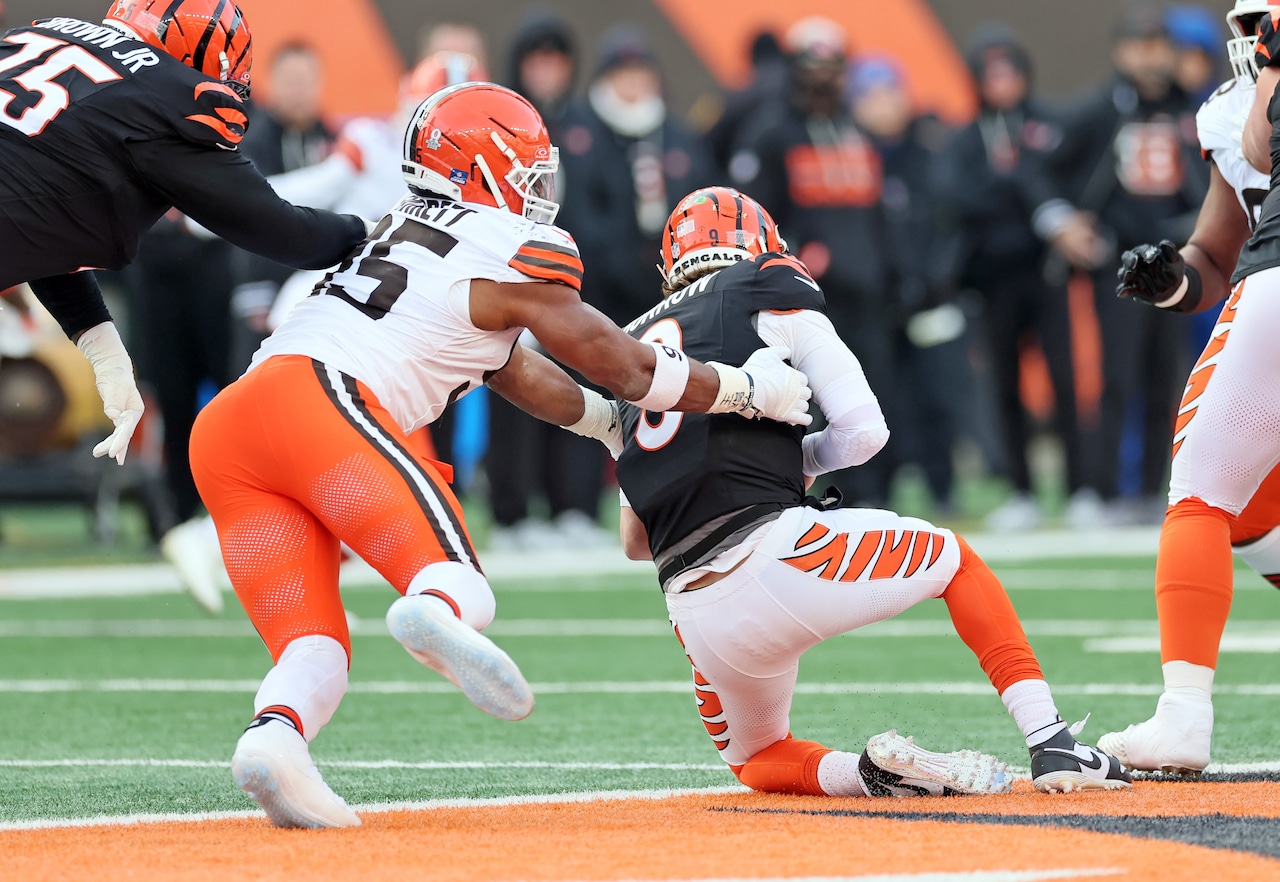
CINCINNATI, Ohio — It took almost 55 minutes on Sunday, but Browns defensive end Myles Garrett brought down Bengals quarterback Joe Burrow to set the NFL’s single-season sack record at 23.
Garrett’s sack of Burrow with 5:13 left in the fourth quarter helped him surpass the record held by Michael Strahan and T.J. Watt.
The record came as the Browns beat the Bengals, 20-18.
In his postgame press conference, Burrow pulled back the curtain on the extreme measures required to combat Garrett’s game-wrecking abilities.
“He’s the focus of our game plan every time we play him,” Burrow admitted. “It’s no secret. And it’s challenging because you have to commit resources to that and that takes away resources from elsewhere.”
This insight from Burrow offers a rare glimpse into the quarterback’s perspective when facing an elite defender. The chess match between offense and defense becomes significantly more complex when one player commands such respect that entire game plans revolve around minimizing his impact.
What makes Garrett particularly dangerous, according to Burrow, is his ability to change games even when largely contained.
“For the most part, I thought we were pretty good against him today, but you can see how impactful he is,” Burrow explained. “We have no help on him one time and he gets one.”
That single play Burrow referenced proved pivotal in the game’s outcome. Despite dedicating extensive resources to containing Garrett for most of the contest, just one snap without additional protection resulted in a history-making moment—highlighting exactly why Garrett demands such extraordinary attention.
The Bengals quarterback went on to detail the multi-layered approach required when facing a talent of Garrett’s caliber. “You know, he’s the best at what he does, and you try to mitigate that as much as you can with your play calls, your protection plan and then how your quarterback plays.”
This three-pronged strategy—play-calling adjustments, protection schemes and quarterback technique—underscores the comprehensive approach needed against elite defenders. It’s not simply about assigning an extra blocker; it requires a fundamental rethinking of offensive philosophy.
Burrow also revealed how Garrett’s presence affects his internal clock and decision-making process. When asked how much Garrett tests his timing on throws, Burrow acknowledged, “Yeah, I certainly don’t go into a play thinking about it, but my natural instincts kick in and you feel him quickly, often. And you know, that certainly affects how far you can push the ball down the field, the protections that you can call, the plays that you can call, and how quickly you want to get the ball out of your hands.”
This rare peek into quarterback psychology when facing an elite pass rusher demonstrates how a single defensive player can limit an entire passing attack—shortening routes, accelerating the decision-making process, and removing certain plays entirely from consideration.
For football enthusiasts interested in the strategic battles that define the NFL, Burrow’s full breakdown of the Garrett matchup offers a masterclass in understanding the game within the game. His candid assessment provides the kind of tactical insight rarely shared so openly by quarterbacks still in their prime.