
Sometimes I think Nick Saban may have permanently broken every college football fan’s brain. Mine included.
The goal of any major college football program — especially in this College Football Playoff-or-bust driven age — is to win a national championship. And for two decades, there was only one guy who had solved that particular puzzle. Either Nick Saban won the national championship, or someone figured out a way to (temporarily) topple him to win one.
From 2009 (when he won his first Alabama title) to 2022 (the year after he won his sixth and final one), Saban won nearly half of the national titles and lost in the title game of three others (to Clemson in 2017 and 2019, and Georgia in 2022, the unofficial end of the Saban dynasty). There were only four seasons over 13 years that Saban was not coaching in the national title game. His team finished in the top 10 of the final AP poll every single one of those years. He basically solved a sport that, for every other human, even some truly great coaches, is unsolvable.
Saban’s brilliance — which was helped by a college football structure that was built to benefit teams like Alabama, something that may no longer be true, one of the reasons Saban was so smart to retire when he did — was so sustained that it has given the illusion that this somehow is repeatable, that winning a national championship is as simple as finding The Right Guy and letting him turn your school into the next Alabama.
This was the driving impetus behind the wild coaching carousel we saw in the last year. Still, it is hardly new: This is, after all, exactly what Georgia had in mind when it ran off Hall of Famer Mark Richt to install Kirby Smart, an alum and The Anointed Next Saban, a full decade ago. That also might have been the closest thing to the strategy actually working — because it usually doesn’t. There is only one Saban. That we keep trying to find another one is exactly how he has broken our brains, to the point that North Carolina even convinced itself it could install the NFL’s Saban in Bill Belichick (who would probably argue Saban was College Football’s Belichick), a strategy that, uh, does not appear to have worked out so far.
The larger illusion in all of this is that there really is such a thing as That Guy in the first place. Saban made us all think that you needed someone truly special to win a championship, and the sport has structured itself accordingly. College has the last sports left on the planet that pay their coaches more than their players, and even in the name, image and likeness era, it’s not particularly close. (The player who received the most in NIL this year, Texas’ Arch Manning, earned an estimated $6.8 million, which would make him the 36th highest-paid coach in college football.)
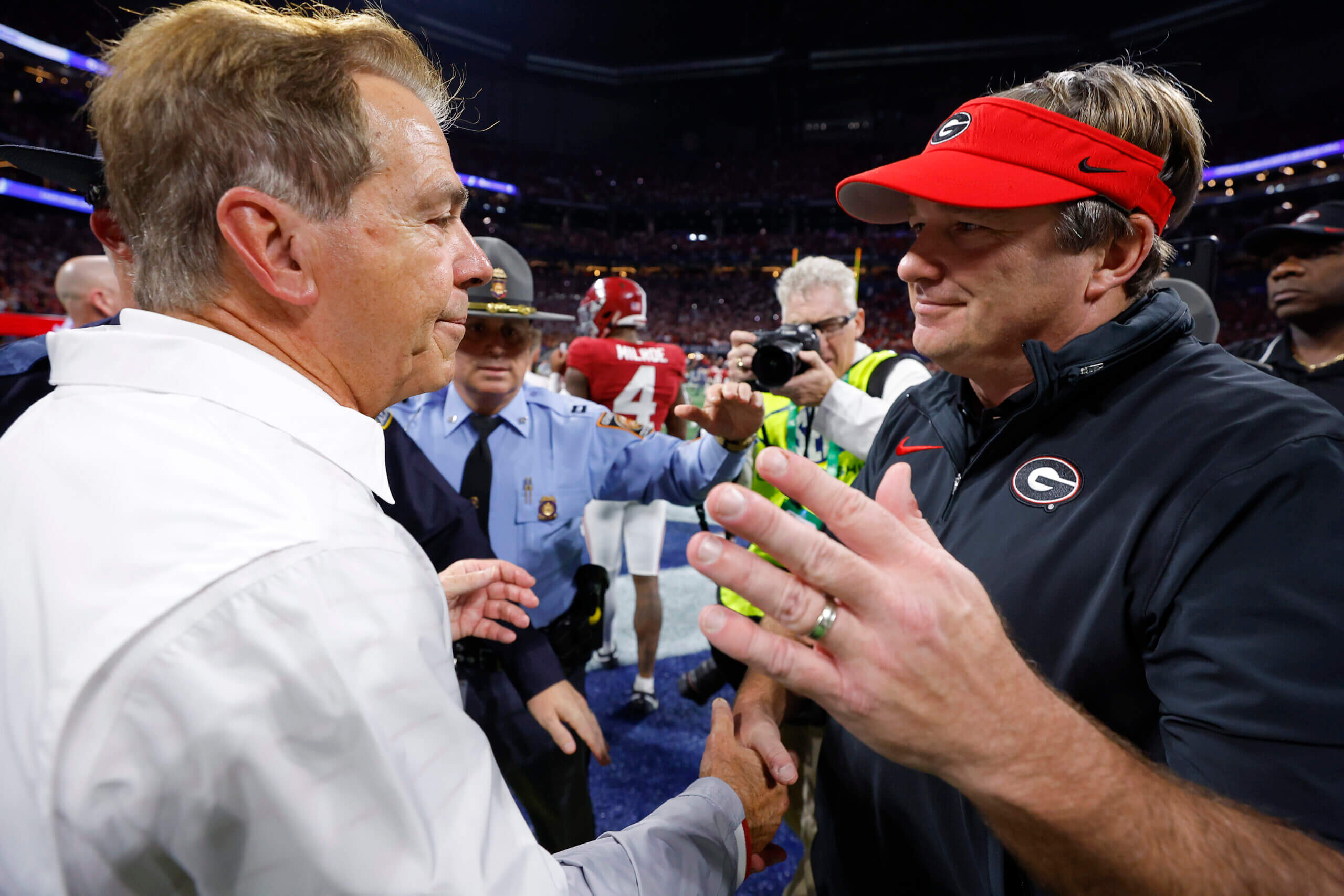
Nick Saban (left) was The Guy in college football, the coach who broke the sport. Kirby Smart (right) is a new The Guy. But the Playoff has four coaches who are Just Guys. What does that say about the sport? (Todd Kirkland / Getty Images)
We’ll see if that’s still the case in 10 years, but for now, universities pay tens of millions of dollars (in salaries and buyouts) to try to find their own Saban — to find That Guy.
You don’t usually have to be That Guy to win a national title, though, and you can tell because guys who win national titles tend to end up getting fired. Eleven coaches have won national titles in the last 20 years.
Three of them are still active: Smart, Dabo Swinney (whose fan base is nearing open revolt) and Ryan Day (who is probably one more disappointing year away from the same thing).
Three (Saban, Urban Meyer and Jim Harbaugh) either retired or left for the NFL (or, in Meyer’s case, both).
The other five were either fired or left before they were about to be: Jimbo Fisher, Ed Orgeron, Gene Chizik, Les Miles and Mack Brown.
Winning a championship didn’t get them considered as all-time great college football coaches (only one of them, Brown, is in the College Football Hall of Fame, and none of the rest are close); it didn’t even get them all that much job security. Each of them was merely an average-to-very-good coach who happened to be in charge when a transcendent player like Jameis Winston, Joe Burrow, Vince Young or Cam Newton blew through town. When their special year was over, they were just regular schmucks like everybody else.
This is not to diminish them, or their titles: Winning a championship is really hard! You can wear that ring forever, but it does not make them That Guy, and this is a sport that is structured around a desperate, fevered, downright undignified desire to find That Guy.
Nick Saban made us think you just had to get That Guy, but it might just be Saban who is That Guy — and it’s possible that in an NIL age, That Guy may just be something that doesn’t exist anymore.
This comes into clearer repose when you look at the four gentlemen still coaching in the College Football Playoff. Five years ago, it would have been impossible to imagine any of them being a Championship Coach, and now one of them is going to be.
Curt Cignetti, Indiana. The story of Cignetti’s immediate turnaround of the Hoosiers is the signature story of the college football season, and it is a measure of just how incredible Cignetti has been that you can legitimately say at this point, if Indiana doesn’t win the title this year, it’s going to feel like … a profound disappointment?
It should be noted that the primary reaction to Cignetti’s hiring two years ago was “man, that guy is awfully old to be getting his first Power Four job.” Cignetti feels like the next coach to break everybody’s brains the way Saban did; he is basically the greatest Power Four hire since Smart, and one that makes coaching look so much easier than it actually is.
Part of me believes that, if Indiana wins, Cignetti should retire after this season and spend the rest of his life on a beach, scowling at resort attendants and being basically unimpeachable forever.
Dan Lanning, Oregon. Lanning is the closest thing to having a Saban Arc as anyone left, which makes sense: He’s from the Kirby Smart Tree, who is from the Saban Tree. If Oregon wins the title, Lanning and Smart (and maybe Day) are the closest things to That Guy as college football will have. Lanning is a bit of fun potential archetype for this, in that, unlike Smart (and Day), the guy feels a little bit unhinged, but in a good way: I’d be lying if I said I hadn’t used his “They’re fighting for clicks, we’re fighting for wins” pregame speech line a few times in my own life. If you want to believe in the That Guy narrative, Lanning is your best bet to keep it alive.
Mario Cristobal, Miami. One of the most fun parts of being a college football fan is finding storylines for coaches and never letting them go (“James Franklin can’t win big games;” “Les Miles has horrible clock management skills”) and accepting them as basic truisms. Cristobal has been plagued by this his entire career (particularly with late-game management), to the point that Oregon fans actively cheered when he left, and, if Oregon were to play Miami in a title game, will be compulsively salivating.
Cristobal has a little bit of the Kalen DeBoer problem, in that while we all understand that coaching is infinitely complicated and a million things are going on behind the scenes that we know nothing about, when you see a shot of him on the sideline during a game, you can’t help but find yourself thinking, “This guy is inspiring precisely zero confidence in me right now.”
Cristobal winning a national title would be wholly vindicating for him and would still probably convince no one.
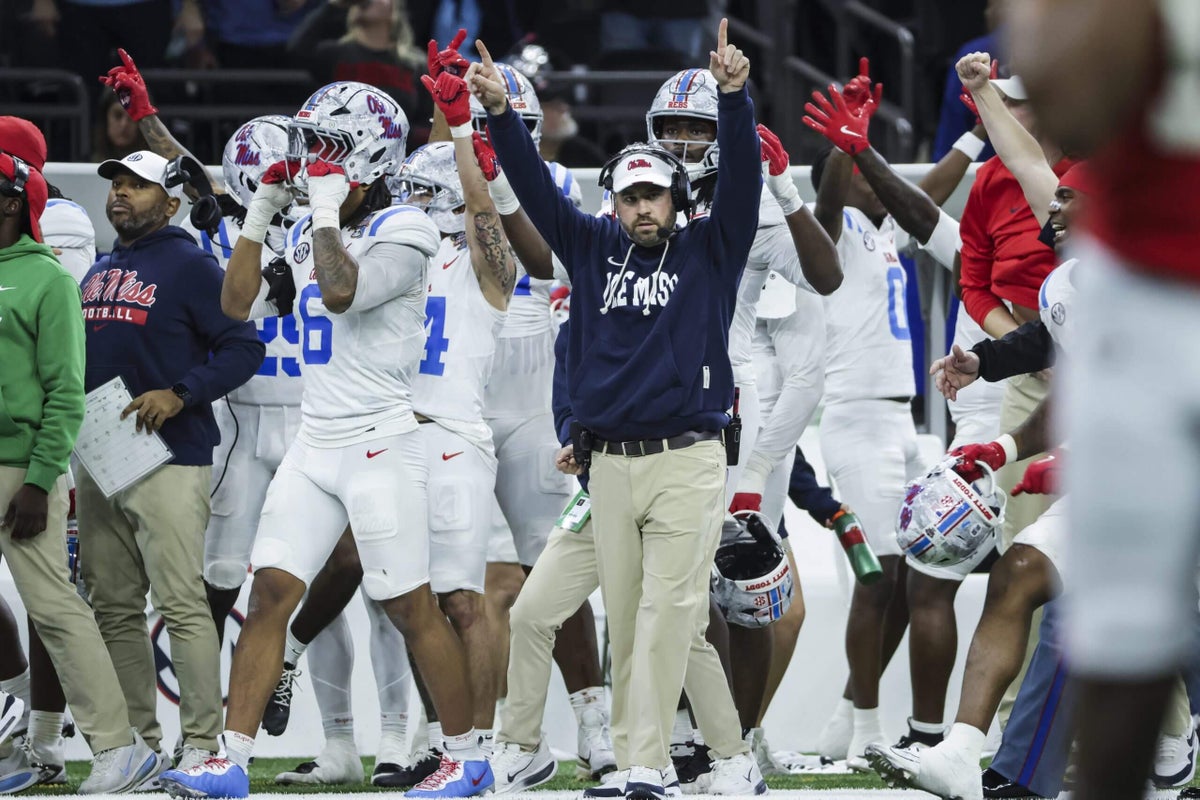
Pete Golding, Mississippi. When the camera cuts to Smart or Swinney or Day, you are used to it and respond accordingly. We have seen them coach many games and have a clear sense of who they are as sideline entities. It has been downright disorienting, then, to see Pete Golding, Widespread Pete, in the context of hugely important postseason games: Hey, look, it’s one of the best college football games you have ever seen, being run by … a guy who a month ago you had no idea existed.
It is like a new character being introduced on “The Sopranos” and having him run the New York crew, like, the very next episode.
Golding, by all accounts, seems to be an excellent coach and a decent fellow, but let’s not kid ourselves here. This is a sport in which universities spend tens of millions of dollars for men not to coach their teams, in which politicians constantly inject themselves into the process, in which we track tail numbers on airplanes to try to figure out who our favorite teams think is going to be That Guy. If Golding just shows up out of nowhere, looking like Paul Walter Hauser, comes out and wins four games and becomes a national championship-winning coach … honestly, how hard can this be?
You don’t need Nick Saban. You just need to stumble across the right coach at the right time. Either way, you can always fire him five years from now anyway.