
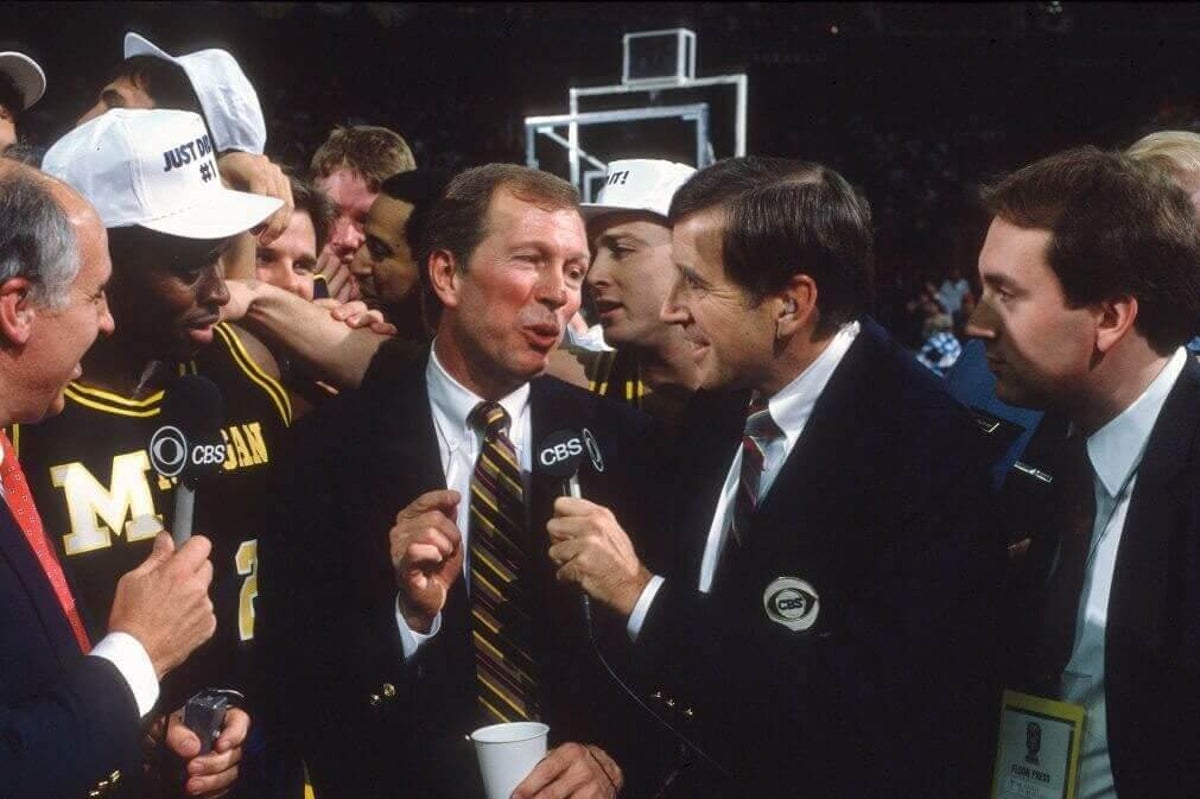
Terry Mills has watched the Ole Miss story with a knowing smile. He followed the Lane Kiffin saga. He made the connection with his own history. Then came the clincher: Trinidad Chambliss, the driving force of this Ole Miss football team, is in fact a Michigan man.
Maybe not the same way as Steve Fisher. Maybe not even the same way as Mills, Glen Rice, Rumeal Robinson, Sean Higgins and the others on one of the most improbable NCAA Tournament champions of all time: The 1988-89 Michigan team, whose coach left for another job the week the tournament began, then won it all anyway.
And so Mills watched Ole Miss and history repeating. The head coach taking another job, but hoping to stay through the postseason. The athletic director telling him no. And now two wins away from a national title, led by Chambliss, the quarterback from Grand Rapids, Mich., by way of Ferris State, the Division II school in Michigan.
“I’m cheering for Ole Miss. I’m in their corner,” Mills told The Athletic from Michigan, where the starting center on that ’89 team is now a color analyst for basketball broadcasts. “I was in awe and couldn’t believe that that was still happening 30 years later, and they haven’t corrected that. But I mean, good for the team.”
Mills isn’t the only player from that Michigan team watching Ole Miss now and rooting it on as it prepares to play Miami in the College Football Playoff semifinals Thursday. It’s a shared experience, 36 years apart, and they know how wild a situation it is, and what it takes to continue to succeed when your coach leaves. But there are also differences.
“There are some parallels. But the big difference, to me, is the personalities,” said Mark Hughes, a senior power forward and co-captain on Michigan’s ’89 team. “Lane Kiffin, he’s a big, big personality. And the way he went about the whole thing, kind of drug it out.”
After weeks of the Kiffin-to-LSU story dragging out, Ole Miss athletic director Keith Carter did what Bo Schembechler did in 1989: told the coach his departure was effective immediately. Carter gave Pete Golding the reins as the Playoff began, the way Schembechler did with Fisher as the NCAA Tournament began.
But in 1989, head coach Bill Frieder’s move to Arizona State was done “as quickly and quietly as possible,” as Hughes recalled this week. Frieder informed Michigan on Tuesday of the NCAA Tournament week that he was taking the job. Schembechler, the athletic director and legendary football coach, memorably rejected Frieder’s request to finish the season: “A Michigan man will coach Michigan.”
The great irony is that Frieder was a Michigan man. He graduated from the school’s college of business. He coached there for 16 years, the last nine as head coach. Frieder’s reasons for leaving were mainly issues with Schembechler over priorities for the program. He also could have tried to keep it quiet, but Frieder — who could not be reached for this story — opted to inform everybody.
“He and Bo didn’t see eye to eye on a lot of things,” Hughes said. “Arizona State made a big, hard push after him. Going to the sunshine, I couldn’t really blame him for the move. But he anticipated coaching us going forward.”
Instead, the whistle was given to Fisher, the top assistant. But unlike Golding, he wasn’t given the permanent job right away. Fisher was the interim throughout the tournament run, but players said that didn’t matter. Fisher recruited a lot of them, and they had a great relationship with him. In fact, as the run went further, part of the motivation was to win for Fisher.
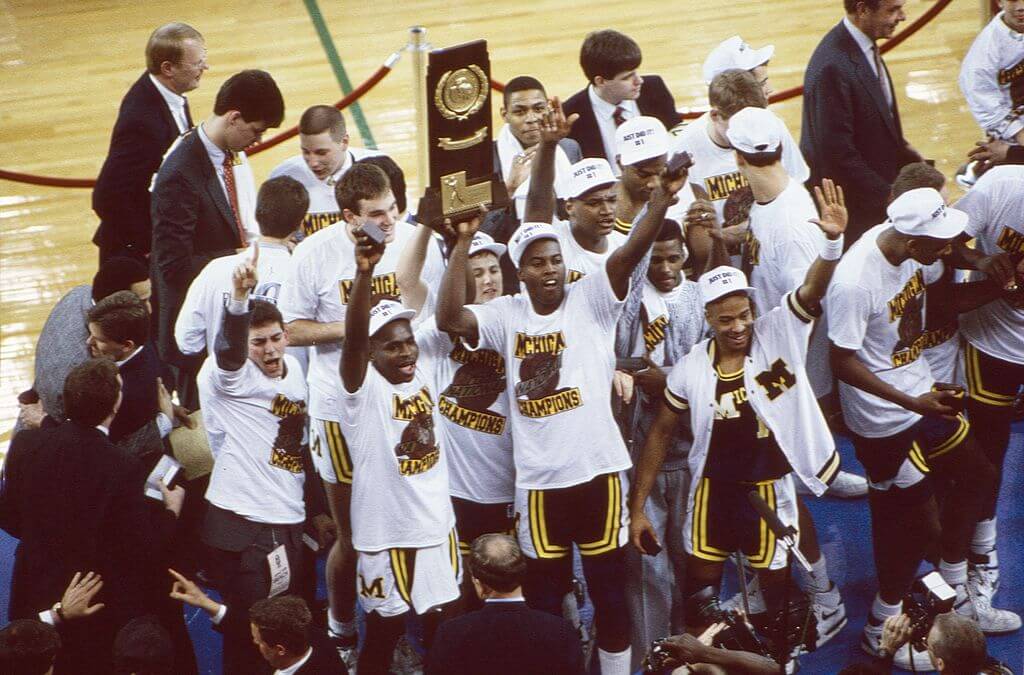
Michigan wasn’t a Cinderella story as a No. 3 seed, but its players felt like one after losing their head coach. (Rich Clarkson / Sports Illustrated via Getty Images)
“I know that drove us,” Hughes said. “Because yes, we want to win a national championship. But we’re also pulling for Coach, because he was our guy. You fight a little bit harder for him, especially dealing with all things we have dealt with.”
But there also wasn’t much anger at Frieder. If there was any initially, it faded during an emotional meeting in Atlanta, where the team was preparing to open the tournament. Frieder, his wife and young daughter met with the players and had a heart-to-heart.
“Everything had been going on in the newspaper and media, you know, people were like dragging him over the bus and swinging through the mud,” said Higgins, a forward on the team. “And he came down and spoke to us at the hotel, and he had his wife and his daughter with him. … She started crying, and it just made everyone in the room water up. It was emotional, right before the first round. That was something that loosened us up in terms of having any resentment against Coach Freider for abandoning us like that.”
It also helped that Fisher had already been running a lot of practice. The players were used to hearing his voice, as Mills put it. Fisher made some changes, such as being more methodical: Hughes remembers pregame talks and walk-throughs being a bit longer.
Fisher, becoming a college head coach for the first time, also proved a good motivator.
“Hey guys, we’re here, no one thinks we’re gonna do it. Let’s show them who we are,” Hughes said, quoting Fisher’s main message. “And the more it went the more the confidence grew. And it became: Hey, let’s go do something special.”
Michigan was still a good team. It entered the tournament as a No. 3 seed and had four future NBA first-round picks. But the Wolverines were also 21-6 and coming off an embarrassing home loss to Illinois in the final regular-season game. (There was no Big Ten tournament at the time.) Throw in the coaching change, and the Wolverines were being discounted. Including by their own school, which didn’t send the school band to Atlanta.
“They figured we were shattered, Michigan isn’t going to make it out in the first round because they’re not going to be able to deal with this,” Mills said. “They figured they’d hire a band local that could play ‘Hail to the Victors.’”
The hired band did that as Michigan beat Xavier (by 5) in the first round, then South Alabama (by 9) in the second round. Those weren’t upsets. But then came North Carolina, which had knocked the Wolverines out of the previous two tournaments.
This time, Rice willed Michigan to the win, putting up 34 points in a 92-87 win. Rice would go on to be the tournament’s most outstanding player.
“I think you’re right on point comparing (Ole Miss) to us,” Higgins said. “Because you take Trinidad, that’s their Glen Rice.”
Everybody did their part in a 37-point rout of Virginia, which had upset top-seeded Oklahoma, in the Elite Eight. That set up a third matchup with Illinois, which had swept Michigan in the regular season. This time it was an epically close game — 33 lead changes — with a tie score with two seconds left when Higgins rebounded a miss and put it back in.
The championship game against Seton Hall was even closer: It went to overtime, and Michigan trailed 79-76 with under a minute left. Mills made a jumper, then after the Wolverines got a stop, a foul was called with three seconds left, and Robinson hit both free throws.
Fisher ended up giving Frieder a championship ring. It wasn’t anger at Frieder that fueled the run, players said — at least not at their departed coach.
“I think we were angry at the rest of the country not giving us a chance. They wrote us off,” Higgins said. “They considered us a Cinderella. We were third seed, but still because of our coach leaving and Coach Fisher not having any head-coaching experience, but they didn’t really know what we had as a unit.”
That may be what’s going on at Ole Miss in this year’s Playoff. The No. 6 seed, Ole Miss was favored to beat Tulane in its opener but was a 6.5-point underdog to Georgia in the quarterfinals. Golding is serving as a head coach for the first time in his career, just like Fisher, although Fisher had been a high school coach.
Would Michigan have won without the coaching change? Mills thinks so, saying they already had anger over losing the Illinois game on senior night and on national television. Mills said players sat in the locker room for another couple of hours and resolved to do better. This was before they knew about the coaching change.
Players say that while coaching matters, talent does too: Michigan had plenty of it, and so does Ole Miss, and both locker rooms may have been motivated to prove it’s not all about coaching.
“We had extra motivation going into the tournament,” Higgins said. “And I think Ole Miss as well, in terms of being identical to what we went through, they have some talent as well on their team, or they wouldn’t be where they are, right?”
The Michigan players also said it was easier to concentrate in their era: less media coverage, no transfer portal, no NIL pressures. That makes what Ole Miss has been able to do more remarkable to them.
“It is so different now than it was back then,” Hughes said. “I mean, I can imagine guys saying, ‘OK, I’m out of here. Oh, I’m leaving. I’m going to get more money.’ It’s a lot tougher, I think, now than it was, you know, when we played, because it’s, ‘All right. This is it. March Madness, everybody. This is what we play for, right?’ So it’s here, boom, you play, and that’s it. And nobody really worried about, you know, what happens next year, for the most part.”
When next year came, Rice was in the NBA, and gradually the players drifted separate ways. Fisher, who could not be reached for this story, recruited the “Fab Five” a few years later and reached two straight NCAA Tournament finals but didn’t win another title during a long and successful career at Michigan and then San Diego State.
Michigan has brought back the 1988-89 team for several reunions. It’s a program with a storied history, yet the only national champion is the one that got a new coach a few days before the postseason began. It’s why the players admire what Ole Miss has been able to do, whether or not it proceeds past Thursday.
“When you’re a young kid like that, those type of things affect you, and they affect you in a big way,” Mills said. “I’m quite sure Lane Kiffin came into their homes, recruited them, told them how he’s gonna be a father figure, help them get a degree, do this, do that, changing from a boy to a young man, that whole spiel — and then all of a sudden he’s gone.
“But I’m sure that they came together, they rallied, and it’s a story, man, it’s a story. Now, yeah, I’m loving what I’m seeing out of them, and I really hope they can pull it off, man.”