
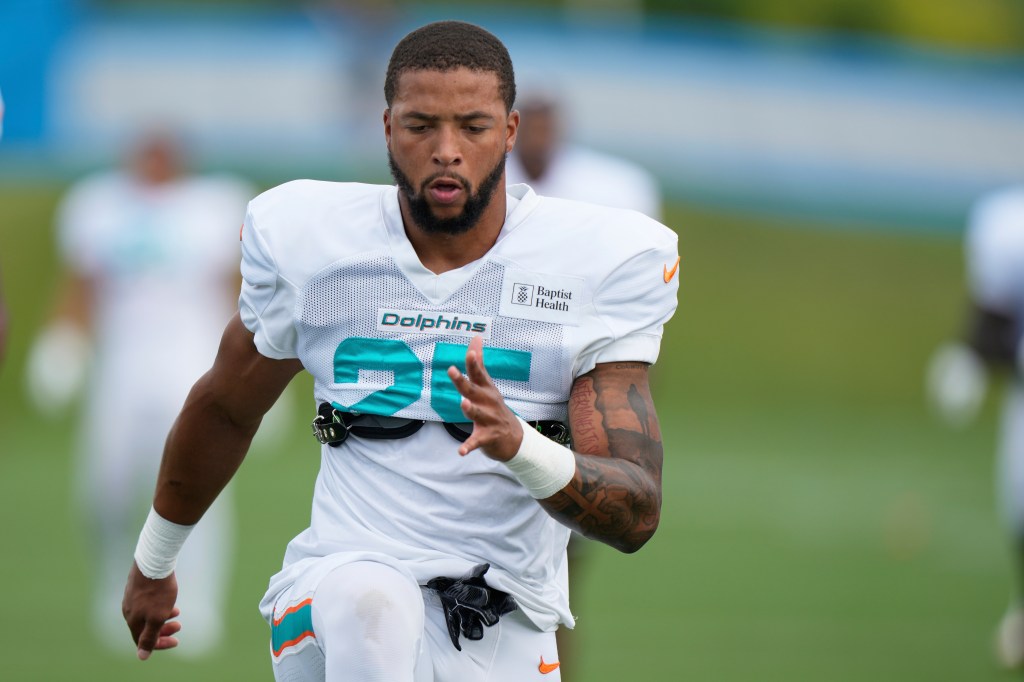
MIAMI GARDENS — Miami Dolphins rookies unanimously say NIL (Name, Image, Likeness) money for college football players is a good idea. At the same time, the Dolphins rookies tell me a freshman salary cap is a necessity.
“I just feel like sometimes those kids are getting too much money and they haven’t even played a snap of ball yet,” said running back Ollie Gordon II, a sixth-round pick who played at Oklahoma State. “So I feel like at this point, it should be earned and just not given.”
On the dark side, safety Dante Trader Jr., a fifth-round pick from Maryland, said NIL “could ruin cultures. It can make people not loyal, like you’re a one-year contractor.”
With the Dolphins’ season over and the college football playoffs in full swing — the University of Miami faces Ole Miss on Thursday night in the Fiesta Bowl — it seemed to be a good time to speak to a few Dolphins rookies who played college football before and after NIL.
They say NIL has changed the game from Oklahoma State to Maryland to Arizona to Florida because it affects everything from love of the game to the transfer portal.
The biggest change to college football brought on by NIL, according to Dolphins rookies, is that incoming freshmen sometimes feel entitled to receiving big bucks. Dolphins players feel strongly about a freshman salary cap.
Trader, a straight shooter, is brutally candid on the topic.
“I do feel like there should be a (freshman salary) cap because now people are just chasing money and everything like that, and what I saw towards my later years, junior and senior year, we have kids with no experience, no plan, talking about, ‘I need ‘X’ amount of money,’ and they’re not even working hard. They’re not going to class. They’re late to stuff. They’re messing up in practice all the time. Messing up in the games. Not taking nothing serious. Not putting in no extra work. So why should you get paid more than veteran players, you know what I’m saying?
“So that’s kind of what killed our culture when I was at Maryland, was bringing in the new with the old.”
To be clear, this isn’t meant to be a scientific, in-depth look at NIL. It’s an anecdotal glimpse based on my curiosity.
My original plan was to focus largely on quarterback Quinn Ewers, the seventh-round pick who earned millions attending Ohio State and Texas. My plan got foiled when Ewers was promoted to starter for the final three games.
I’d casually chatted with Ewers a couple of times during the season on this topic. The last time we talked was the Friday of the week before he got promoted. We’d agreed to talk on the record one day the following week. I didn’t talk to him on the record previously.
Optics are bad when the team is 0-3, 1-6, 2-7 or on a four-game winning streak, and it appears that the rookie quarterback is spending time opining on NIL instead of preparing for his next NFL opponent.
I wouldn’t put Ewers, or any of the other rookies, in that position.
I chalk it up as a missed opportunity. That’s life.
For the record, Ewers has some good thoughts on NIL. I think one idea in particular on how players should be paid, is unworkable as proposed, but a version of it is definitely worth exploring.
But back to the other rookies …
Dolphins rookies think NIL has been positive overall.
And, no, the money didn’t always cause problems. But sometimes it did.
“I think at Michigan it was a really tight brotherhood,” said defensive tackle Kenneth Grant, the Dolphins’ first-round pick. “Of course we would share our numbers and things like that, but there was never any hatred or beef towards, ‘I should be making this,’ or anything like that.”
Guard Jonah Savaiianea, the second-round pick from Arizona, said they didn’t know how much anyone else earned. He’s unsure whether it would have caused problems.
“It could go good or bad,” he said. “Sometimes when you know what someone is making and he might not play up to that expectation it could really mess up someone’s mood. I’d rather not find out.”
Gordon said Oklahoma State’s NIL numbers were leaked and published.
“Some people are tender about it, but that’s the way life goes,” he said.
I also asked players if they think the day will come when college players invest their NIL money in, say, real estate, and emerge from school with enough money to retire. They don’t see that day on the horizon.
“I feel like they just want to spend money on things that don’t really matter,” Gordon said of college players. “So I feel like, nah, they probably won’t be able to do that.”
To that end, Grant said Michigan did a good job of providing financial advisors for players. He said he still uses the financial advisor the school provided.
Overall, there’s no denying NIL money brought changes.
“I definitely would say everything changed in a way as far as off the field stuff,” said cornerback Jason Marshall Jr., who attended Florida and was a fifth-round pick. “Shoot, even for me, my first year, I was driving one of my parents’ old cars around Gainesville. Then once NIL hit, I’m driving in the latest car now. So I do feel like it does have an impact on that.”
Positive impact or negative impact?
“Positive impact,” Marshall said. “But then again, it also has a negative impact, too. Everybody’s ego grows. They feel like they should earn this much amount of money. They feel like they’re getting low balled, and now they’re leaving. That’s why the transfer portal is so crazy now. It’s all hand-in-hand at the end of the day.”
And that’s a turn off to Savaiinaea.
“It’s kind of taking the love of the game away,” Savaiinaea said, later adding. “Before NIL, we’ve always had guys that were always committed to each other and committed to the program. And I feel like when money’s involved it takes all that away. So that’s what I just feel like. Someone else might say otherwise, but that’s what I feel.”