
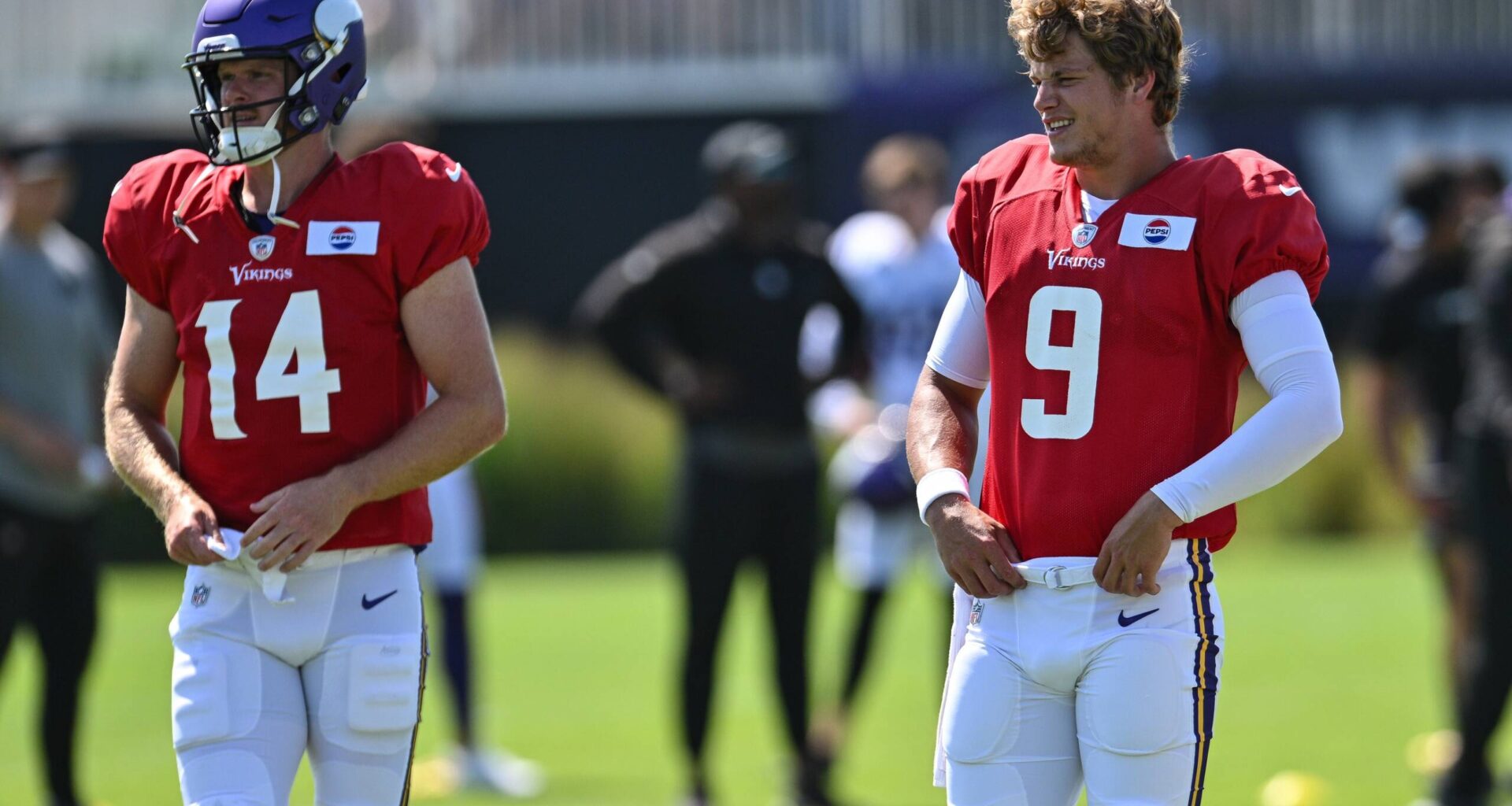
At the NFL combine last year, the Minnesota Vikings were still deciding whether to start J.J. McCarthy or re-sign Sam Darnold.
Minnesota had initially signed Darnold as a bridge for McCarthy. However, McCarthy suffered a season-ending meniscus tear in the preseason, and Darnold threw for 4,319 yards with 35 touchdowns and 12 incompletions, leading the Vikings to a 14-win season.
The Vikings had a decision to make. Bring Darnold back on the franchise tag, costing them $40 million against the cap, but ensuring that they had a veteran starter. Or start McCarthy and build a superteam around him with the extra cap space.
“Every option is afforded to us,” Kwesi Adofo-Mensah said.
“When we [signed Darnold] originally, we wanted to create optionality. And part of the optionality was believing and betting on a guy who was young, talented, believing in our infrastructure to be able to do the things we can do with the quarterbacks.
“So, we’re now in a position where we have options. And we’ll continue to work those options, figure out the best way for the Vikings to move forward.”
Optionality is related to versatility because versatile teams have enough options on their roster to adapt to any situation. They have a defense that can stop the run and the pass, and depth at crucial positions in case a wide receiver or defensive end gets hurt.
Before the season, Adofo-Mensah emphasized versatility. He said he wanted to construct a team that could win any matchup, especially in the playoffs. After losing as favorites to the New York Giants in 2022 and the Los Angeles Rams in 2024, Adofo-Mensah sought to build Minnesota into a “versatile warrior” capable of winning any postseason matchup.
“It’s the type of team that can show up to a fight, not knowing what the fight is going to be, and be the last one standing,” Adofo-Mensah said before training camp in July. “The different types of games you can play obviously in an NFL season, but in a single-elimination playoff situation, you might have to play a certain type of game. And so, we just want to build the type of team that is versatile, could win in different ways.”
By then, Minnesota had chosen to go with McCarthy. Darnold signed a three-year, $100 million contract with the Seattle Seahawks. The $37 million in guaranteed money was slightly below the franchise tag, making it a modest commitment.
The Seahawks likely will double down on him after he threw for 4,048 yards, with 25 touchdowns and 14 interceptions, leading them to a 14-win season and the NFC’s No. 1 seed this year. Darnold has become the first player to lead two different teams to 13 or more wins in NFL history.
Seattle’s odds to win the Super Bowl were +6000 at the beginning of the year. Now, they have the league’s shortest championship odds at +375.
Meanwhile, the Vikings were +1400 to win the Super Bowl at the start of the season and were out of the race by December. The Chicago Bears officially eliminated them before the Dallas Cowboys game in Week 14. However, they had less than a percent chance of making it after the Green Bay Packers beat them 26-6 in Week 12.
Quarterback play was the primary culprit. McCarthy finished his first season throwing for 1,632 yards with 11 touchdowns and 12 interceptions in 10 games. He suffered a high ankle sprain in Week 2 that lingered until Week 9. He also suffered a concussion that kept him out of the Week 13 game in Seattle and a hairline fracture in his throwing hand at the end of the season.
Retaining Darnold would have allowed the Vikings to keep McCarthy on the bench, where he would have remained healthy and could have worked on his mechanics. Franchise-tagging Darnold would have created valuable optionality for Darnold, McCarthy, and the Vikings.
Darnold would have cashed in after the season he had this year. Instead of playing on a team-friendly $100 million contract in Seattle, he could have commanded top dollar from any team that needs a reliable starter.
Meanwhile, McCarthy wouldn’t have potentially lingering injuries, especially the concussion he suffered in Green Bay. He’d still have to monitor his knee after tearing his meniscus as a rookie, but he would have been able to practice his throwing mechanics for a year before playing a regular-season game. His 57.6% completion percentage is a significant concern heading into next season.
The Vikings also would have maintained optionality at the most important position on the roster. If Darnold flames out in the playoffs, they could move on from him and turn to McCarthy after a year of practicing behind Darnold. And if Darnold leads them on a playoff run, they could trade McCarthy for draft capital.
Darnold’s success would mean Kevin O’Connell couldn’t develop a franchise quarterback. Perhaps he’d have regrets if Darnold turns out to be too turnover-prone, and McCarthy succeeded elsewhere. Kwesi Adofo-Mensah would also have to build a roster around Darnold’s franchise deal instead of a rookie contract.
Still, now the Vikings are left trying to find a veteran to compete with McCarthy after a trying first season. They cannot allow their quarterback situation to get out of hand, as it did this year, when they signed Carson Wentz in August and had to start him in September. Max Brosmer, an undrafted third-string quarterback, shouldn’t be starting in Seattle and in primetime against the Detroit Lions.
Minnesota enters next season looking for a veteran quarterback they can trust under center in case J.J. McCarthy doesn’t develop into a franchise quarterback. It will likely be a reclamation project. Someone the league has given up on whom Kevin O’Connell thinks he can turn into a star.
Someone like Sam Darnold.