
This could be deemed a time for more. More reps. More film study. More meeting time.
More, more, more.
It’s the postseason, after all. If you’re going to leave it all on the field because it’s win or go home, your cliche-loving behind better bring a little more with you to the party. Right?
Well, yes. In some cases.
The Patriots may watch a little more film this week, players have acknowledged. They may do more in the training room to ensure they’re as recovered as they can be for this weekend. Receivers may have gotten a few more reps after recent practices with Drake Maye.
But they aren’t changing the essence of what they do ahead of their Wild Card Round game against the Chargers.
“You don’t try to go and make new macaroni,” Stefon Diggs said Wednesday. “We’re not going in with the new macaroni. You’re just going in with that same thought process and just trying to tighten up a little bit, far as putting a little bit of extra time on your body or putting a little bit of extra time on film or whatever it is that’s going to help you get an edge.”
Maye concurred, explaining that the do-what-we-do message has trickled down from head coach Mike Vrabel.
“I think what Coach was preaching is just don’t change our process, our preparation, throughout the week, what we’ve been doing,” he said. “I think the natural thing is to get a little more amped. I guess that’s just natural, as a human, for a big game. Just trust what you’ve been doing.
“I told these guys at the end of the season, before the playoffs came, to put some extra work in, to stay after practice. Some guys have been running extra routes and little things like that that can go a long way, but don’t do anything out of the ordinary. That’s the biggest thing. Trust what you’ve been doing. Trust the preparation you’ve been doing all season.”
As the Patriots prepare this week, what strategies might they be able to employ to help them advance to the Divisional Round? Which matchups might they try to exploit?
Let’s take a stab in our Wild Card Round preview…
Matchup that will determine the outcome
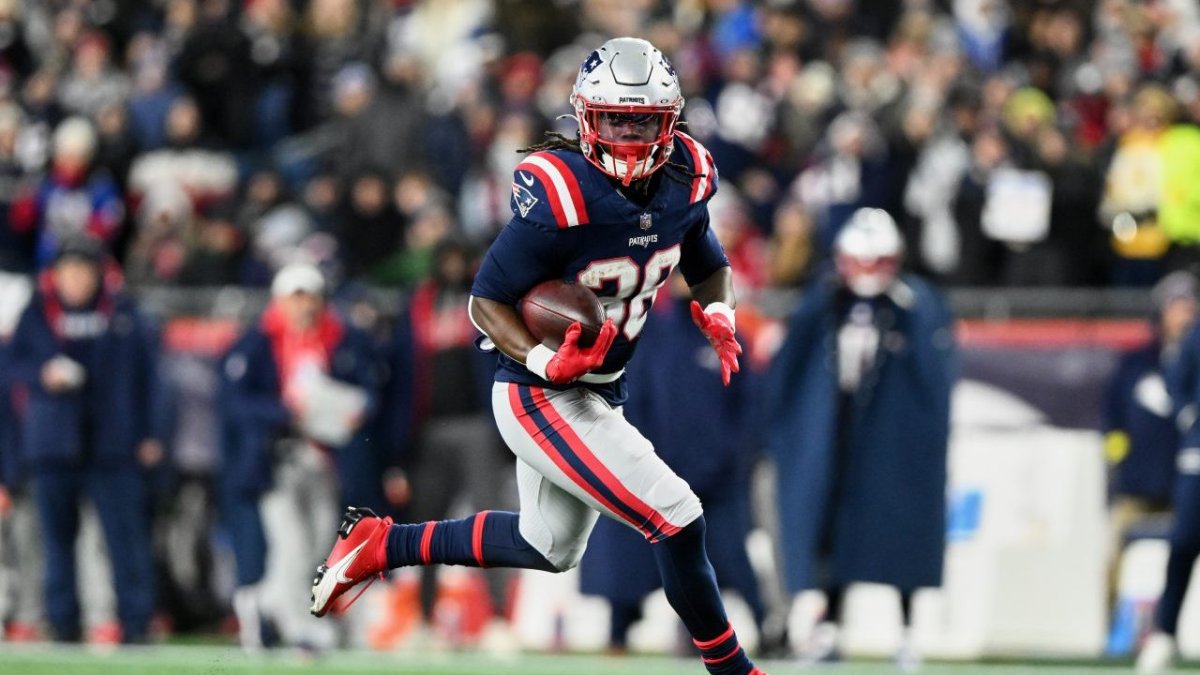
Patriots backs vs. Chargers light boxes
The Chargers play a lot of two-high safety looks. Per TruMedia, the rate at which they show two safeties deep is the fifth-highest in the NFL, which has helped them rank eighth in the league in explosive pass rate allowed.
But those types of defensive structures can also make them vulnerable to the run. No one saw more rushing attempts with light boxes up front (six or fewer defenders) than the Chargers (198), according to Sports Info Solutions, and they led the league in rushing yards allowed when using light boxes (1,053). Additionally, opponents averaged 5.3 yards per carry with Los Angeles deploying light fronts.
If they dare the Patriots to run, then Josh McDaniels should jump at the opportunity.
In this week’s “Board Games”, Phil Perry and Ted Johnson break down two of Rhamondre Stevenson’s TDs and Elijah Ponder’s sack in the win over Miami.
New England’s offense ranked seventh in the NFL this year in EPA per carry against light boxes, and in the last month, they’re first in that category. They’re fourth in yards per carry against light boxes over the last four weeks (6.6) and first in first-down percentage (52.4).
Additionally, whether they see light boxes or not, the Patriots should continue to lean into their “jumbo” package run plays with an extra offensive lineman.
Lately, that’s been Thayer Munford, but it could be any number of Patriots big bodies. Since their bye in Week 14, those calls have become a significant part of their offensive identity — partly due to the weather turning, partly due to losing Mack Hollins to injury, and partly due to Mike Vrabel wanting to find ways to maximize his personnel on all sides of the ball, McDaniels explained recently. They’ve averaged 8.3 yards per carry on 47 “jumbo” runs over the last month.
“It obviously adds an element of size, physicality,” McDaniels said. “But it also allows us to distribute some of the responsibilities that others have shared during the course of the season to some other people. Whether that’s tight ends doing some things that the receivers were doing, or Thayer doing some things that the tight ends were doing, we try to utilize our bodies…
“I was excited to see the volume of (jumbo) snaps we’ve accumulated now. We kind of know what we’re doing. It adds an element for us that can take some things off of others.”
The Chargers have a relatively sound run defense, allowing 105.4 rush yards per game (eighth in the NFL). But they’ve had some issues with heavier personnel packages at times. They’re 22nd in positive EPA rate allowed on runs featuring a sixth offensive lineman, and they’re 24th in EPA per attempt when defending two-back runs.
How the Patriots run the football against a sound pass defense could make all the difference in the outcome of the game.
Matchup that will surprise you
Chargers zone coverages vs. Drake Maye
While Drake Maye has been among the best in the league — if not the best — against a variety of different coverages, what he’ll be presented by the Chargers will represent a challenge.
Start with the two-high looks referenced above. According to Sumer Sports, he hits on deep passes (20 yards or more down the field) against two-high coverages at a 36.8 percent clip. Against single-high? That number shoots to 66.7 percent.
The Chargers also play a ton of zone with defensive backs who have their eyes in the backfield and an aggressive approach. They finished second in the NFL in interception rate, and per Sumer, they’re first in EPA allowed on passes thrown 10 yards or more down the field.
Phil Perry, and Albert Breer join Arbella Early Edition with Trenni to discuss the Patriots’ Wild-Card Round matchup vs the Los Angeles Chargers.
Maye has noted in the past that he’s not thrilled about the idea of being a “checkdown Charlie,” but he might have to play that kind of game on Sunday Night Football. And he’s shown that he can. The Patriots are first in EPA per pass attempt thrown less than 10 yards down the field, according to Sumer, while the Chargers defense ranks 18th in EPA per attempt targeting that area of the field.
“I think you just take chances when they’re there,” Maye said. “I think in one-on-one coverage, you’ve got to take chances. One-on-one, I like our guys. They’re making plays on the football when they have one-on-one coverage, and I like putting ball placement and giving them a chance to go make a play.
“At the same time, just be patient. Don’t get bored being efficient, executing underneath and letting things come to you. I think that’s the biggest thing is starting off, staying on track on first and second down and knowing that when we’re behind the sticks, they have the advantage.”
Matchup that could ruin your Sunday
Chargers outside runs vs. Patriots edge defenders
While the Chargers won’t wow folks with their ability to clear space up front for their running backs — they are 21st in Pro Football Focus’ run-blocking grade — they can, in fact, run it. They’re ninth in the NFL in yards before contact per carry (1.54), and they’re sixth in EPA per rush (0.01).
They’re particularly effective when running outside the tackles. Only the Bears and Ravens have more runs of 10 yards or more when running outside; the Chargers have 44. Only the Ravens average more yards when running outside; the Chargers average 5.7. And no team has a higher EPA per rush outside (0.18).
How do they do it? Offensive coordinator Greg Roman devised a variety of run plays to get his backs into space. He pulled linemen, used receivers to “crack” down as blockers on toss plays, and dialed up wide zone. Justin Herbert also scrambled to pick up big chunks around the edge, meaning Patriots edge defenders will have to be on the lookout for a variety of runners.
Before solidifying their run defense against the Dolphins in Week 18 (2.5 yards per carry allowed), between Weeks 13 and 17, the Patriots allowed 5.4 yards per attempt on runs to the outside.
Matchup that will make your Sunday
Justin Herbert vs. Patriots front
The duality of the Patriots pass-rush will need to be on full display Sunday to slow down Justin Herbert.
Disciplined but aggressive. Patient but violent.
Herbert is the type of quarterback you don’t want leaving the pocket. But you also don’t want him comfortable inside the pocket either. Therefore, the key is to keep him contained while simultaneously bothering him.
Easier said than done.
Phil Perry breaks down the Patriots landing the Sunday Night Football slot against the Chargers in the AFC Wild Card round
Herbert led the league in outside-the-pocket touchdown passes this year with nine (against just one outside-the-pocket interception), according to Sports Info Solutions. He’s also second among quarterbacks in rushing yardage this year (498), and his 6.0 yards per carry rank fourth among signal-callers with at least 25 carries.
Inside the pocket, Herbert is effective, completing 69.6 percent of his passes (seventh-highest in the NFL), and averaging 7.6 yards per attempt (12th). But when pressured, Herbert is 26th in the NFL in rating, per NextGen Stats (67.1). Meanwhile, his EPA per dropback when pressured (-0.39) ranks 20th, which is a sharp drop-off compared to his No. 7 ranking in that metric when he’s kept clean (+0.33).
Blitzing him might not be a great idea since his yards per attempt, completion percentage and EPA per dropback all rank in the top 10 in the league when blitzed. But playing straight up — perhaps while sprinkling in some games with New England’s front four — might be the way to go against what is the 30th-ranked offensive line in pass-blocking efficiency, per PFF.
Prediction: Patriots 24, Chargers 23