
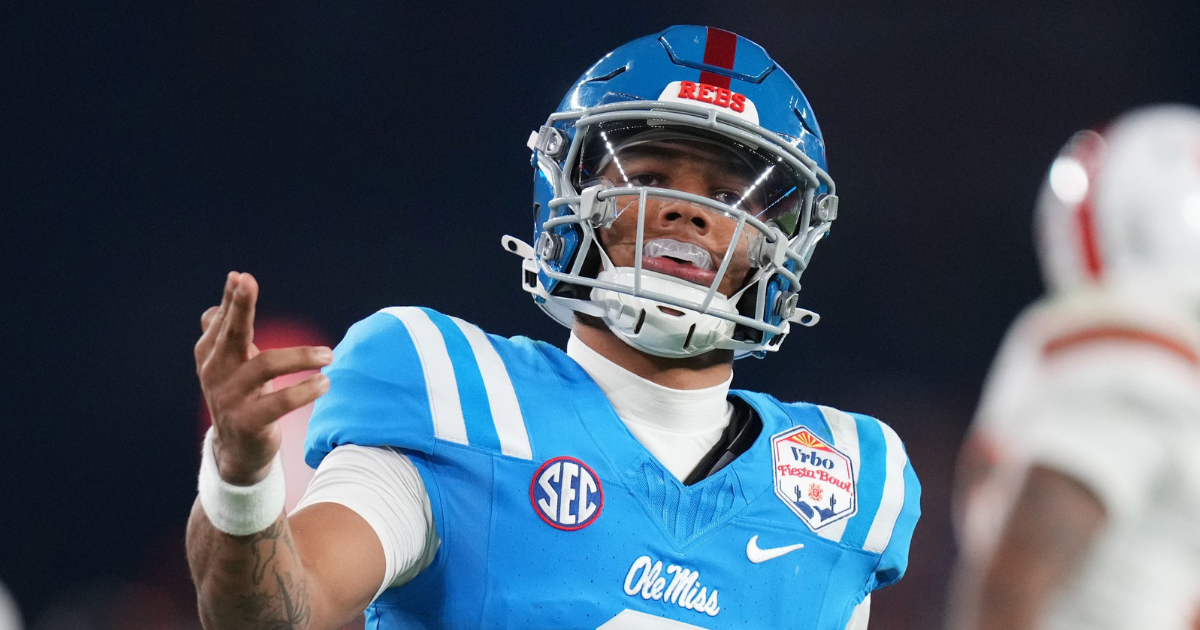
In November, Ole Miss quarterback Trinidad Chambliss filed a waiver petition to receive a sixth year of eligibility. He transferred to Ole Miss ahead of the 2025 season after spending four years at Division II program Ferris State.
Following the Rebels’ stellar 13-2 season and appearance in the College Football Playoff Semifinals, the ruling on Chambliss’ eligibility has finally been handed down from the NCAA.
The Grand Rapids native’s waiver has officially been denied, dealing a massive blow to Pete Golding and the Ole Miss Rebels. Chambliss will now head to the NFL Draft, where he sits at No. 4 on Mel Kiper Jr.’s quarterback rankings. He is slotted behind Oregon‘s Dante Moore, Indiana‘s Fernando Mendoza, and Alabama‘s Ty Simpson.
NCAA statement on Trinidad Chambliss:
In November, Ole Miss filed a waiver request for football student-athlete Trinidad Chambliss, seeking to extend his five-year Division I eligibility clock, citing an incapacitating illness or injury. Approval requires schools to submit…
— NCAA News (@NCAA_PR) January 9, 2026
Chambliss opened the season as Austin Simmons‘ backup, but assumed starting duties once Simmons suffered an injury in the Rebels’ 30-23 victory over Kentucky on Sept. 6. Not only did Chambliss serviceably fill in for Simmons, but he evolved into one of the best quarterbacks in the sport. He passed for 3,937 yards and 22 touchdowns with just three interceptions this season, along with rushing for 527 yards and eight more scores.
Ole Miss‘ starting quarterback passed for at least 300 yards in eight games and finished eighth in Heisman Trophy voting. He cemented himself as a program legend thanks to his performance in the Rebels’ 39-34 win over No. 3 Georgia in the Sugar Bowl, where he pulled off multiple spectacular plays to clinch the historic victory.
NCAA’s Full Statement on Trinidad Chambliss:
“In November, Ole Miss filed a waiver request for football student-athlete Trinidad Chambliss, seeking to extend his five-year Division I eligibility clock, citing an incapacitating illness or injury. Approval requires schools to submit medical documentation provided by a treating physician at the time of a student’s incapacitating injury or illness, which was not provided. The documents provided by Ole Miss and the student’s prior school include a physician’s note from a December 2022 visit, which stated the student-athlete was “doing very well” since he was seen in August 2022.”
“Additionally, the student-athlete’s prior school indicated it had no documentation on medical treatment, injury reports or medical conditions involving the student-athlete during that time frame and cited “developmental needs and our team’s competitive circumstances” as its reason the student-athlete did not play in the 2022-23 season. The waiver request was denied. This decision aligns with consistent application of NCAA rules. So far this academic year, the NCAA has received 784 clock extension requests (438 in football). Of those, 25 cases cited an incapacitating injury (nine in football). The NCAA approved 15 of those (six in football), and all 15 provided medical documentation from the time of the injury. Conversely, all 10 that were denied (three in football) did not provide the required medical documentation.”
“To receive a clock extension, a student-athlete must have been denied two seasons of competition for reasons beyond the student’s or school’s control, and a “redshirt” year can be used only once. One of the rules being cited publicly (Bylaw 12.6.4.2.2) is not the correct rule for the type of waiver requested by the school. Ole Miss applied for the waiver in November, and the NCAA first provided a verbal denial Dec. 8.”
Chambliss will now head off to the NFL, while Pete Golding and Ole Miss scramble to find a replacement at the position. Austin Simmons, who Chambliss replaced, announced his transfer to Missouri on Jan. 6.