
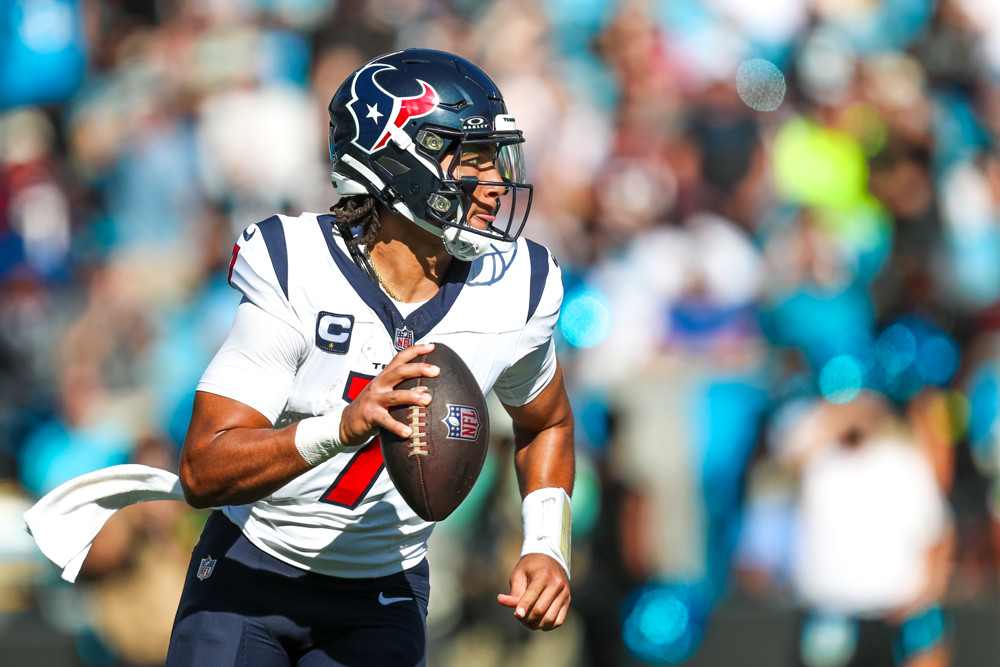
With the Houston Texans and the Pittsburgh Steelers, we’ve got two teams that are better on defense than offense. But let’s be clear: The Steelers are a good defense, but the Texans are a great defense.
Some stats will have the Texans No. 1 in the NFL this season. They were No. 1 in yards and first downs allowed. Our DVOA stats have them No. 2 behind Seattle in both run and pass defense.
Meanwhile, the Texans offense has actually improved in recent weeks. On the other side, the Steelers are getting back their best wide receiver, DK Metcalf, who missed the last two games of the regular season with a suspension.
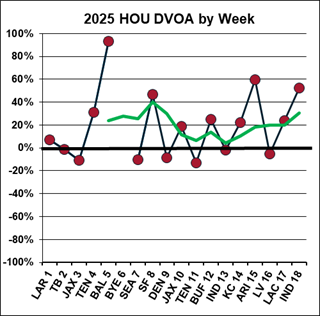
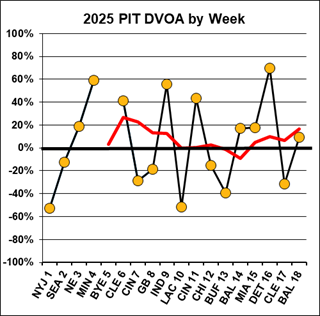
Week-to-week charts represent that team’s single-game total DVOA. The extra line is a rolling five-week average. If you’re checking out FTN’s DVOA for the first time, it’s all explained right here.
HOU (12-5)
PIT (10-7)
DVOA
18.9% (4)
8.2% (12)
WEI DVOA
23.4% (5)
11.1% (12)
Texans on Offense
HOU OFF
PIT DEF
DVOA
-2.5% (19)
-5.5% (11)
WEI DVOA
-1.2% (16)
-8.9% (9)
PASS
17.6% (15)
1.0% (13)
RUSH
-16.8% (29)
-14.7% (6)
Steelers on Offense
HOU DEF
PIT OFF
DVOA
-19.3% (2)
2.3% (16)
WEI DVOA
-21.4% (2)
2.3% (15)
PASS
-18.7% (2)
9.8% (22)
RUSH
-20.0% (2)
2.0% (7)
Special Teams
HOU
PIT
DVOA
2.1% (11)
0.4% (17)
We’ll start with the Houston Texans offense. Their passing DVOA is a shocking ninth in the NFL since Week 10. The big thing here are deep passes, 16 or more air yards. Before Week 10, C.J. Stroud had -14.7% DVOA and 9.4 yards per attempt on deep passes. Since Week 10, Stroud has 65.4% DVOA and 12.6 yards per attempt on deep passes.
The Steelers don’t allow a lot of deep passes because their pass rush gets to the quarterback. The Steelers rank fourth in ESPN pass rush win rate compared to the Texans offensive line being 30th in pass block win rate. And that’s not a place where the Texans have improved in the second half of the year. The Steelers have allowed only 39 deep passes since Week 10, the second-lowest figure in the NFL. But when you can throw deep on them, they have the worst defensive DVOA in the league on those passes, allowing a league-high 56% completion rate since Week 10.
What about the running game? Rookie Woody Marks is now the top running back for Houston. Stats very clearly show you want to run to the right on the Steelers. They were third and sixth in adjusted line yards on runs marked left end and left tackle. Then they were 16th on runs up the middle and 27th on both right tackle and right end runs. The Houston offense was generally better running up the middle than around either end, and didn’t run around end very much in either direction.
But the Texans may not want to run very much at all. On first downs, for example, the Texans had 23.2% DVOA (10th) when passing but -25.9% DVOA (29th) when rushing. The Steelers defense was 10th against the pass on first down and fifth against the run. Also, the Steelers run defense has been killer in recent weeks, ranking third in DVOA since Week 10.
While deep passes will be important for the Texans offense, stopping short passes is the name of the game when you are facing the Steelers offense. Nobody is getting the ball out faster than Aaron Rodgers this year, and only Dillon Gabriel had a shorter average depth of target. The Texans were second in DVOA against ultra-short passes of up to five air yards, although they were average with 6.0 YAC allowed.
You probably know the Texans have excellent defensive backs. Derek Stingley Jr. was near the top of the league in coverage DVOA and both Kamari Lassiter and nickelback/safety Jalen Pitre were very good as well. However, there’s a big difference with their two off-ball linebackers. Azeez Al-Shaair had -41.9% coverage DVOA while Henry To’oTo’o was at 33.0%. The Texans were third in DVOA against running backs as receviers, but if you can get Kenneth Gainwell matched on To’oTo’o, you can get some plays.
The Steelers want to use a lot of two-tight end sets but they were actually not very good from them this season. Pittsburgh had 13.2% offensive DVOA with 11 personnel compared to -12.5% offensive DVOA from 12 personnel. The Texans defense was better against 11 personnel, but the Texans were good against all personnel groups.
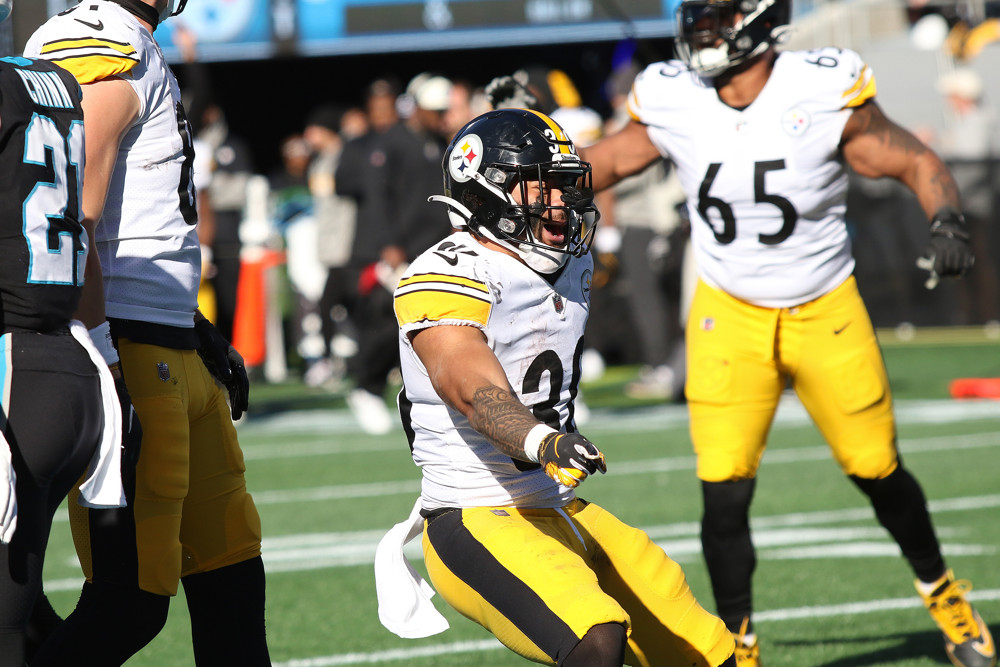
The Steelers were very good running the ball this year. Main running back Jaylen Warren had an illness this year but returned for full participation in practice and will play. The Texans run defense was even better than the Steelers run offense and the Texans were particularly good at cutting down opposing runners at the second level. They were third in the league in second-level yards allowed per carry and second in open-field yards allowed per carry.
Watch to see if the Steelers can extend drives on third down. Although the Steelers rank 16th in offensive DVOA, they improve to eighth on third and fourth down. And while the Texans rank second in defensive DVOA, they drop to 14th on third and fourth down. That’s almost entirely because they are surprisingly poor on third-and-long. The Texans are fourth on third-and-short and third-and-medium but 28th in DVOA on third-and-long (7 or more yards to go). Opponents converted 31% of these plays (including fourth downs) compared to an NFL average of 26%, and had 7.7 yards per play compared to an NFL average of 6.0 yards.
Here’s a remarkable stat: The Houston Texans had -31.5% defensive DVOA when they were behind or the game was tied. This was by far the best in the league, with Seattle second at -20.0%. When the Texans were leading, their defensive DVOA was -11.5%, which ranked sixth.
On special teams, both teams have good kickers, Chris Boswell and Ka’imi Fairbairn. The Steelers had interesting special teams this year because they were fantastic on net kickoffs and net punts but terrible on both kickoff and punt returns. The Texans were pretty average across the board except for Fairbairn on field goals.
Finally, note that the Texans struggled in the red zone this year. Their offense dropped to 32nd in the league inside the 20 while the defense dropped to 17th. The Steelers offense and defense were both essentially the same either way.