
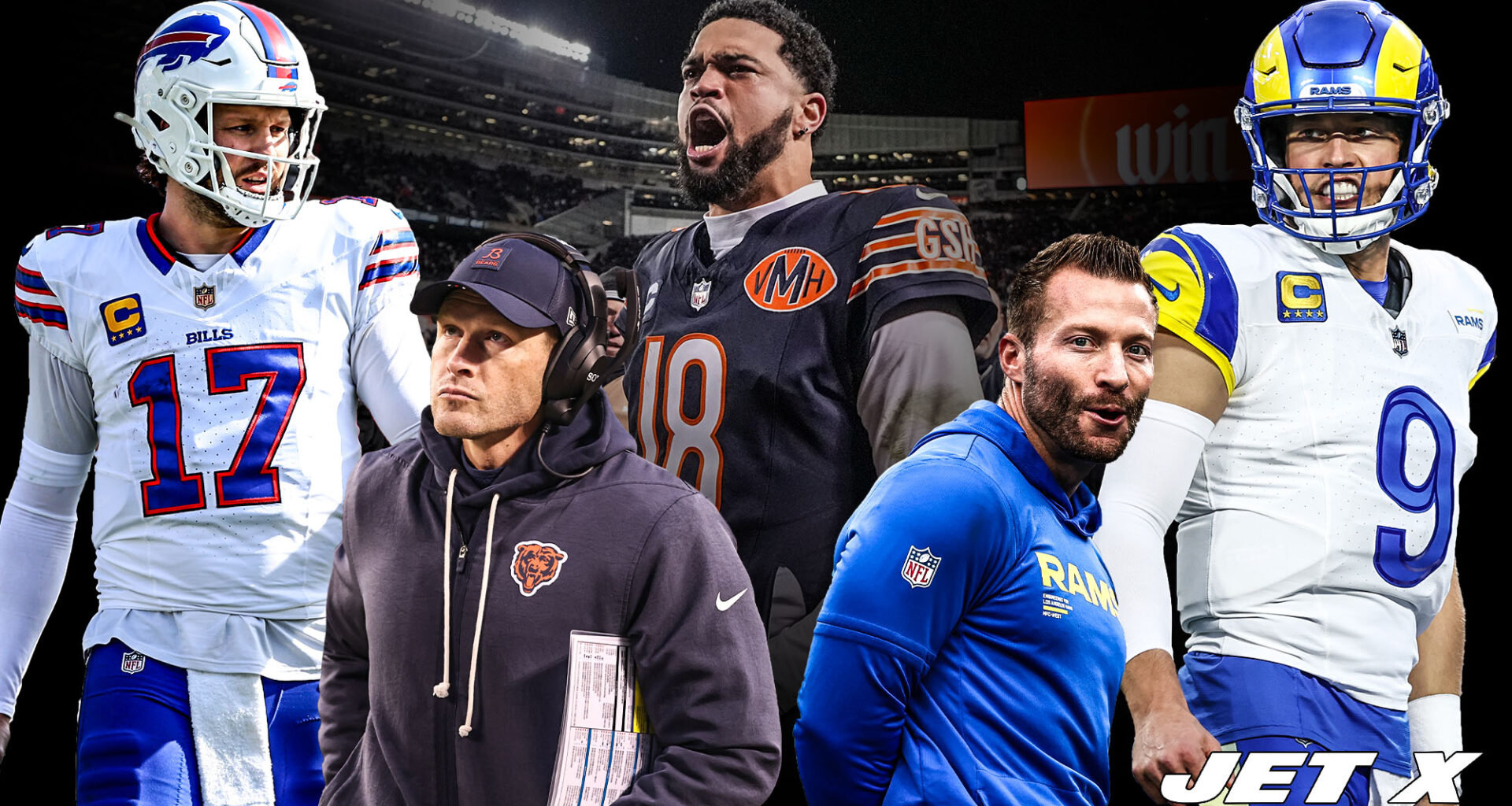
One wonders what the New York Jets’ decision-makers think about when watching the NFL playoffs. Is it more about emotions, such as feeling the fire to achieve similar success, or does an analytical and/or logical know-how take hold?
What does Woody Johnson think about when watching Josh Allen’s Buffalo Bills escape Jacksonville with a thrilling 27-24 victory? Perhaps it’s all about the quarterback, thinking that having one of those coveted face-of-the-franchise types isn’t just the ticket to wins on the field but great for business (see Brett Favre in 2008).
What does Aaron Glenn ponder when watching Robert Saleh’s San Francisco 49ers’ no-name defense execute the rare crunchtime defensive stop against the defending champion Philadelphia Eagles? Perhaps the Jets’ head coach is salivating over just how dominant his 2026 defensive unit can potentially be.
Well, hopefully, for the sake of the New York Jets fan, neither of those two thoughts occurred during wild-card weekend. At the very least, the Jets would be better served if neither thought is overwhelming in each individual’s mind.
The theme over the first four games this weekend is a familiar one that Jets X-Factor has pounded into the sand, time and again, praying that the Jets organization grasps: Innovation, not motivation, is what’s required to lead a winning NFL team today.
Save for the folks who simply enjoy the games, coupled with the old heads who refuse to conform, what we’re experiencing in this particular NFL tournament can be put simply yet hold serious significance…
Football is offensively bananas.
A wild wild-card weekend
The early Saturday game nearly produced an outrageous upset. In the end, however, Matthew Stafford broke the Carolina Panthers’ hearts. Sean McVay’s offense marched 71 yards on 7 plays, resulting in a 19-yard Colby Parkinson receiving touchdown, for the game-winner.
This was truly a play that confirms “perfect offense” beats “perfect defense” these days. When the quarterback places it like this, the defender can’t touch the target, and the target can use his hands freely enough, forget about it.
Although the entire game featured high-scoring prowess, the fourth quarter was a madhouse. Each team put up a pair of touchdowns, ultimately leading to a 34-31 Rams’ victory.
That night, a similar theme unfolded — on steroids. In what looked like Ben Johnson’s rookie head-coaching nightmare, his Chicago Bears overcame an 18-point lead to stun the Green Bay Packers by a 31-27 final.
Caleb Williams ripped off the Huggies en route to an enthralling fourth quarter that forced the casual world to become acquainted. He frequently extended plays, as only uniquely gifted gunslingers can do, which saved the Bears’ honey.
In that vein, Woody’s dream of employing a franchise quarterback makes perfect sense, and all Glenn defenders can hold onto that sole reason for why his rookie season produced historically poor results.
Staying at the “in that vein” point is where the shortsighted individuals commonly remain … shortsighted.
Offensive play-callers steer the ship
While it’s certainly true that the quarterback is the most valuable position in sports these days, the concept of the “franchise quarterback” is crucial on the path to potential team success.
Sure, having a stone-cold consistent player like Josh Allen is advantageous, and working with an uber-talented kid like Caleb Williams is drool-worthy, but neither player would have come into his own if not for the organization’s wherewithal.
The play of Williams is night and day when comparing 2025 to 2024, with and without Ben Johnson. The same can be said for Trevor Lawrence, who consistently heard catcalls of “bust” until the offensive-minded Liam Coen arrived in Jacksonville.
What about the quarterback who leads the NFC’s No. 1 seed, the Seattle Seahawks? Sam Darnold was once considered the New York Jets’ hopeful “franchise quarterback.”
All told, there are a little over 20 so-called “franchise quarterbacks” in the NFL. Only a handful are stone-cold consistent, whereas the others wildly fluctuate in production from year to year.
The first four games of the weekend featured a grand total of seven offensive-minded head coaches (Sean McDermott representing the lone defensive wolf). This fact isn’t meant to make it impossible for defensive-minded head coaches to exist; it’s instead about acknowledging the reality of the situation…
Offensive-minded head coaches. particularly those with quarterback expertise, enjoy mind-boggling advantages in today’s sport.
Not only is defensive football much tougher to execute these days, but it’s also something that no longer exists — at least not in the form we once knew it.
Fourth quarter madness
All four games produced high-point totals (well, subjectively speaking, at least three of the four games did):
Los Angeles Rams 34, Carolina Panthers 31
Chicago Bears 31, Green Bay Packers 27
Buffalo Bills 27, Jacksonville Jaguars 24
San Francisco 49ers 23, Philadelphia Eagles 19
Moreover, each game followed quite a familiar pattern that gives away the secret to today’s game: fourth-quarter offensive madness.
LAR-CAR: 28 of 65 of the game’s total points scored in the fourth quarter.
CHI-GB: 31 of 58 of the game’s total points scored in the fourth quarter (with Chicago responsible for 25 of those 31 points).
BUF-JAX: 28 of 51 of the game’s total points scored in the fourth quarter.
SF-PHI: 16 of 42 of the game’s total points scored in the fourth quarter.
An NFL game these days — particularly when featuring two quality teams — follows a pattern that consists of an “in-structure” part (usually the first three quarters plus some of the fourth) and an “offensive bananas” phase.
The “in-structure” part of the game is where defensive football at least looks somewhat competent. It’s this timeframe for when defensive coordinators can do their thing, while putting up halfway decent numbers. The “offensively bananas” phase is when both offensive play-callers throw all caution to the wind.
Wait, that doesn’t make sense. Why wouldn’t offensive play-callers try to score as many points as possible over the course of the entire game?
Well, that’s the wrong question, and an entirely incorrect way to think about it. It’s not that they’re not trying to score points; it’s that they must, at the very least, play with some conservatism over the meat of the game (the first three-plus quarters).
The way every NFL fan can truly understand just how dominant offensive football is these days is through the realization of what happens in the fourth quarter. Once times are tough and yards/points are needed, the offense generally wins.
Once caution is thrown out the window, balls get thrown at the wall, and the offensive minds cook the defense.
Here we go again: Yet another NFL game that is played a bit *safely* over the first three quarters, only to then EXPLODE OFFENSIVELY in the fourth quarter.
Where will this 20-17 score wind up? Again, defense rarely stops offense; offense decides to play it safe or not.
— Robby Sabo (@RobbySabo) January 11, 2026
In fact, offense is so dominant late in games that it could easily be argued that defensive football no longer exists. Seriously. What we knew of defensive football in the Herm Edwards or even Rex Ryan eras, when physicality still meant something, has evaporated thanks to the Charmin soft rules.
As opposed to playing on equal footing with the offense and having the ability to impose one’s will, a defense can simply choose what’s best to relent over the course of a contest. It’s much better stated that offenses stop themselves more — courtesy of the “in-structure” period of the game that features conservatism — as opposed to defenses having anything to do with it.
The Jets must recognize this reality
Of the four games, only Robert Saleh’s defense could get a legitimate crunchtime stop (when not counting much more challenging offensive situations, such as the Lawrence interception with under a minute remaining, or the Panthers’ late-game offensive failure).
Every other game was won by an offensive game-winning drive. And even for Saleh’s Niners, Kyle Shanahan’s offense marched down the field to take the lead against one of the more celebrated defenses this football season (in the Eagles). More incredibly, Brock Purdy did everything in his power to give the game away (with two brutal-looking interceptions).
For all those who refuse to move into this new-age NFL, where defenders are discriminated against, and offensive yards are like Tic Tacs, this is all you need to understand…
Ben Johnson went on fourth down four times against Green Bay in the first half Saturday night, converting just once. More appallingly, while desperate and out-gunned, trailing 14-3 with 5:19 remaining in the second quarter, Johnson opted to go on a fourth-and-5 situation from his own 32-yard line.
Did you hear that correctly? We’re talking about a fourth-and-5 situation at your own 32-yard line, in the second quarter, while trailing just 14-3 in a playoff game.
Chicago failed to convert.
Chicago still won the game.
People go crazy about going for fourth downs on your own 32, and I get why: bc traditionally speaking, it makes zero sense. I hate the idea. But guess what? WE ARE NO LONGER IN TRADITIONAL TIMES. Defensive football doesn’t even exist in many ways. May as well go for it. #Bears
— Robby Sabo (@RobbySabo) January 11, 2026
The Bears’ victory is much more appalling than the decision to go for it in that situation, as much as I dry-heave every time I think of that move. As much as I hate it, as a traditionalist, however, I need to put as much care into realizing just how drastically football has changed.
It’s tough to even praise Dennis Allen’s Bears defense, a unit that did a tremendous job in the second half. While they helped turn that game around, it was they who put the team in the early hole, and they even relented a late-game touchdown drive that put the Packers up by two possessions. (Matt LaFleur’s mindset, up big at halftime, reverted to safe mode for a chunk of the second half; thus, Green Bay’s offense did a better job of stopping itself, but I digress… )
Never would a 1980s team come out on top after making such a disgusting call. Yet, Ben Johnson understands what’s happened to the NFL. He assessed the situation, realizing his defense could not stop a nosebleed, while simultaneously understanding he needed to get his struggling quarterback going, and bet on the time-of-possession aspect of the strategy.
If they convert, then great. It would serve as a badly-needed shot in the arm.
If they fail, it’s disastrous — yet it’s not as disastrous in today’s brand of ball, courtesy of the short field yielded to the Green Bay Packers. At that point, LaFleur was rolling, and the ensuing touchdown drive would take much less time off the clock than it otherwise would have (had they opted to punt).
Hey, I don’t like it. I may never like it. But that’s what this game has become.
Do the New York Jets recognize this reality?
The Jets’ lack of recognition
Bryce Young and Brock Purdy both exist. Where does each of these guys rank among quarterbacks in the NFL? Where does Jordan Love rank, objectively speaking?
Simply put: It cannot boil down to, “What do you expect? Aaron Glenn did not have a quarterback.”
The league is so incredibly dumbed-down to the point that, as previously stated, there are over 20 hopeful “franchise quarterbacks” in this league, most of whom’s production wildly fluctuates. Besides, it’s more troubling that the Jets’ head coach swapped an extremely efficient playoff quarterback, Aaron Rodgers, for a guy, Justin Fields, whose passing inefficiency is world-renowned.
The truth is simple: Glenn shoved aside modern football realities for what he believed was the proper way to win. He decided to shove his brand of football down the throats of a roster, as opposed to molding a unique brand with what was present, in what’s become a brandless sport.
“Heart and soul of who we’re going to be; heart and soul of who we’re going to be,” Glenn shouted at the Jets’ running backs while in positionals at practice this past summer.
My question would be, “Why?”
Why, in this league, would your running backs be the “heart and soul” of the team? What evidence or logic points to that idea as a smart one?
He chose Fields to construct a rush-heavy offense. He pegged Charles London as the quarterbacks coach, despite his having much more experience at the running back position. Everything about his public words was transparent, indicating that he wanted a heavy rushing offense.
Deploying a rush-heavy offense isn’t even close to a sin in today’s NFL; it’s how you arrive there that’s the important nuance. Anything short of building an offensive infrastructure that lives by the quarterback efficiency gospel is the incorrect path.
At least it’s been the incorrect path for the better part of the last 12-15 years, since the rules began strangling the sport.
At one point during training camp, the New York Post’s Mark Cannizzaro asked Glenn a question about his level of concern regarding his quarterback’s struggles at camp. Glenn, without missing a beat, was defiant in his response…
He refuted Cannizzaro’s claim that today’s NFL is a “passing league” by referencing the Philadelphia Eagles’ successful rushing game, which helped them capture last year’s Super Bowl.
That’s just not the way to approach the head coaching post in today’s National Football League.
Not even the Eagles approach it that way. Like Ben Johnson (and every other successful NFL head coach), they achieve a dominant rushing game by funnelling it through a quarterback-efficient architecture.
Not only that, but Glenn’s intent on special teams focus surely produced a tremendous Chris Banjo-led unit. Then again, how did the Jets achieve those results?
How much practice time was allocated to special teams, as opposed to keeping the offensive efficiency priorities at the top of the list? (If training camp was any indication, Glenn spent way too much time on special teams, as Jets X-Factor witnessed firsthand.)
I don’t even want to delve into the possibility that the Jets, as an organization, along with its head coach, believe defensive football is still on par with the offense. Such thoughts ruin entire weeks.
The Jets’ only hope
Fortunately for the modern NFL fans, the first four wild-card games produced exciting results. Unfortunately for the traditionalists, defense is nearly dead.
Unfortunately for New York Jets fans — with plenty of doom sprinkled on top — everything this organization preaches and signals comes from a time of yesteryear.
Even New York Jets chairman Woody Johnson hasn’t quite caught on to the evolution, as his insistence on hiring a CEO-type leader-of-men head coach does not jibe with the January football being played out on our screens.
The only hope is as follows: Aaron Glenn alters his core philosophies in an unprecedented way, and the New York Jets find their stud quarterback in the 2026 NFL draft.
Oh wait, there’s more…
Everybody will have to pray that offensive coordinator Tanner Engstrand is a sleeping giant of the game, an out-and-out offensive stud, and the head coach lets him cook as such — allowing his quarterback-driven offense to lead the weekly game plan and squad’s soul.
After all, just glance at the offensive coordinators of the five (of 14) playoff teams that are led by a defensive-minded head coach. Names like Josh McDaniels, Joe Brady, Arthur Smith, Nick Caley, and Klint Kubiak — who I firmly believe is the next giant of a football head coach in this league —smack us in the face with offensive authority.
Anything short of that is akin to a professional football organization trying to force an older, more traditionally shaped square peg into a sleeker, alien-looking circular hole. And no, talent alone will not save the New York Jets. (If anybody can name one 49ers defender from this weekend, a cookie shall be awarded.)
The sport of football, as seen in the first four games of the NFL playoffs, can not only be described as offensively bananas but also discriminatory against defenders. Aaron Glenn (a tremendous defender in his own right) and the New York Jets must recognize this and pivot — as quickly as humanly possible.
Grit, violence, and belief don’t move the needle like they once did. If the NFL playoffs are convincing enough, nothing will suffice.