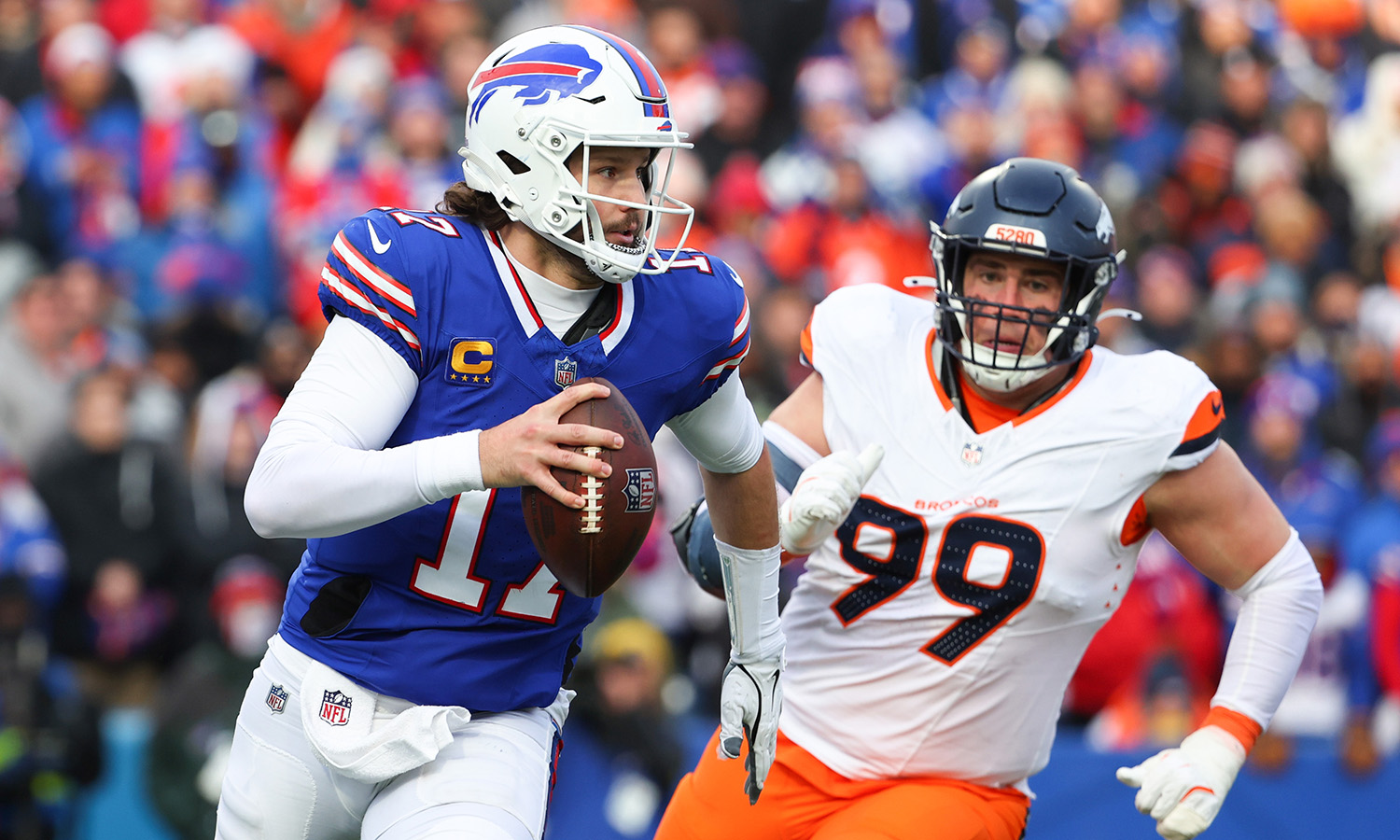
The Broncos couldn’t keep pace with the Bills 12 months ago.
Buffalo’s 31-7 wild-card beatdown of Denver last January was comprehensive, and the score didn’t reveal the scope of the demolition.
The Bills’ methodical disassembly of the Broncos was because the Broncos couldn’t sustain drives. And to be certain, Buffalo remains capable of controlling the pace, with an offense that can cause similar problems as it did last year, even though its wide-receiver corps is battling injuries.
Josh Allen just completed a season in which he posted his highest passer rating since 2020 — the COVID-19-impacted season in which NFL offensive records were shattered in part due to an absence of fans allowing teams to operate in noise-free vacuums. His completion percentage reached a career high. His performance Sunday in Jacksonville was exquisite, despite finding himself in the blue medical tent at one point in the first half.
But an equal problem last year was James Cook, the three-time Pro Bowler and second-team All-Pro who gashed the Broncos for 120 yards last year and ripped through them for 109 yards in their 2023 showdown — even though he carried the ball just 12 times that night as then-offensive coordinator Ken Dorsey stopped giving him the ball for much of the game after an early fumble. (Dorsey was fired the next day. It wasn’t a coincidence.)
Cook led the NFL in rushing this season, the Bills ranked No. 2 in rushing DVOA, EPA per run and ground success rate, and the balanced Buffalo attack had the time-of-possession advantage in 14 games during the regular season — the most in the NFL. Buffalo won on the clock again against the Jacksonville Jaguars on Sunday and improved to 12-2 over the last two seasons when holding the football for at least 33 minutes.
It’s daunting, no doubt. And some recent wobbles for the Broncos’ No. 2-ranked defense against Washington and Jacksonville prior to a closing fortnight against division foes led by backup quarterbacks Chris Oladokun and Trey Lance offers cause for concern.
But there’s a massive difference for the Broncos this time around.
Their offense can control the clock, too.
BRONCOS HAVE FOUND THE EXTRA CLUBS IN THEIR BAG
Through the end of November, the Broncos had lost the time-of-possession statistic in 27 of 47 games during Sean Payton’s tenure as Broncos head coach. Since then, they’ve won it in four of the last five — including two in which they held the football for at least 39 minutes.
Aside from the 2024-regular-season-ending game against the Chiefs’ backups, the Broncos had only held the football for that long once in the last nine seasons — in a Nov. 7, 2021 win at Dallas, when they took a 30-0 lead before coasting to the finish of a 30-16 win.
Capitalizing off soft zone coverages from the Las Vegas Raiders and Kansas City Chiefs in particular, the Broncos settled in for laborious, balanced drives and found another way to win. Over the last five games, they cobbled together seven possessions that drained at least eight minutes from the clock.
In the previous 47 games of the Sean Payton era, they had just four possessions lasting at least eight minutes.
It’s a similar story when it comes to the total number of plays in a series. Of the 13 possessions in the Payton era to last at least 14 offensive plays (not including a field-goal attempt at the end of the series), seven have come in the last five games.
“I think it makes it really difficult because we can get in heavy [personnel] and we can run the ball and we can throw it out of that. We can do a lot of play-action passes and stuff that have been successful. We can get in 11 [personnel] and run the football and spread you out and throw the ball,” right tackle McGlinchey said late in the regular season.
“Obviously, Bo does a great job, and I think we throw it more than anybody. So it’s been a great year being able to find ways to win, find ways to be successful offensively in each game.”
Last January at Highmark Stadium, the Broncos couldn’t counter Buffalo’s clock-chewing drives with lengthy possessions of their own.
Following Troy Franklin’s 43-yard touchdown catch from Bo Nix on the Broncos’ opening series, three of their next five possessions went three-and-out. Another would have ended in a single first down had it not been resuscitated by a successful fake punt; that only delayed the inevitable, as the Broncos punted four plays later. Only an eight-play sprint in the two-minute drill at the end of the first half cut through the fog of ineffectiveness.
Meanwhile, as the Broncos’ offense mustered just one first down and 25 net yards from those four drives outside of the two-minute scenario, Buffalo’s offense AVERAGED 62 yards a possession and racked up 16 first downs. The Bills held the ball for 24 minutes and 42 seconds; Denver’s time of possession on those four series was just nine minutes and 17 seconds. Buffalo turned the game into a runaway.
Denver’s offseason moves primarily focused on a defense that Allen, Cook and Co. gashed to rack up a time-of-possession discrepancy not absorbed by the Broncos in a game since at least 1983 — which is as far back as the time-of-possession single-game data at Pro Football Reference goes.
But the offense’s inability to sustain drives was equally responsible last year. That won’t happen again, because these Broncos found another way to win in December.
“Sean says it all the time: There’s a way to win each game, and, you don’t have to rely on one way to do it,” McGlinchey said. “And I think that becomes advantageous — especially late in the year.”
Last January, the Broncos weren’t capable of playing the kind of game that could allow them to keep pace with these Bills.
Now, they are. That makes them ready for this rematch.