
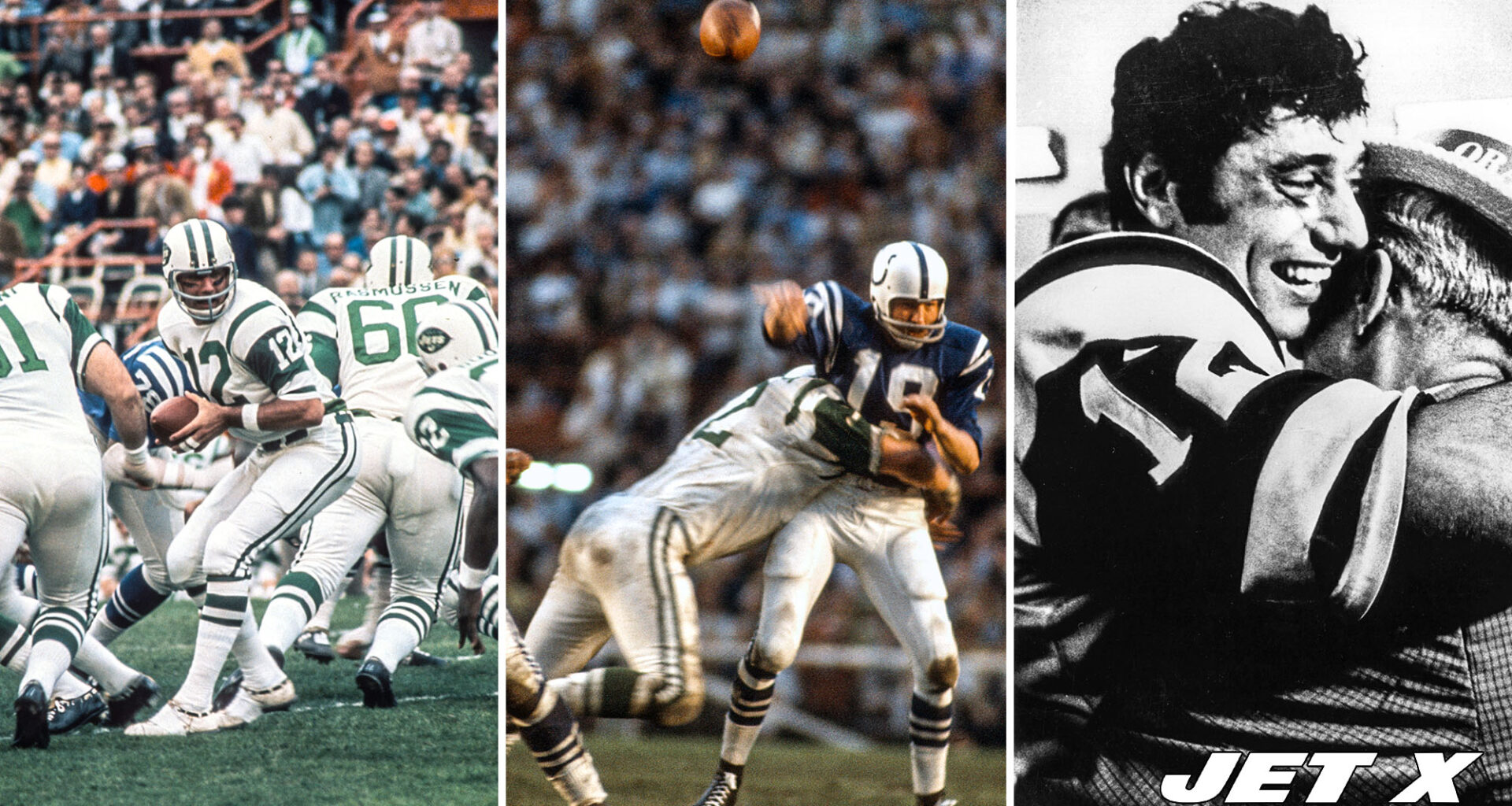
For those who are old enough to remember Jan. 12, 1969, you already know what this day represents. It was this particular Sunday that hosted the New York Jets’ lone top-of-the-mountain professional football moment.
Quarterback Joe Namath led the Jets to what remains arguably the greatest upset in sports history, in a 16-7 victory over the Baltimore Colts in Super Bowl 3.
Yes, ladies and gentlemen, the famed date happened an incredible 57 years ago on this very day. (And no, despite claims to the contrary, I am, indeed, not old enough to have remembered this one — in spite of the clear color of the hair on my head.)
This time around, Jan. 12 takes place on a wild-card Monday, one set to host the final Round 1 game of this year’s tournament: Aaron Rodgers’s Pittsburgh Steelers hosting Derek Stingley Jr.’s Houston Texans.
Not only is it remarkable to realize just how significant the evolution of professional football has been since then — which continues to push the date of the Super Bowl later in February — but fans all owe the Jets organization a debt of gratitude for the sport’s overall health.
Remember, when Namath guaranteed victory against the mighty Colts, as an 18-point underdog, American Football was nowhere near the machine it is today. Baseball was still king, despite the New York Yankees finally finding a rough patch during this time period, and Muhammad Ali was leading one of boxing’s golden ages.
When Weeb Ewbank’s Jets drafted Alabama’s Namath in 1965, the American Football League was only a half-decade old. Moreover, Pete Rozelle and the National Football League were hardly the powerhouse they ultimately turned into.
Super Bowl 3 changed everything
Granted, the Baltimore Colts’ 23-17 victory over the New York Giants in the 1958 NFL championship moved the needle in a major way. It marked the first overtime game in the league’s history (sudden-death, no less), and NBC’s nationwide broadcast helped kickstart the sport’s surge in popularity.
A little over a decade later, two of the faces who partook in “The Greatest Game Ever Played,” the Giants’ Don Maynard and the Colts’ Johnny Unitas, were fully immersed in the sport’s other great needle-mover: The Jets’ Super Bowl 3 victory, which shocked the football world to its senses.
Good morning! Today in 1969, Joe Namath led the NY Jets to victory over the heavily favored Colts in Super Bowl III.
Before the game, the brash Broadway Joe “guaranteed” a win. pic.twitter.com/wU0lJRUQx1
— Steve Cortes (@CortesSteve) January 12, 2026
Forget about the run-of-the-mill jaw-dropping upset; what the Jets accomplished at the Orange Bowl on Jan. 12 proved revolutionary.
For one, Namath, the bright-eyed youngster who took the sport by storm by becoming the first to throw for over 4,000 yards in a single season, became a cultural icon. At that stage in this country’s history, few (if any) were able to cross over and into the mainstream.
Alongside the aforementioned Ali, as well as professional golfer Arnold Palmer, Namath’s presence extended well beyond the football field.
More importantly, the Jets’ flabbergasting 16-7 win legitimized an entire league. Paving the way for the AFL’s legitimacy, Namath and the Jets struck the first salvo for what became the modern NFL we know and love.
After Hank Stram’s Kansas City Chiefs doubled the AFL’s success in Super Bowl 4, the NFL-AFL merger became a near-guarantee — this, after a decade of hard feelings, wisecracks, and diaper-wearing jokes.
The box score
As far as the actual game was concerned, Namath famously earned Super Bowl MVP honors despite finishing with a less-than-phenomenal stat line. His 206 yards on 17 of 28 passing (0 touchdowns, 0 interceptions) made his MVP case questionable, despite his at-the-line leadership and play-calling shining brightly in the game.
Had Namath not guaranteed the victory, many believe running back Matt Snell would have snagged the MVP. Snell rushed for 121 yards on 30 attempts (a long of 12 yards), to go along with the game’s only touchdown, a 4-yard second-quarter scamper that opened the scoring.
Namath’s quick-snap call undoubtedly helped the Jets’ off-tackle concept cross the goal line.
Leading the Jets in receiving wasn’t the Hall of Famer Maynard, who was amazingly shut out in the game (no receptions). Instead, it was George Sauer who finished with a team-high 133 yards on 8 grabs.
The unsung hero of Ewbank’s team, however, was the defense.
Led by edge Gerry Philbin, defensive tackle John Elliott, linebackers Al Atkinson and Larry Grantham, and defensive backs Jim Hudson (one interception), Bill Baird, Randy Beverly (one interception), and Johnny Sample (two interceptions), Walt Michaels’s unit (with help from Buddy Ryan) tormented league MVP Earl Morrall and head coach Don Shula all afternoon.
1/12/1969
Super Bowl III
One of the keys to victory in SB III was the @nyjets D creating turnovers. They forced 5 Colts turnovers including 4 Ints.
Here is a clip with all 4 Ints.
1. Game tied 0-0 early 2nd qtr Randy Beverly picks off Earl Morrall in the EZ
2. Jets up 7-0… pic.twitter.com/cJfljzokOd
— New York Jets History (@nyjetshistory) January 12, 2026
As great as Super Bowl 3 remains for all fans, young and old, the state of the current team is anything but. After a brutal 3-14 rookie season, head coach Aaron Glenn is set to enter his second offseason with the organization.
Hey, cheer up, New York Jets fans; it’s only been 57 years. After all, the New York Rangers’ 1994 Stanley Cup snapped a drought so disgusting that the Blue Seaters could never be convinced it was anything other than a legitimate curse.
In that particular case, the Rangers hadn’t won a title in … oh, wait a second … 54 years.
Can Mark Messier play football?