
This is precisely what Roger Goodell and the powers that be wanted when they expanded the field from 12 to 14 teams. Moving from wild-card weekend to a wilder wild-card weekend has fans falling off of and/or jumping out of the edge or base of their seat.
“Glorious” is just one way to describe the high-flying, thrilling action. “Dramatic” is yet another way to describe the events that have unfolded over the last three days.
No matter anyone’s preferred description, a heart-of-the-matter takeaway peeking its head out, just waiting to be spotted by the teams searching for answers, while gobbling down popcorn on the sofa.
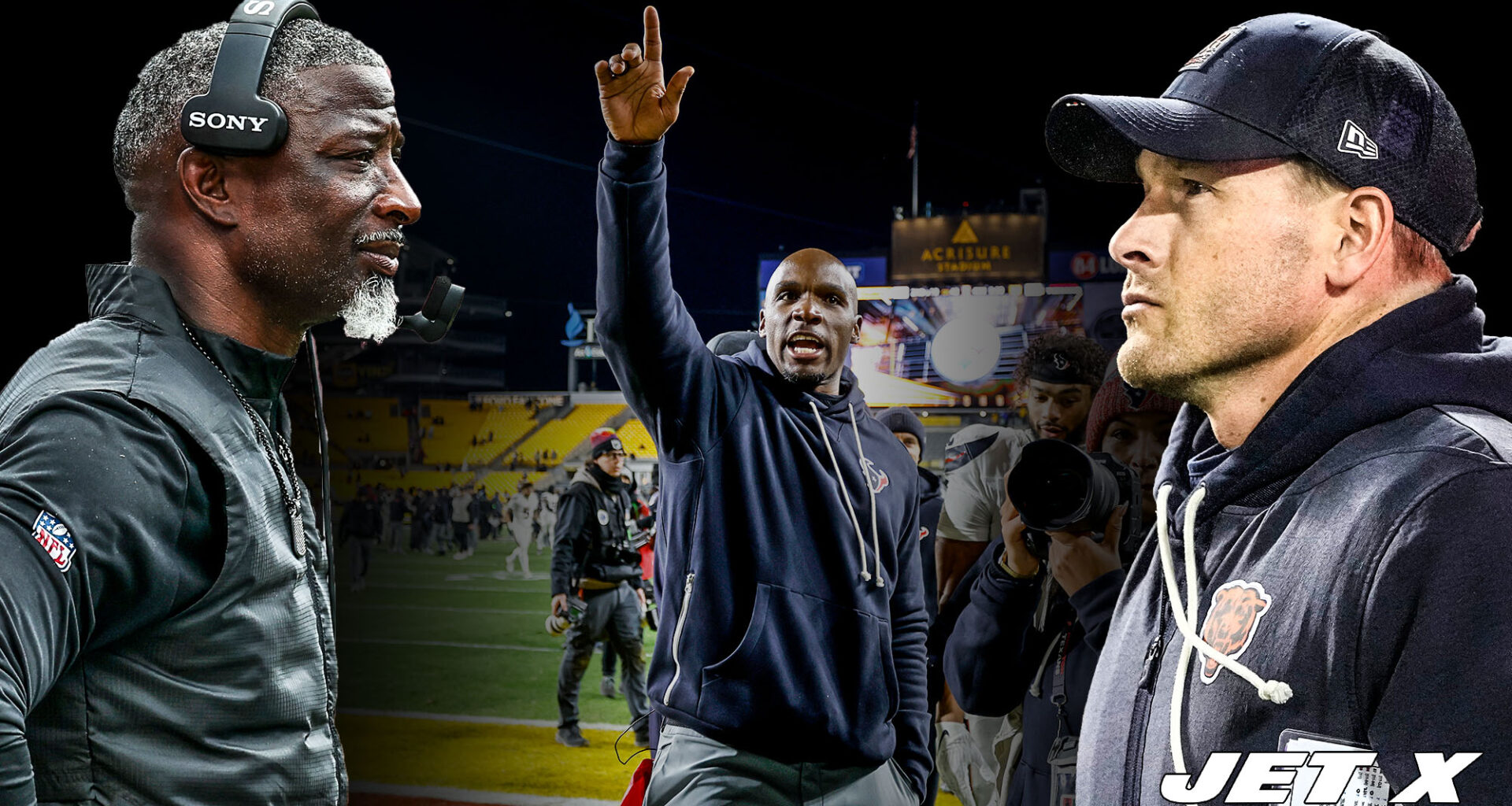
From “offensively bananas” in nut-cutting time to “slow-plotting conservatism” on the battlefield, the NFL’s wild-card round this season proved just how much a head coach’s vision matters.
Hopefully, Aaron Glenn and the New York Jets grasp this notion with full clarity.
Offensively bananas
Saturday started the tournament with a bang. Despite the Dave Canales-led Carolina Panthers’ valiant effort, Sean McVay’s Los Angeles Rams did their usual high-flying offensive thing. A picture-perfect Matthew Stafford pass, resulting in a Colby Parkinson touchdown, was good enough for a late-game 34-31 victory.
Next, Ben Johnson’s Chicego Bears overcame an 18-point lead by upending Matt LaFleur’s Green Bay Packers in stunning fashion. Johnson, a man renowned for his “staying ahead of the offensive curve,” failed on three of his four fourth-down attempts in the first half, one of which came in the form of a fourth-and-5 on their own 32-yard line.
As outrageous as that desperation move was, he still won the game — which should be considered even more appalling.
Hey, guess what? That’s where the game is these days. He knew his defense couldn’t stop a nosebleed, knew LaFleur’s offense was rolling, and decided to give Green Bay a shorter field, which took less time off the clock.
Josh Allen’s Buffalo Bills also came away with a fourth-quarter thriller of a victory. The ping-ponging of leads in this one was historic, and the Bills knocked off Liam Coen’s Jacksonville Jaguars.
Not even one of the more celebrated defenses this year, in the Philadelphia Eagles, could stop the San Francisco 49ers offense when they needed to most. Despite doing everything in his power to lose the game for his team — throwing two ugly interceptions — Brock Purdy engineered a late-game drive that dethroned the champs.
For NFL teams whose top-of-mind vision is led by offense, particularly quarterback efficiency, a game’s flow usually plays out this way:
The “in-structure” phase (three-plus quarters): Offensive play-calling that fits more of a safe route, yet still has its moments where chances are taken.
The “offensively bananas” phase (the back-half of the fourth quarter, or sometimes even the entire fourth quarter): Offensive play-calling that throws caution to the wind, which encourages quarterbacks to play ball.
The game flow particularly follows this pattern when two quarterback-driven head coaches are matched up against each other, i.e., McVay vs. Canales, Johnson vs. LaFleur, Shanahan vs. Sirianni, or even Coen vs. McDermott, the latter of whom has the best quarterback in the sport.
What happens when a contrasting mindset is steering the ship?
Slow-plotting conservatism
As nutty as the first three (or four) games were this past weekend, the final two games of the round contrasted that tone.
First, Mike Vrabel’s New England Patriots smothered Jim Harbaugh’s out-gunned Los Angeles Chargers team, 16-3. While many traditionalists loved the throwback feel of the game, many of those same individuals understood what had happened…
The Bolts’ offensive line just didn’t know which way was up.
Kudos to Harbaugh for even having that squad in the playoffs. Nevertheless, Vrabel’s defense limited Justin Herbert and company to just 207 yards of offense.
The weekend capper featured, by far, the most dominant defensive performance. DeMeco Ryan’s Houston Texans overwhelmed Mike Tomlin and Aaron Rodgers’s Pittsburgh Steelers.
They didn’t have a shot from the get-go.
Houston’s front four dominated the Steelers’ offensive line. While Rodgers’s quick-release ability could be viewed as positive, Pittsburgh’s weapons had little ability to separate downfield, and the Texans created a situation in which there was little time to do so (via the pass-rush).
The 30-6 final was hardly indicative of what played out on the field. Houston clung to a 7-6 lead early in the fourth quarter. Houston’s 23-point fourth-quarter outburst was hardly a product of the “offensively bananas” phase, either; instead, it dealt more with Pittsburgh’s desperation.
Vrabel vs. Harbaugh (offensive-minded, though playing to his defensive strength due to his offensive line’s status) and Ryans vs. Tomlin speak for the other side of this new-age NFL.
Yes, it contrasts greatly, but what does that tell us?
The head coach’s overall mindset and top-level vision for the football team are crucial. It always begins there.
What it means for the Jets
For Aaron Glenn and company, before personnel and coaching changes are even a thought, a baseline understanding must occur: What is this team’s vision?
Last offseason, it was evident: Glenn wanted a tough, violent, physical team that could run the ball and impose its will at any point. That’s why he pointed the finger at Justin Fields and drafted roadgrater Armand Membou.
Beyond that, how does Glenn envision weekly game plans unfolding? Will it always showcase his rushing attack and physical defense (that loves to press and play man coverage), or will it be more versatile depending upon the situation?
When he’s facing a defensive-minded head coach, that slower-plotting game flow can surely commence. However, how does that work when taking on a team like the Jaguars, for instance? How would it look against the Rams or Bears?
Asking a head coach to change his core philosophies is a near-impossible ask. Let’s be honest; that’s just the nature of football coaching.
Core philosophies are one thing; understanding the rules of engagement is a completely different matter.
Wanting a physical rushing attack is admirable and not incorrect. Chicago showcases one. The route to finding that success is the rub here.
Ben Johnson didn’t force it down the throats of his roster and opponents. He instead allowed it to grow organically. Remember, Chicago didn’t come out of the gates rushing the ball well. They instead funneled it through the lens of quarterback efficiency first.
Mike Vrabel’s slower-plotting game feel can certainly occur — as we just witnessed — but it won’t always play out in that vein. He must have his offense neatly fitting through the quarterback efficiency gospel, first and foremost — which is surely the case in Josh McDaniels’s corner of the football world.
Simply put, it’s much more difficult to play great defense as opposed to great offense in today’s NFL. As much as I’ll be rooting for the defense in these playoffs, if recent history is any indication, the offensively driven head-coaching minds will come out on top for the rest of the way.
Interestingly, next up for Vrabel is Ryans, for whom a semi-defensive-minded head-coaching bracket of this tournament has shown face. How the winner fares against the Broncos or Bills will be interesting.
If either gets through to the Super Bowl, it’ll be doubly interesting in the Super Bowl.
For Jets fans, the hopeful template for your team is the Houston Texans. For Glenn, however, it cannot stop there. The idea that these games play out so differently, depending upon which head coaches are involved, is impossible to overlook.
At the end of the day, Aaron Glenn’s mindset means everything for the New York Jets.