
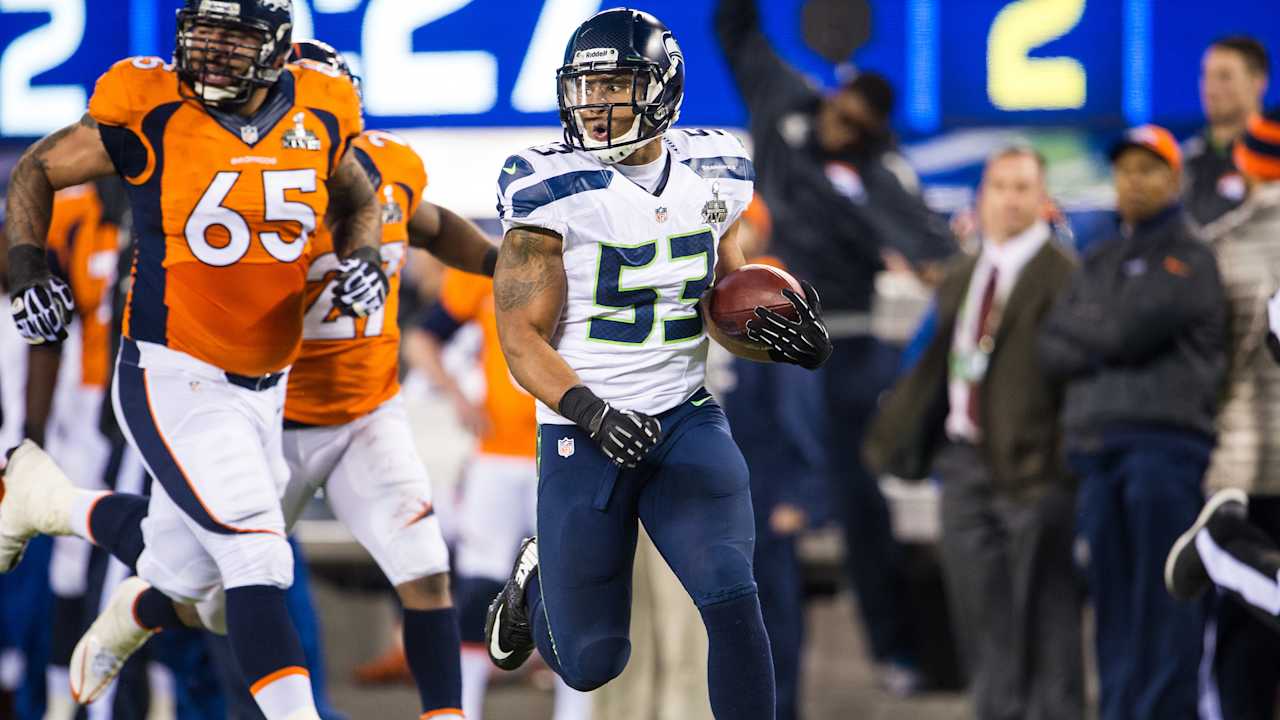
In the continuing celebration of 50 years of Seahawks football and the team’s return to the playoffs, Seahawks.com is highlighting the 12 of the greatest playoff games in franchise history. Take a memorable trip into the Seahawks’ playoff time machine, with unforgettable victories as far back as 1983. We feature many playoff standouts from the team’s postseason chronicles, from Steve Largent, Curt Warner and John Harris to Jordan Babineaux, Marshawn Lynch, Kam Chancellor, Richard Sherman and Jermaine Kearse.
Super Bowl XLVIII: Seahawks 43, Broncos 8: The greatest single game team performance in franchise history was also possibly the most dominant single-game defensive display in the history of the Super Bowl itself. That especially rings true when you consider that the Seahawks only allowed a garbage-time TD to a record-setting offense that was one of the most potent of all time entering the game.
With a healthy number of 12s in the stands at New Jersey’s MetLife Stadium, the tone of the game was set immediately with a safety on the very first play for the Hawks’ first score. Kam Chancellor then left no doubt that the day belonged to the Seahawks defense. In the first quarter, he delivered a bone-rattling hit on Denver wide receiver Demaryius Thomas that sent a clear message on which team was going to own the turf.
In the second quarter, Marshawn Lynch registered the first-ever touchdown run in Seahawks Super Bowl history, scoring from the one-yard line. Later in the quarter, the defensive front sandwiched Peyton Manning and his pass was intercepted by Super Bowl MVP Malcolm Smith and returned 69 yards for a TD.
When Percy Harvin took the opening kickoff of the second half for an electric 87-yard touchdown, it was clear at 22-0 that the Seahawks were well on their way to earning their first Vince Lombardi Trophy. Russell Wilson later added two TD passes, one to Jermaine Kearse in which he spun around defenders and busted loose, and another to Doug Baldwin.
Chancellor also intercepted a pass as the “Legion of Boom” etched its name in Super Bowl history and officially took its rightful place among the greatest defensive units of all time.
2013 NFC Championship Game: Seahawks 23, 49ers 17 – The Seahawks earned their second Super Bowl trip, with Richard Sherman and Russell Wilson sewing up the win in the fourth quarter. On the final play of San Francisco’s last offensive possession, Sherman authored what has simply become “The Tip,” a reference to one of the most legendary moments in Seattle sports history.
One of the truly elite cornerbacks of the decade tipped Colin Kaepernick’s ill-fated final pass, which was intended for Michael Crabtree, to Malcolm Smith in the end zone for an interception that ended the game and set off a memorable celebration with the 12s. Sherman then provided what may be the most spectacular postgame interview ever.
Wilson had moved the Seahawks into the lead for good with a 35-yard fourth quarter TD pass on fourth down to Jermaine Kearse, who will always be revered for his multiple big-play moments during the Seahawks’ consecutive Super Bowl runs.
After Wilson threw the TD pass on a free play where the defense jumped offsides, Kam Chancellor’s interception set up a Steven Hauschka field goal for the final points of the game. Doug Baldwin’s 69-yard kickoff return set up another field goal, and Marshawn Lynch, who always seemed to shine brightly under the postseason spotlight, ripped the Niners’ defense with a 40-yard TD run for the first Seahawks TD of the game.
2014 NFC Championship Game: Seahawks 28, Packers 22 (OT): For the second consecutive season, Russell Wilson threw a 35-yard TD pass to Jermaine Kearse for a decisive score. This one was a game-winner in overtime and secured a second straight NFC Championship and the third in team history.
Wilson overcame four interceptions and five sacks to deliver the game-winning drive on the first possession of overtime. The final TD pass was preceded by another 35-yard pass, to Doug Baldwin. The Seahawks produced the most memorable comeback in franchise history, with the defense doing its part all along. Green Bay was held to six second-half points.
After the Packers moved out to a 16-0 halftime lead, the dramatic resurgence began with 19-yard TD pass on a fake field goal from punter Jon Ryan to tackle eligible Garry Gilliam. Wilson then added a one-yard TD run, set up by 44 scrimmage yards from Lynch on the drive. Then, the story of the biggest comeback in NFL conference title game history turned magical.
With the Seahawks trailing at 2:09 of the fourth quarter, a hero of the 2014 postseason, Chris Matthews, recovered an onside kick. At 1:25 of the fourth quarter, Lynch raced for a 24-yard TD run to set up one of the most improbable two-point conversions in Seahawks lore. On a broken play, Wilson maneuvered near the right sideline, and tossed a high, looping pass to Luke Willson near the left side of the end zone for the most stunning two-point conversion you may ever see.
After a Packers field goal sent the game to overtime, the Seahawks claimed their second straight George Halas trophy, as Wilson threw a game-winning TD pass in a second consecutive NFC Championship Game. Lynch rushed for 157 yards and Baldwin caught six passes for 106 yards. Richard Sherman intercepted a pass and worked through a left arm injury, and Byron Maxwell’s interception prevented Green Bay from building on their 16-point second quarter lead.
2005 NFC Championship Game: Seahawks 34, Panthers 14: The result of the Seahawks’ first conference title game victory never seemed to be in doubt, as they scored the first 17 points of the game in front of a frenzied and hungry home crowd. The first of Shaun Alexander’s two TD runs bumped the cushion to 17-0, and his second TD run put a final wrap on the win at 34-7 in the fourth quarter.
Alexander, the 2005 NFL MVP, rushed for 132 yards, and Matt Hasselbeck passed for 219 yards, two TDs and no interceptions as the Seahawks rolled to their first-ever Super Bowl appearance. Darrell Jackson and Jerramy Stevens each caught one TD pass. The defense forced four turnovers, including interceptions by Lofa Tatupu, Marquand Manuel and Michael Boulware, and a Craig Terrill forced fumble that was recovered by Marcus Trufant.