
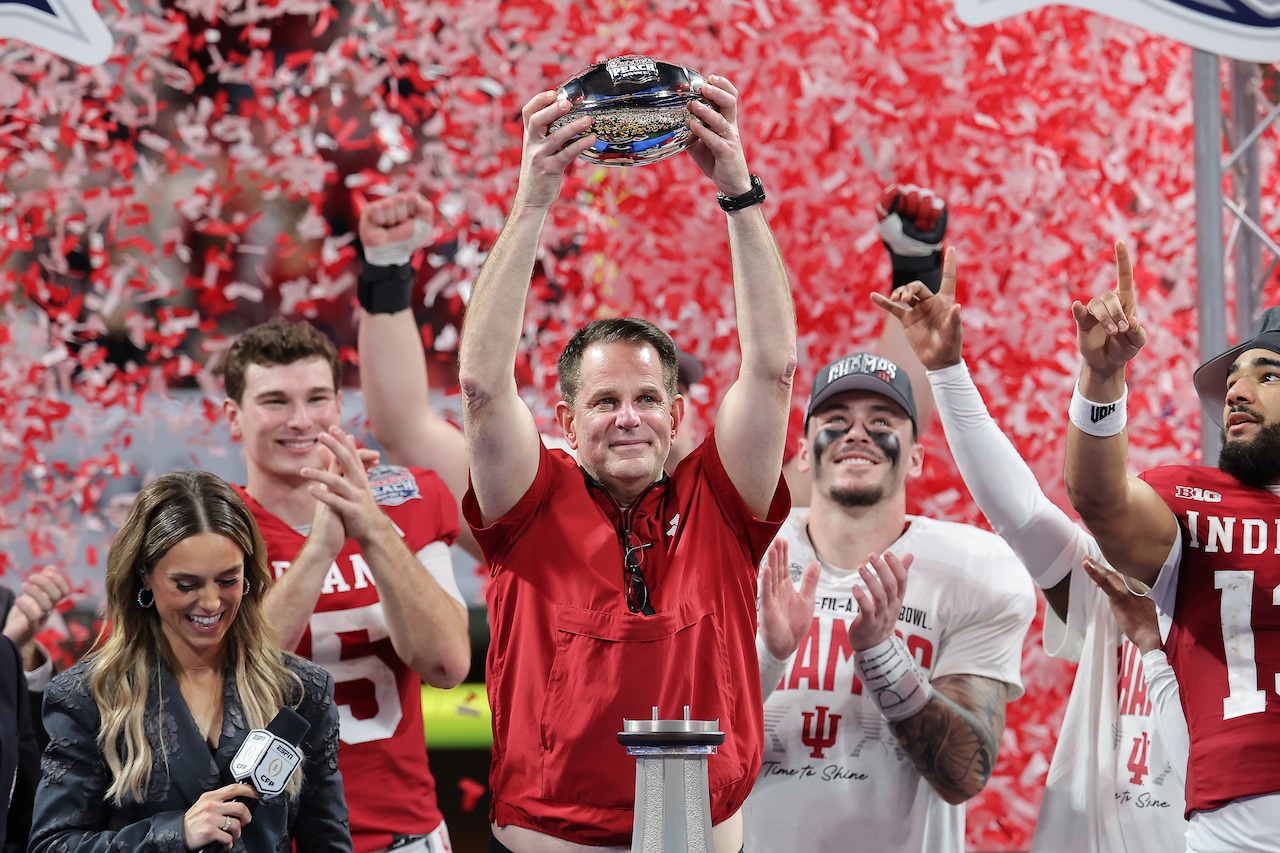
COLUMBUS, Ohio — Curt Cignetti just spent 26 months pulling off the impossible.
On Nov. 30, 2023, Indiana hired a man in his early 60s whose experience as an FBS head coach was limited to two seasons at James Madison, which had only recently made the jump from the FCS level.
He was tasked with taking a doormat of a football program with an all-time win percentage of 40.2% and making it respectable. But he wasn’t looking for respectability.
Cignetti didn’t look at the Hoosiers and see a dead end. He saw potential. All it needed was the right guy in charge with a vision that would galvanize a fan base, the alumni and their boosters. Just like that, you’d have a contender.
Two years in and he’s proven to be a prophet. He showed up at the right time as college football was changing, whether it be the transfer portal, NIL conference expansion, or even the College Football Playoff moving from four to 12 teams. Mix that with a favorable 2024 schedule where Indiana’s only losses were on the road to Ohio State and Notre Dame — also known as the teams playing in the national title game — and suddenly, he had everybody’s attention.
Then he followed up by using the 2025 season to prove what happened in Year 1 wasn’t a fluke, but a sign of change. Now he’s one win away from punctuating what might be the most impressive coaching job ever seen in major American sports when Indiana faces Miami in the College Football Playoff National Championship Game on Monday night.
How did a guy who made his name coaching at the FCS level take over major college football so fast?
More importantly, what can the Buckeyes and everyone else do to retaliate?
‘Get old and stay old’
When Cignetti set out to build his roster for the 2024 and 2025 seasons, he didn’t do so with recruiting stars. He did so with experience.
The Hoosiers took 23 transfers in the 2025 class, many of whom were experienced college players even before they stepped foot on campus in Bloomington. In adding veterans, Indiana became experienced on both sides of the ball, and at the most important positions.
Mendoza, who turned 22 years old in October, had played 1,303 career snaps and thrown 629 passes at Cal before joining Indiana, per Pro Football Focus. Cignetti did the same thing at quarterback the year prior, when he took former Ohio quarterback Kurtis Rourke – a 2019 enrollee with the Bobcats – to lead the way in 2024.
Running back Roman Hemby, 23, is in his fifth-year of college football. Prior to this season, he’d had 1,692 total snaps at Maryland. The same is true for Indiana’s two leading receivers – Omar Cooper Jr. and Elijah Sarratt – who are both 22 years old and have played multiple seasons of college football before.
At both lines of scrimmage, the Hoosiers are older and experienced. Center Pat Coogan, a transfer from Notre Dame, is 23. He played 813 snaps on an Irish team that went to the national title game a season ago. He’s the anchor of a line that is homegrown at every other position, and one that has five starters with at least 1,200 snaps played headed into the title game against Miami. Three of them (tackle Carter Smith, tackle Kahlil Benson and Coogan) have played more than 2,000 collegiate snaps.
Indiana’s top cornerback, D’Angelo Ponds, is relatively inexperienced considering the players he plays with – and he’s been a two-year starter at Indiana, and started in his freshman season at James Madison in 2023. Defensive end Mikhail Kamara was another player who followed Cignetti from the Dukes. The member of the 2020 class has been a mainstay on that line when healthy.
The Hoosiers are, certainly, one of the best coached teams in the sport, aided by the fact that there aren’t many “freshman mistakes” to be had on a roster that doesn’t rely on young players in load-bearing positions. Indiana is fifth in the nation in fewest penalties per game (3.7) and despite having played in 15 games thus far, is still tied for third in the nation with just eight turnovers lost.
While other programs have certainly held the same belief over the years about experience and age – Michigan and Ohio State in 2023 and 2024, the last two national champions, were both extremely veteran teams – Indiana has done so at a level that has been remarkable to observe.
Many key players on the roster were transfers from other, lower-level programs. But their age and experience have certainly proved more valuable than recruiting stars.
Because, for Cignetti and his coaching staff, potential isn’t something that wins games.
‘Production over potential’
College football is all about talent, and that will never change. But the description of that talent and how you go about getting it is changing. That is something Cignetti discovered early and explains his approach to roster construction.
The team with the best players wins in this sport. For a long time, that meant recruiting as much high school talent as possible and developing it. That created a “have‘s and have not’s” in the sport where teams like the Buckeyes, Alabama, Texas and other bluebloods could stockpile every five-star and highly rated four-star while leaving the rest to fight over the scraps.
The transfer portal and NIL changed that. Those two factors let more people into the dinner party. When you live in a world where everyone’s got talent, then you have to find a way to separate yourself.
“I’m into production over potential,” Cignetti said in an interview with Adam Breneman. “I learned that a long time ago.”
When you can stockpile talent, you can afford to rely solely on potential. It’s like hitting the lottery, where the more tickets you have, the more likely you are to hit. The less you have, the more calculated you have to be. You can’t just operate anymore on the idea that a player might one day be good. Even on his way out the door, former OSU coach and now South Florida head coach Brian Hartline started to figure that out.
“It’s not that you can’t do it with development, it’s just development takes time sometimes,” Hartline said before the Cotton Bowl. “I know you might be good in 24 months, but we need a guy this year. You have to find an immediate fix versus relying on maybe their time to develop.”
Cignetti isn’t waiting on anyone. He’d rather have a guy who’s proven capable of doing the job he needs him to do rather than someone who might be able to do it because his natural traits say he could one day do it.
For two years, he’s used that approach to build Indiana rosters that’ve gone 26-2 and 17-1 in Big Ten play and haven’t lost in over a full calendar year.
His approach is almost NFL-like, where development comes second to what a player can do for you right now.
It’s not just about having veterans who’ve been around college football for a long time. It’s getting veterans who’ve proven they can play high-level football. You can no longer invest the time nor finances in an idea.
Stars and talent still matter. Cignetti just isn’t referring to high school recruiting when he talks about those factors.
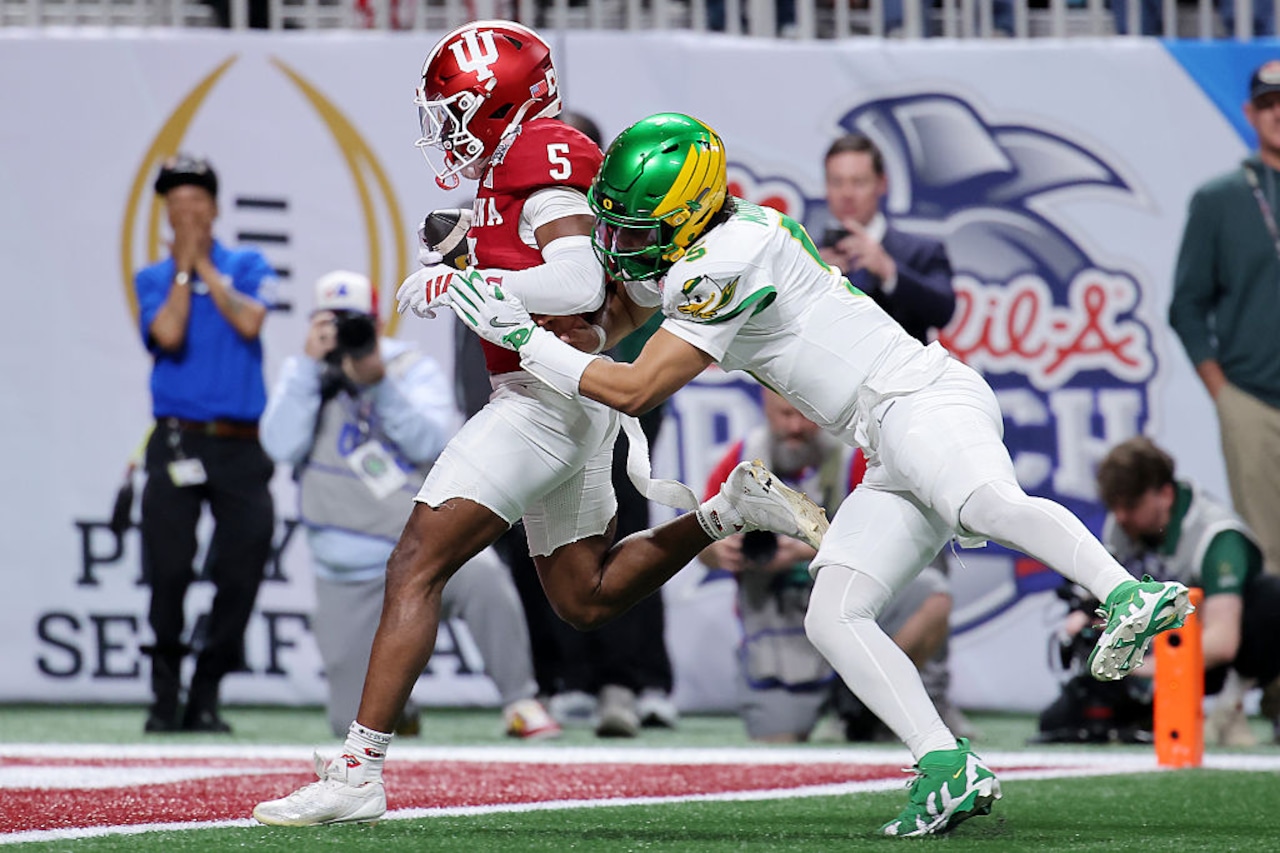 D’Angelo Ponds of the Indiana Hoosiers scores a touchdown on an interception against Dante Moore of the Oregon Ducks during the first quarter in the 2025 College Football Playoff Semifinal at the Chick-fil-A Peach Bowl at Mercedes-Benz Stadium on January 09, 2026 in Atlanta, Georgia.Getty Images‘Show me the money’
Tom Allen’s statement, following his firing as Indiana football coach in November 2023, included language telling of changes the Hoosiers needed to make for his successor.
“College football has changed dramatically over the past several years,” he said. “Some of those changes have been a shock to the conscience of those who support IU football. The time has come to fully embrace those changes and I pray that IU does just that.”
The Indiana faithful came through, helping bolster financial support for the program.
Allen’s firing came with a $20.8 million buyout, though the two sides agreed to work the terms down to $15.5 million with the money provided across two installments. The buyout was paid through athletic department donor funds.
IU was also able to promise its next coach, which turned out to be Cignetti, a strong starting point in the name, image and likeness market. A baseline of $3 million in NIL was guaranteed, which was viewed then as a “competitive working figure,” according to a report from the IndyStar.
There was also hope that with enthusiasm from the fanbase, the figure could grow. Cignetti helped deliver, invigorating Hoosiers with his bold statements and memorable one-liners shortly after his hiring.
“It’s pretty simple,” he once said, “I win. Google me.”
Cignetti also helped send a message across the collegiate sports landscape. With proper investment, even the worst football programs could become competitive.
IU’s stunning rise during the 2024 season furthered that point, and Indiana has only continued to invest in Cignetti.
He received a contract extension after his first season, giving him an eight-year deal worth $72 million. During the 2025 season, he was again given a new eight-year deal with an annual compensation of approximately $11.6 million. At the time, only Day and Georgia’s Kirby Smart were slated to make more.
With investment in Cignetti came impressive financial promises to those around him.
IU defensive coordinator Bryant Haines has worked with Cignetti for the better part of the last 12 years. His side of the ball has been stellar since arriving at Indiana, making him a popular head coaching candidate. Instead, he signed a new deal with Indiana worth about $3 million annually, making him one of the nation’s highest-paid assistants.
The Hoosiers also gave offensive coordinator Mike Shanahan a new deal worth nearly $2 million annually.
Many have noticed how Indiana, which is often regarded as a basketball school, has bought into football – even those now watching from afar.
“Just really happy that they’ve chosen to invest in football,” Allen said last month when asked about IU’s success. “That’s something they knew they needed to do – said that when I left. They had not done that in the past at a level that was necessary. And it’s been awesome to see them recognize that and invest and be able to see them be rewarded for that.”
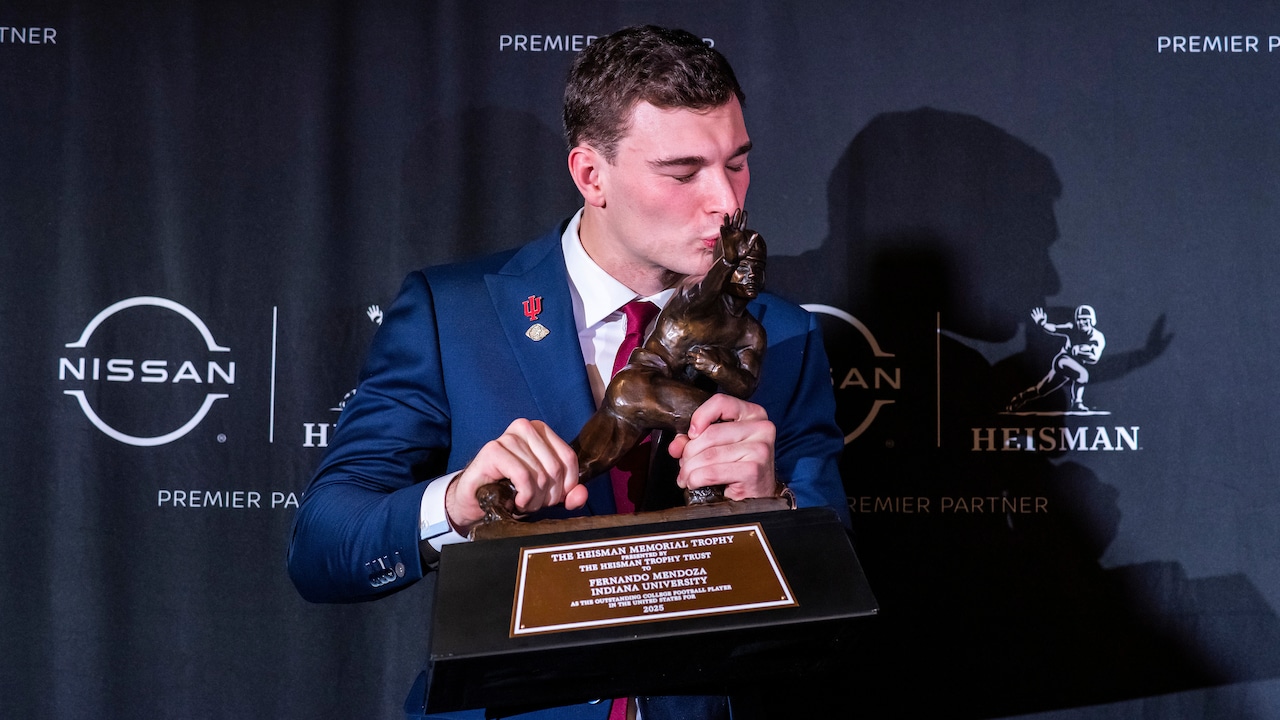 Indiana quarterback Fernando Mendoza kisses the Heisman Trophy.APFundamentals and execution
When coaches talk about a team being well coached, we are not talking about hype, emotion, or social media clips. We are talking about discipline, preparation, and consistency.
The Hoosiers play clean football and rarely beats themselves. They finish drives and control the details that impact the outcome of games. The difference shows up in two areas: fundamentals and execution. Fundamentals prevent self-inflicted mistakes, and execution allows you to put pressure on the opponent.
Fundamentals
Indiana’s foundation for winning starts with discipline. Over a 15-game season, they were flagged 55 times for 403 yards. That averages out to 3.7 penalties for 26.9 yards per game, which is ranked second in the country.
That tells you they line up correctly, communicate clearly, and understand the situation on every snap. There are no wasted plays and no free yards when you play the Hoosiers. Good football starts before the ball is snapped, and Indiana consistently wins that part of the game. When you stay on schedule, you give your offense a chance to operate and your defense a chance to dictate.
The Hoosiers take care of the football and finished the season with 29 takeaways and only eight giveaways, giving them a plus-21 turnover margin. They had 18 interceptions and recovered 11 fumbles. They only lost one fumble all year and that does not happen by accident. That comes from daily emphasis on ball security, two-hands-on contact, proper tackling angles, and attacking the football on defense. Turnovers swing games. the Hoosiers make them swing in their favor. When you win the turnover battle, you control possessions, field position, and momentum.
Indiana scored on 67 of 73 red zone trips, a 91.78% conversion rate, with 54 of those scores being touchdowns. When space gets tight, details matter, blocking angles matter, route spacing matters and quarterback decision-making matters. The Hoosiers execute those details and do not waste scoring opportunities. When they get inside the 20-yard line, they come away with points. That is the difference between good teams and great teams.
Indiana’s fundamentals show up when it matters. On the play below, D’Angelo Ponds plays the corner position with incredible technique. He keeps outside leverage and keeps both the receiver and the quarterback in his vision. The quarterback’s drop and the receiver’s route tell the story, and Ponds trusts what he sees. He drives on the throw and takes it back 25 yards for a pick-six.
Indiana’s fundamentals show up on film.
D’Angelo Ponds keeps outside leverage, reads the quarterback’s drop and the receiver’s route, and jumps it for a 25-yard pick six.
Technique. Discipline. Execution.#Hoosiers pic.twitter.com/Qv9P4qR9fd
— Lance Reisland (Coach Riz) (@LanceReisland) January 15, 2026
Execution
Execution is taking those fundamentals and applying them under pressure on game day. Indiana does not just practice the right way, it carries its practice habits to the field. Low penalties combined with elite turnover margins mean the Hoosiers win the hidden yardage battle every week. They do not give opponents short fields and do not extend drives with mistakes. When the other team slips, Indiana takes full advantage.
Defensively, Indiana consistently gets off the field in crucial third-down situations. Opponents converted just 31.49% of their third-down attempts. That means Indiana lines up correctly, communicates coverages, fits the run, and rushes the passer with discipline. Third down is where games are won and Indiana does just that. When you force punts, you control tempo, field position, and momentum. That allows your offense to play with rhythm and confidence.
On both sides of the ball, the Hoosiers control games. They averaged 42.6 points per game and allowed only 11.1. Offensively, they gained 461 yards per game. Defensively, they gave up just 260.9. Those numbers show they are dictating games and are in control all four quarters. That comes from players knowing their assignments and executing the game plan. Everyone understands their role and stars in whatever that role may be.
This is not about flashy schemes, it is about preparation, accountability, and detail. Cignetti built a program based on those principles. His teams are disciplined and they protect the football. They execute in critical moments and players know what is expected of them. This relentless attention to detail culture shows up every Saturday in how Indiana plays the game.
Look at the execution of these two plays below. Down 10–6, Mendoza throws a perfect back shoulder fade for a touchdown. Later, on third-and-6 with under three minutes left, he drops a dime down the sideline to finish it.
Two favorite throws from the Big Ten Championship.
Down 10–6, Mendoza throws an elite back shoulder fade for a TD. Timing, trust, ball placement. That’s one of his specialties.
Then the throw of the game.
3rd & 6. Under 3 minutes. Absolute dime down the sideline to end it.… pic.twitter.com/jExKXpyzED
— Lance Reisland (Coach Riz) (@LanceReisland) December 17, 2025 What’s next?
Indiana’s run is almost Cinderella-like.
The program is the young damsel withering away in squalor at the hands of his evil stepmother and stepsisters, with no hope of being anything more than a nobody. Then comes along a fairy godmother otherwise known as Curt Cignetti, who, with a simple wave of a wand, provides you with the most wonderful night of your life.
Only this time, there’s no warning that you have to leave the castle at midnight or risk being exposed. There is no losing your glass slipper and needing Prince Charming to come save you later in the story by making sure your foot is the perfect fit for the shoe.
Every move Cignetti has made so far this offseason, whether it be the 17 players he’s added in the transfer portal, giving him the nation’s No. 2 class — according to On3 — or the intrigue he’s built that is now affording him the proper investment to keep this train going, suggests the magic isn’t running out at midnight.
Phase 1 was using every advantage this new college football landscape provides to execute the fastest possible turnaround. The only thing left to do now is to beat Miami and punctuate these 24 months with a gold trophy.
Phase 2 is taking that foundation and building something sustainable. And that plan is already in motion.