
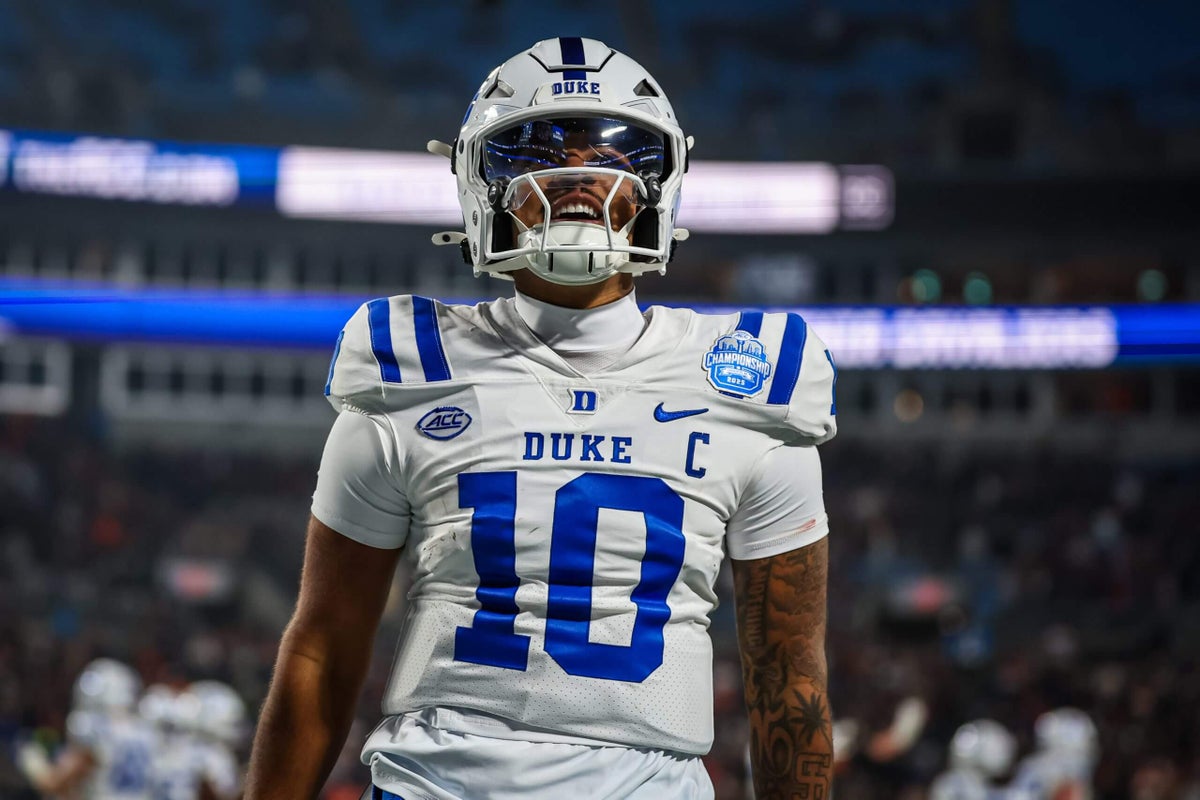
Less than a month ago, Duke quarterback Darian Mensah recorded a video to announce his return to the Blue Devils for the 2026 season.
The video, which he posted on his Instagram account, took a page from LeBron James’ “The Decision” in 2010, when Mensah said toward the end, “And with that, I decided to take my talents …”
Instead of announcing his next destination, Mensah playfully cut himself off: “Nah, I’m just playing, let’s run this back.”
It would have been more accurate if the video — which was present Friday afternoon but no longer appears on his page — ended the way James’ did back in 2010, announcing his departure. On Friday, Mensah announced that he is indeed heading to the transfer portal, hours before it’s set to close.
Darian Mensah has entered the transfer portal with Miami as the heavy favorite
Here is Mensah making a LeBron type Decision in which he announced a return to Duke… one month ago
— Unnecessary Roughness (@UnnecRoughness) January 16, 2026
Mensah is leaving despite having signed a two-year contract when he arrived at Duke a year ago, when the Blue Devils committed to making him one of, if not the, highest-paid quarterback at the time, with annual compensation of more than $3 million that could stretch to $4 million with incentives. His move Friday was a shocker.
The reaction from all corners of the sport is what you’d expect: anger, disappointment, outrage, finger wagging at Mensah and lamentation of the state of college football. Mensah’s now leaving Duke without a starting quarterback and with virtually no time to find a comparable replacement, since most of the top transfer quarterbacks have already signed elsewhere.
Those perspectives aren’t wrong. But Mensah is simply following the example set for him by college football leaders, who have been doing the same for decades: looking out for themselves rather than the greater good.
Mensah made a business decision. Nothing he did, that we know of, is against the rules, and he notified Duke roughly eight hours before the required deadline to do so. But his decision didn’t happen in a vacuum. If a player of his caliber is leaving a stable situation voluntarily, it’s because somebody else wants him and is willing to give him more money than his current school.
It turns out that somebody is likely one of Duke’s conference rivals: Miami. The Hurricanes have been in the transfer quarterback market this month but struck out on other options they explored, such as Arizona State’s Sam Leavitt (now at LSU), Cincinnati’s Brendan Sorsby (Texas Tech) or Alabama’s Ty Simpson (declared for the NFL Draft).
Miami was willing to offer Simpson as much as $6.5 million to pull his name from the draft and transfer, he told On3 earlier this week. The Canes need a starting quarterback for 2026 and don’t appear to be content with their current options, so with time running out and most of the other top transfers spoken for, they’re doing what they can to acquire one.
If Mensah ends up at Miami, it will be a clear case of one ACC team cannibalizing another.
College football coaches cry out for rules and structure. But when someone tries to establish them, they can’t even agree to follow them. Coaches complain about tampering, but it runs rampant with nobody seemingly willing to put a stop to it, and few willing to publicly call out their colleagues for it.
The head of the College Sports Commission — the enforcement body created by the Power 4 conferences after the House v. NCAA settlement, which was supposed to bring some order to the chaos — pleaded to member schools this week to sign an agreement that they would abide by CSC rules and not challenge it in court.
In November, the CSC sent Power 4 schools an 11-page document that would require them to cooperate with investigations and abide by enforcement decisions. But the general counsel for Texas Tech said the school shouldn’t sign it because it could violate state laws, and attorneys general from several other states, including Tennessee and West Virginia, later made a separate public statement questioning the legality of the agreement.
So, do we want rules or not?
“Everyone wants to blame the NCAA. The NCAA is us,” Texas athletic director Chris Del Conte told Yahoo Sports this week. “We made the rules as a governing body and yet members broke the rules and lawyered up to sue over the rules they created.”
There are many instances when the greater good of the sport falls squarely behind self-interest. The SEC and Big Ten can’t seem to agree on a College Football Playoff expansion format in part because each wants what best serves its conference, even though it is supposed to be a national playoff. Conferences have been cannibalizing one another for decades to increase the value of their media rights contracts.
It didn’t matter that it’s nonsensical to pit Rutgers and UCLA, schools that reside on opposite coasts, in the same conference. It also didn’t matter that the conferences got so big that it’s impossible for everyone to play each other in a single season and led to convoluted tiebreakers, which is why Mensah was able to quarterback a five-loss Duke team to an ACC Championship Game win. The Blue Devils were one of five teams, along with Miami, tied with a 6-2 conference record.
The NCAA did its best to keep that money out of the pockets of the players until court rulings forced its hand. Instead of seeing the writing on the wall and preparing for a future that included things such as name, image and likeness compensation or revenue sharing, the organization kicked the can down the road until it could no longer, then implemented NIL with guidance that lacked real structure.
College sports leaders have begged for congressional intervention ever since, but it has yet to bear fruit. Its latest Hail Mary, the SCORE Act — which included a limited antitrust exemption and preemption of the patchwork of state laws that also contributes to this mess — appears unlikely to pass. This comes after the House settlement’s implementation, wherein schools were given a $20.5 million cap with which to share revenue with athletes. Of course, the most well-resourced schools promptly worked to figure out how to circumvent the cap (third-party NIL deals approved by the CSC are not subject to the cap).
When it comes to college football’s structure, there is a solution that makes sense, and more are speaking out about it: collective bargaining.
There are a ton of hurdles to get there. It’s without question a complicated and difficult undertaking. But more athletic directors and coaches are beginning to recognize that it may be the only real path to establishing the type of structure that is desired.
This 👇. There is a pathway to build a much healthier environment for college athletics within the current laws of our country – it’s called collective bargaining. It will be complicated, hard, and likely not perfect, but it’s far past time that we roll up our sleeves and do the… https://t.co/koDoc2GEeF
— Danny White (@AD_DannyWhite) December 17, 2025
Athletes.org, a membership organization for college athletes that advocates for them, even took a crack at a first draft of a proposed collective bargaining agreement. People are trying. But it’s not enough, and too many people are simply content to capitalize on the status quo or wait until the magical government fairy drops an antitrust exemption.
Which brings us back to Mensah. The timing of his departure is a terrible look. It leaves his former team in a bad spot. The Blue Devils’ backup quarterback in 2025, Henry Belin IV, already transferred out. Duke took a transfer quarterback — Ari Patu from North Alabama in the FCS — but as a depth option since the Blue Devils believed Mensah was returning. Now the Blue Devils must scramble to figure out who their starter in 2026 will be.
But we don’t have to look far for evidence of a “leader” leaving his team in a lurch with a poorly timed business decision. It was only months ago that Lane Kiffin accepted the head coaching job at LSU, leaving legitimate contender Ole Miss before the College Football Playoff began.
If the commissioners, administrators and coaches — the ones who are supposed to set an example — are going to look out only for themselves, why should we expect the players to do any differently?