
With Dante Moore headed back to Oregon, the New York Jets’ quarterback options in the 2026 NFL draft are looking a whole lot slimmer. The team’s draft plans have likely changed in the wake of Moore’s decision.
While the Jets desperately need a quarterback and possess the second overall pick, there is now a possibility that New York waits until after the first round to draft a quarterback. The consensus seems to be that they will target one in the second or third round.
What if the Jets wait even longer, though? If the Jets take the “best player available” at each pick slot, they may not grab a signal-caller until Day 3.
Or, given how thin they currently are at quarterback, what if the Jets double-dip at quarterback? They could take one on Day 2 and then add another on Day 3, giving them two bites at the apple.
Either way, it’s worth evaluating the Jets’ potential quarterback options on Day 3 of the 2026 NFL draft. Here are three of the most intriguing targets.
Taylen Green, Arkansas
We’re going to use our recent analysis of predictive quarterback metrics to help us identify potential steals on Day 3 of the 2026 NFL draft.
Analyzing the 35 first-round quarterbacks chosen from 2015 to 2024, three particular metrics from the prospects’ final college seasons correlated the most with future success in the NFL:
Deep pass attempt rate
Turnover-worthy throw rate (higher is better)
Scramble rate
In particular, quarterbacks in the data sample tended to perform better when they hit the following benchmarks: a 15% deep pass attempt rate, a 3% turnover-worthy throw rate, and a 7% scramble rate.
Arkansas’ Taylen Green, currently ranked No. 159 on the consensus big board, hits two of those three boxes. That’s equal to the combined total of Indiana’s Fernando Mendoza (one), Alabama’s Ty Simpson (one), and Oregon’s Dante Moore (zero).
11.3% deep pass attempt rate
5.3% turnover-worthy throw rate
9.4% scramble rate
Green struggled with ball security this season, tossing a turnover-worthy throw on 5.3% of his passes, but history actually suggests that this is a good thing for a prospect’s NFL ceiling; perhaps it indicates confidence and aggressiveness. Green’s mark is particularly high, though, indicating he needs a few years to hone his aggressiveness and turn it into a positive.
Among 35 first-rounders from 2015 to 2024, Green’s 5.3% turnover-worthy throw rate would slide between Sam Darnold (5.4%, the highest of the group) and Josh Allen (4.9%), with Jordan Love (4.7%) next in line. All three quarterbacks are stars as of the 2025 season, although each took at least three seasons until they reached a Pro Bowl level.
For a Day 3 pick, waiting at least three years is perfectly fine. Just to be mentioned alongside those players is exciting for a prospect in this part of the draft.
Green’s 9.4% scramble rate is also enticing; it would slide between Kyler Murray and Lamar Jackson among first-rounders since 2015. In the 35-player sample, only four players had a scramble rate of at least 7% and a turnover-worthy throw rate of at least 3%: Patrick Mahomes, Joe Burrow, Anthony Richardson, and Josh Allen.
The trends for Green are positive. Obviously, though, the production and traits that he has shown in college are nowhere close to these prospects; otherwise, he would be in the first-round conversation.
The redshirt senior played his first three seasons at Boise State, where he started from 2022 to 2023. Green transferred to Arkansas in 2024 and started two seasons for the Razorbacks, compiling a 9-15 record while completing 60.5% of his passes for 5,868 yards (8.3 per attempt), 34 touchdowns, and 20 interceptions. Green added 1,817 rushing yards and 16 rushing touchdowns.
Fumbles were a huge issue for Green in 2024, as he let 12 balls hit the ground, but he got that number down to five in 2025, which is promising. However, sacks remain a major problem, as he took 59 of them over the last two seasons. There was little improvement in 2025, as his sack rate went from 7.0% in 2024 to 6.9% in his final season, so this is an area where he needs development.
Green offers excellent size for the position at 6-foot-6, although he carries a lanky 215-pound frame relative to his height. He is an excellent athlete and has tremendous upside as a rusher. The work must come with accuracy, avoiding sacks, and ball security, but his tendencies as a chance-taker and scrambler are the stuff of a high-ceiling quarterback if he manages to work out the finer points of his game.
You expect a multi-year development process with any Day 3 quarterback. What you want in a signal-caller at this part of the draft is a ceiling—an exciting potential reward in the unlikely event that the prospect develops as hoped. Green offers that.
Diego Pavia, Vanderbilt
Diego Pavia played two years at the New Mexico Military Institute before moving on to New Mexico State from 2022 to 2023, where he became a primary starter in 2023. Pavia transferred to Vanderbilt in 2024, where he started for two years.
In 2025, Pavia finished second behind Fernando Mendoza in the Heisman Trophy voting after a highly productive season, completing 70.6% of his passes for 3,539 yards (9.4 per attempt), 29 touchdowns, and eight interceptions while adding 983 rushing yards and 10 rushing touchdowns.
Despite his gaudy production, Pavia is not a touted prospect due to multiple red flags. First and foremost, he is very undersized at six feet and 200 pounds, which will almost always send a quarterback flying down the draft board. Pavia is also believed to have underdeveloped skills as a processor from the pocket.
As someone who played six years of college football and will already be 25 years old when the draft arrives, there are concerns about how much room Pavia has for development, especially due to the limitations of his frame. It also concerning that he did not truly break out until he was 24, when he had significant advantages in experience and athleticism over his peers.
With all of that said, it should not be overlooked that Pavia shredded through SEC competition in 2025. His production is enough to warrant a shot in the NFL as a late-round draft pick. If he hits, the ceiling is high.
Pavia’s 11.2% scramble rate and 15.6% deep pass attempt rate are positive signs for the NFL. His 2.5% turnover-worthy throw is lower than you’d like, however (yes, it seems counterintuitive to ding a prospect for throwing too few of these passes, but they’re valuable as indicators of confidence, aggressiveness, and not playing in an easy offensive environment).
Among the 35 quarterbacks in our data sample, there were two who had a scramble rate above 10% and a deep pass attempt rate above 15%: Jayden Daniels and Drake Maye. Both quarterbacks also had low turnover-worthy throw rates.
Again, it’s somewhat of an apples-to-oranges comparison since Daniels and Maye had the traits and tape to warrant first-round hype, whereas Pavia has obvious red flags that those prospects did not. Still, it indicates the promise of Pavia’s tendencies.
The odds are stacked against a quarterback with Pavia’s stature, but his dominant production against top-tier competition and positive tendencies in key metrics are enough to warrant a Day 3 roll of the dice.
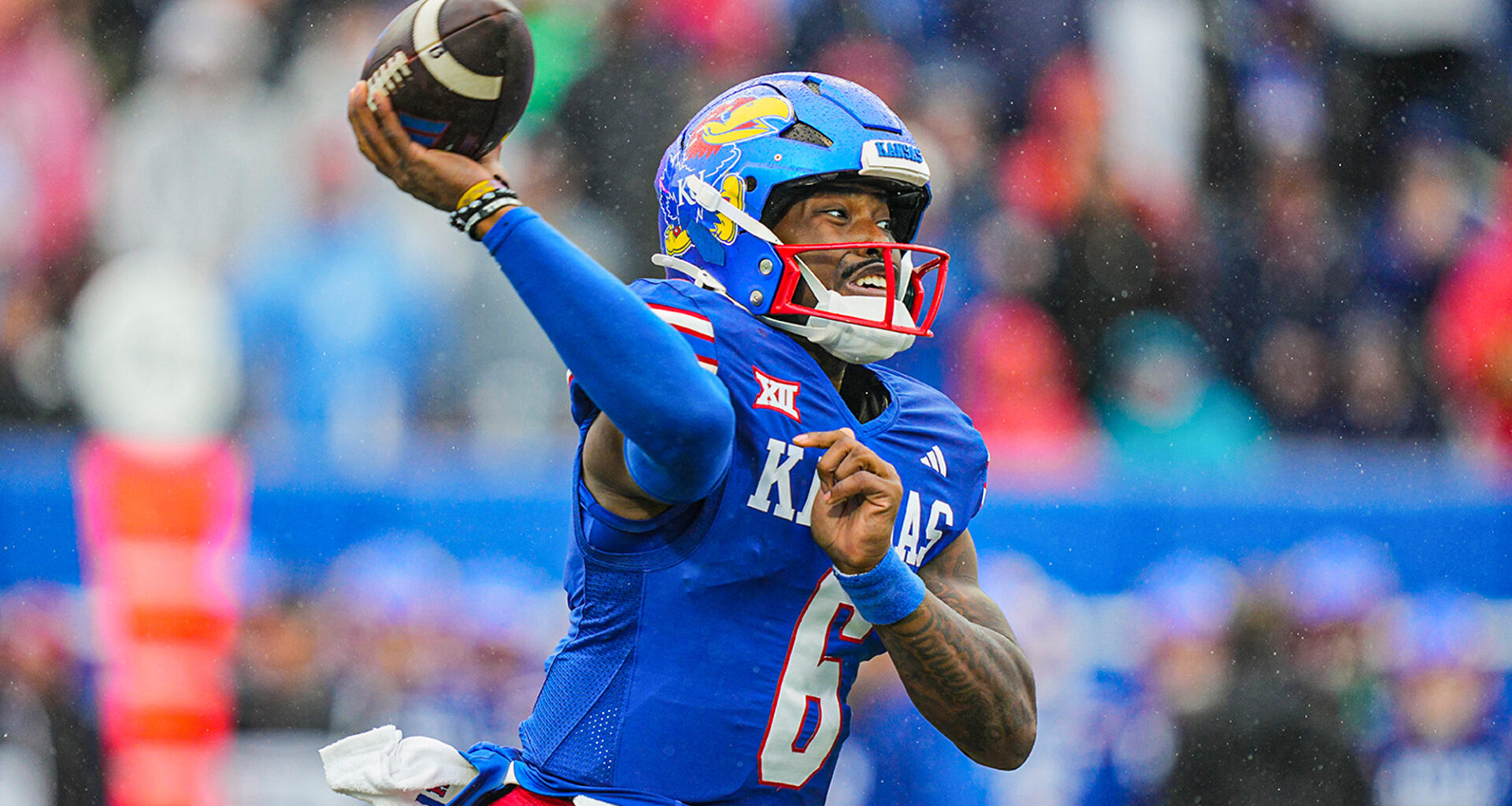
Jalon Daniels, Kansas
Currently ranked 280th on the consensus big board, Jalon Daniels is considered a prospect who borders on draftable.
A six-year player at Kansas, the dual-threat quarterback had an injury-plagued career, dealing with shoulder issues in 2022, back problems in 2023, and a knee surgery before the 2025 season.
When on the field, Daniels struggled to stand out as a passer. For his career, Daniels completed just 61.5% of his passes for 9,282 yards (7.8 per attempt), 67 touchdowns, and 31 interceptions.
He flashed potential in the deep game, though; in 2025, Daniels earned a 92.6 grade from Pro Football Focus on deep passes (20+ air yards), ranking 18th out of 145 qualified FBS quarterbacks. The Jayhawks’ signal-caller was two spots behind Diego Pavia and 26 spots ahead of potential first-rounder Ty Simpson.
Daniels flashed a tantalizing rushing ceiling with 1,916 career rushing yards and 23 rushing touchdowns. However, he had 10 more fumbles (33) than rushing scores, including 18 fumbles to 10 rushing touchdowns over the last two seasons.
Accuracy is also a major work in progress, especially in the middle of the field; in 2025, Daniels had an adjusted completion percentage of 57.1% on intermediate passes (10-19 air yards), ranking 104th out of 145 qualified FBS quarterbacks.
Like Diego Pavia, size is a concern, as Daniels is listed at six feet and 220 pounds.
So, with all of these concerns, why is Daniels listed in this article?
Well, he is the rare quarterback prospect who checks all three of the boxes we highlighted in our recent predictive-metric breakdown.
To reiterate, these three benchmarks from players’ final college seasons proved to be especially valuable in predicting their NFL success:
>15% deep pass attempt rate
>3% turnover-worthy throw rate (higher is better)
>7% scramble rate
Daniels hit all three of those benchmarks in 2025:
17.1% deep pass attempt rate
3.9% turnover-worthy throw rate
8.1% scramble rate
In the 35-player sample we analyzed, the only players to hit all three of those benchmarks were Patrick Mahomes, Joe Burrow, Lamar Jackson, Josh Allen, and Anthony Richardson.
Those aren’t bad odds for a possible seventh-round pick.
Among the 35 first-rounders chosen from 2015 to 2024, these are the top-five most similar prospects to Daniels across these three metrics:
Joe Burrow
Patrick Mahomes
Lamar Jackson
Josh Allen
Caleb Williams
Again, to be clear, we’re comparing a late-round prospect to first-rounders. Daniels has red flags in his profile that guys like Williams, Burrow, and Mahomes did not. Just because he is similar to these prospects in these particular metrics, it does not mean he has the same odds of success as they did; there are too many other variables involved to boil everything down to three numbers.
Admittedly, it makes more sense to evaluate potential first-rounders using this system, as it’s an apples-to-apples comparison when accounting for the prospect’s overall profile and perceived talent level. That’s why our article detailing the closest comparisons for potential 2026 first-round prospects like Fernando Mendoza and Ty Simpson is quite telling.
Nonetheless, when weeding through Day 3 prospects, who are all littered with red flags, it isn’t a bad idea to bet on the guys whose traits and tendencies align the closest with the most successful prospects in recent memory.
Comparing these prospects against the historical data of post-first-round prospects wouldn’t yield as much value, since those guys hit at such a low rate that it would be difficult to identify any meaningful trends; the rare players who pan out are simply outliers. If we want to find meaningful data on quarterback scouting, most of it will come from analyzing first-rounders.
Quarterbacks who scramble often, throw a fairly high rate of turnover-worthy throws, and chuck a lot of deep bombs have tended to work out in the first round. That does not mean the same hit rate will apply to post-first-rounders, but it’s a promising indicator to work off of when you’re trying to maximize your odds of identifying a steal in a part of the draft with a very low hit rate.
When looking through this lens, all three of Taylen Green, Diego Pavia, and Jalon Daniels stand out as interesting prospects, at least relative to the lowly expectations of post-first-round quarterbacks.