
Missing it again wasn’t on the table for Miami Hurricanes lifer Dain Ferrero. Sitting out the program’s 2001 title run, followed by a loss in the 2002 title game, turned “next time” from a shrug to an oath. So this time, he reversed the order of things, splurging on his ticket first and holding his breath while the Canes caught up.
Several hours before Miami’s introduction at the Fiesta Bowl national semifinal, Ferrero committed real money to a hypothetical seat, dropping $1,138 into CFP RSVP — a deposit-based reservation system that grants early access with one unambiguous warning: If your designated team loses the game, you lose the cash. Win, and you claim a seat at face value for a national championship matchup that hadn’t yet materialized against top-seeded Indiana.
“Not going to the game was not an option,” Ferrero said. “The second I did it, I was at peace with it.”
From Atlanta, Ferrero watched his gamble turn golden. Miami’s 31-27 escape of Ole Miss meant he was able to secure a title game ticket for $1,638 total after a $500 face-value cost. His commitment looks like a bargain as price tags for Monday’s game at Miami’s Hard Rock Stadium are reaching what ticket analysts say are unprecedented levels on the secondary market. Get-in prices have floated between $3,500 and $4,500. SeatGeek shows the average resale price for this year’s final sitting at $4,974, a $1,529 leap from last season and the highest of the past five CFP championships.
The demand has led some fans to a reckoning: How much are they willing to spend?
“This year’s national championship market is behaving much more like some of the Super Bowls we’ve tracked and less like a typical college football final,” said SeatGeek director of marketing Chris Leyden. “It’s a perfect storm of demand — a local team playing at home paired with a massive, national fan base traveling in.”
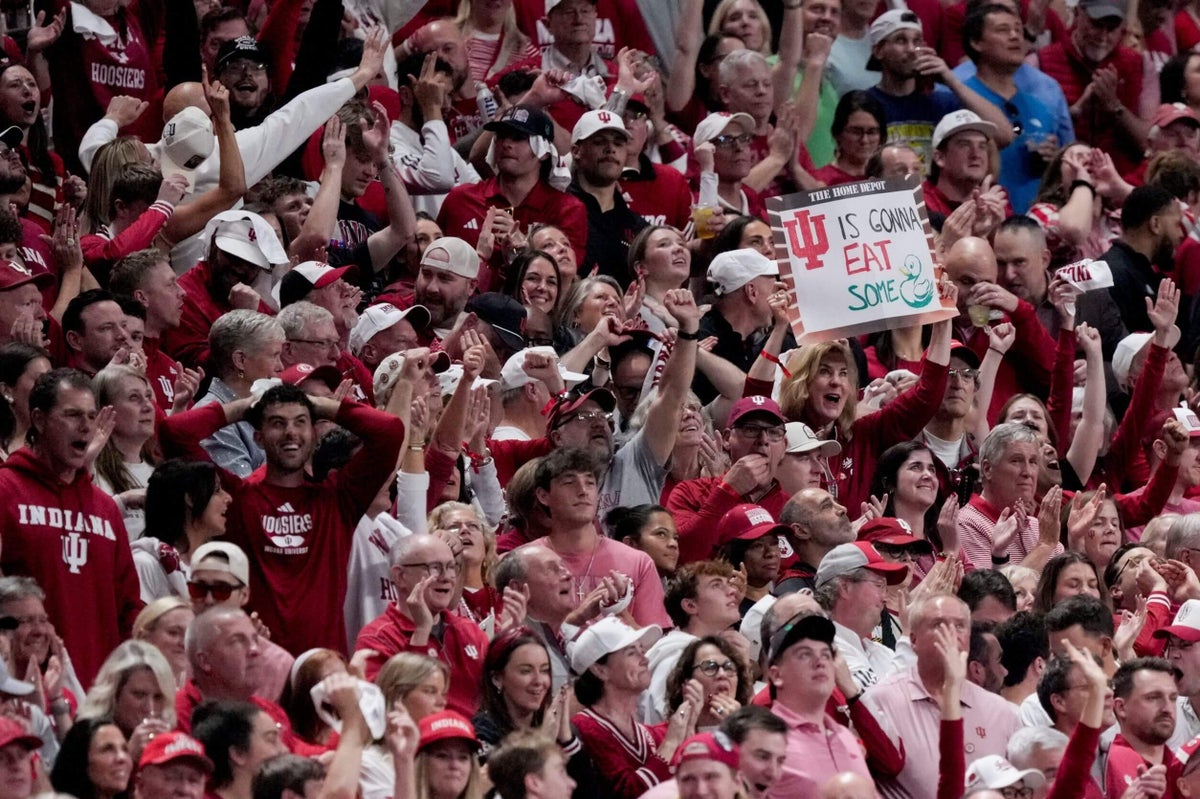
It doesn’t quite require advanced math. Miami is chasing its first championship since 2001 in the stadium where it plays its home games — a scenario the CFP and Bowl Championship Series have never had. Indiana is buoyed by an alumni army large enough to bend geography — already proven in Los Angeles at the Rose Bowl and in Atlanta at the Peach Bowl. Now, improbably, the long suffering Hoosiers stand as first-time finalists staring down history.
Scott Pincus, a 42-year-old cosmetic dentist from Fort Lauderdale, Fla., pulled the trigger at halftime of the Peach Bowl — with his Hoosiers leading Oregon 35-7 — locking in a $3,600 seat in the upper deck end zone. To his friends still hesitating because of money, he had a message:
“How much would you pay for a ticket to ‘see God?’” he said he told them. “I find what’s happening to Indiana is a miracle.”
As of Saturday morning, the average get-in solo ticket across StubHub, SeatGeek, GameTime and Ticketmaster sat at $3,938.
CANES FAM, WE NEED YOU TO MAKE @hardrockstadium AND ALL OF MIAMI THE LOUDEST IT HAS EVER BEEN ON MONDAY! SHOW UP, SHOW OUT, AND WEAR YOUR BEST ORANGE FITS WHEREVER YOU ARE 🙌 #GoCanes pic.twitter.com/olKVrmhCJO
— Miami Hurricanes (@MiamiHurricanes) January 15, 2026
For Canes fan Kenny Interian, the math stopped making sense. He paid roughly $1,000 for the entire season. Now the market wanted about $3,500 for a single upper-deck corner, blowing past even his highest expectations. He’s chased every possible backchannel, from program contacts to donors to his sister, a university nurse. Nothing has budged the price.
“It’s become more of a ‘who’s who’ and who can attend the game,” Interian said. “My wife’s like, ‘Hey, let’s YOLO, let’s just do it.’ And I’m like, ‘No, I love the Canes, but I have a responsibility to my family.’”
Of Hard Rock Stadium’s 65,000 seats, Indiana and Miami are each allocated 20,000 at face value according to a CFP spokesperson, generally ranging from about $500 to $900 and sold to supporters according to each school’s protocol. The remaining 25,000 seats were controlled by the CFP and distributed through its ecosystem of partners and stakeholders, including sponsors, bowl and conference entities, broadcast partners and premium packages. A CFP spokesperson declined to outline the distribution, saying there are “too many groups and the blocks vary to share that detail.”
Interian expressed frustration with tickets going to others who may not be as “invested on an emotional level and caring about the actual team.”
Because much of the inventory is pre-distributed — and because not all recipients ultimately attend — general fans hunting online are funneled into the pricier resale market due to the scarcity of a traditional public on-sale. Some of those face-value tickets inevitably end up on the secondary market through resellers, brokers and individuals flipping seats they can’t or won’t use.
According to TicketIQ, the average asks were hovering in the mid-$6,000s as mid-level and lower-bowl inventory thinned, sending prices into five figures. The closest modern parallel of these numbers was in 2018, when Georgia played Alabama at a near-home game for the Bulldogs in Atlanta, but even then, a battle of longtime SEC blue bloods sold at an average of about $2,300.
Ray Castillo has followed Miami since 1967. Better known for dressing as Darth Vader at Canes games, Castillo wanted no part of the “price gouging.” He could pay. But he vehemently refused.
“The way they jacked up all the prices, I mean, we’re trying to figure out who the hell did all this and how they can,” Castillo said. “I’d rather sit at home.”
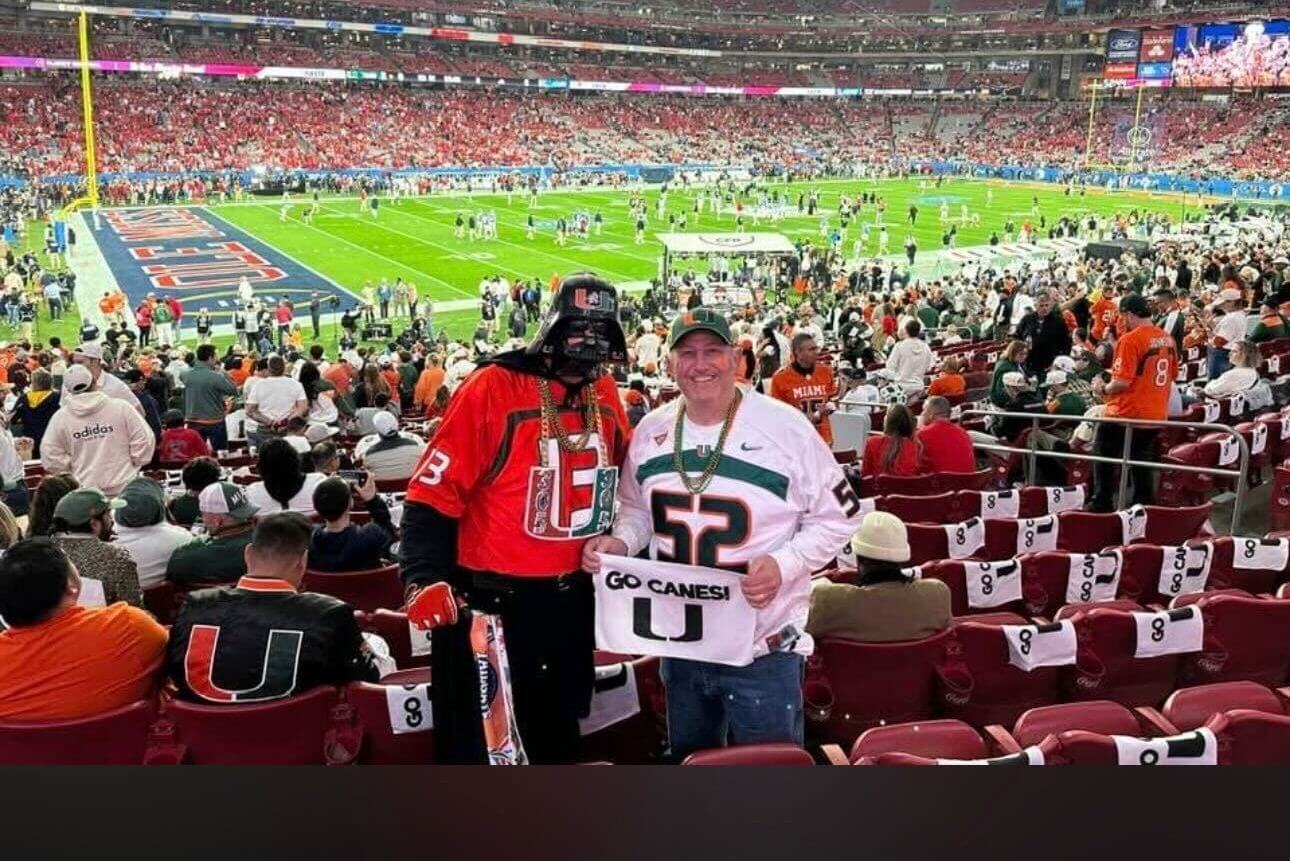
Ray Castillo dresses up as Darth Vader at Hurricanes games: “May the Force Be With You — The U.” But he’s found title game prices too high. (Courtesy of Ray Castillo)
Bryan Callahan, a Miami fan since age 7 and founder of a 4,000-strong fan group Canes United, said even with face-value access through being a season-ticket holder, he put his two tickets on a credit card — requesting a higher limit — and expects to be paying this season’s costs off for three to five years.
The price spiral doesn’t stop at seats, with parking passes following the same script after rates flew from $75 to closer to $1,000.
For Brad Hilton, an Indiana graduate working in private wealth management in Nashville, chasing a ticket became his evening job. He posted, promoted and crossed his fingers during Instagram lotteries, then tried his luck again via a “The Pat McAfee Show” giveaway for lower-level seats. Nothing hit.
“If this is the trajectory we’re on, we’ve priced out students, and you’re just catering to ultra wealthy boosters and alumni, which are great,” he said, “but you lose a little bit of the soul and culture of what you want a college athletics championship to be.”
AJ Lazoff, a 22-year-old senior in IU’s accelerated master’s program, said the student chase began months ago with a $400 combo pass for home football and basketball games, and a resulting points system that turned attendance into currency. Last week, those who attended the most games got their hands on tickets with no additional fee. Everyone else fought for scraps Wednesday, when a limited batch went first-come, first-served alongside a $200 charge. Fortunately for some lucky students, though, Taco Bell annually picks up the tab for all student-section tickets.
“It was an absolute mess,” Lazoff said. “Very few people got lucky.”
The same dilemma shadows students and alumni alike: go or cash out. Platon Alexandrakis, who earned three degrees at Miami before starting to teach there, landed four tickets through his season-ticket access. His row 20, section 106 seats cost $800 apiece — each equal to $10,000 on the secondary market. Sell all four, and he clears a net total of $36,800 overnight.
“At some point, you say, well, am I an idiot for not trying to sell?” Alexandrakis said. “But I’m a diehard. It would take a lot for me to give them up.”
Hoosier fans brought the ENERGY⚡️🔋#CFBPlayoff #NationalChampionship pic.twitter.com/jUpL0sR3fP
— College Football Playoff (@CFBPlayoff) January 10, 2026
Sherry Wright, 55, was already en route last week to Miami from Wesley Chapel, Fla., 300 miles north, sounding so excited over the phone it could be assumed she had seats waiting to watch her Canes. She didn’t. She and her husband had spent the week refreshing SeatGeek, StubHub and Ticketmaster every 30 minutes, chasing prices and dodging scammers. They set a $5,000 budget for two seats and set themselves a Sunday-night deadline.
Indiana alum Gabe Pincus, an entrepreneur based in Nashville, reloads prices “religiously,” keeping four resale sites open. He bought two Big Ten title game tickets for $800 each, watched them rise to $4,500 a week out, then fall back to $1,600 by kickoff. He waited until 5 p.m. on the day of the Peach Bowl and landed a sixth-row ticket for $619, with a fan beside him saying he’d paid $1,200 a week earlier. This time, he’s sticking to the same rule: wait until he lands in Miami, then buy a seat in the 100s or 200s sections. He’d rather overpay than risk a flight delay turning a four-or-five-figure ticket into nothing.
But this championship has broken the usual rulebook, including the belief that waiting brings relief.
“There’s a level of uncertainty we don’t usually see this late,” said SeatGeek’s Leyden, noting ticket prices often soften closer to game day. But this year, perhaps impacted by hometown fans not having to pay for lodging and airfare, prices appear to be rebounding as kickoff nears.
Indiana’s Cinderella story spun pragmatism into optimism, nudging fans to rely on their hearts over their calculators. Dustin Gordon, a 2005 IU graduate who freelances in sports marketing and talent management, waited it out — passing on the quarterfinals and semifinals in case this moment came. It did, and through a personal connection, he secured his tickets at last.
“It’s cliché, but this is unreal,” Gordon said. “When I got the tickets, it felt like an out-of-body experience. It felt like a bit of destiny, like the world giving me some karma, rewarding me for not going to the semifinal game.”
But the same market that delivered karma to some also served as a gatekeeper for others. Chris Stonelake, a Miami lifer, flew into the city from Roanoke, Va., without tickets. He knew that, because of a pile of medical bills, a $3,000 ticket for him was never realistic.
“I really can’t even find the words to say how awesome it would be to be at the game,” Stonelake said. “If I could sell a kidney, I would.”