
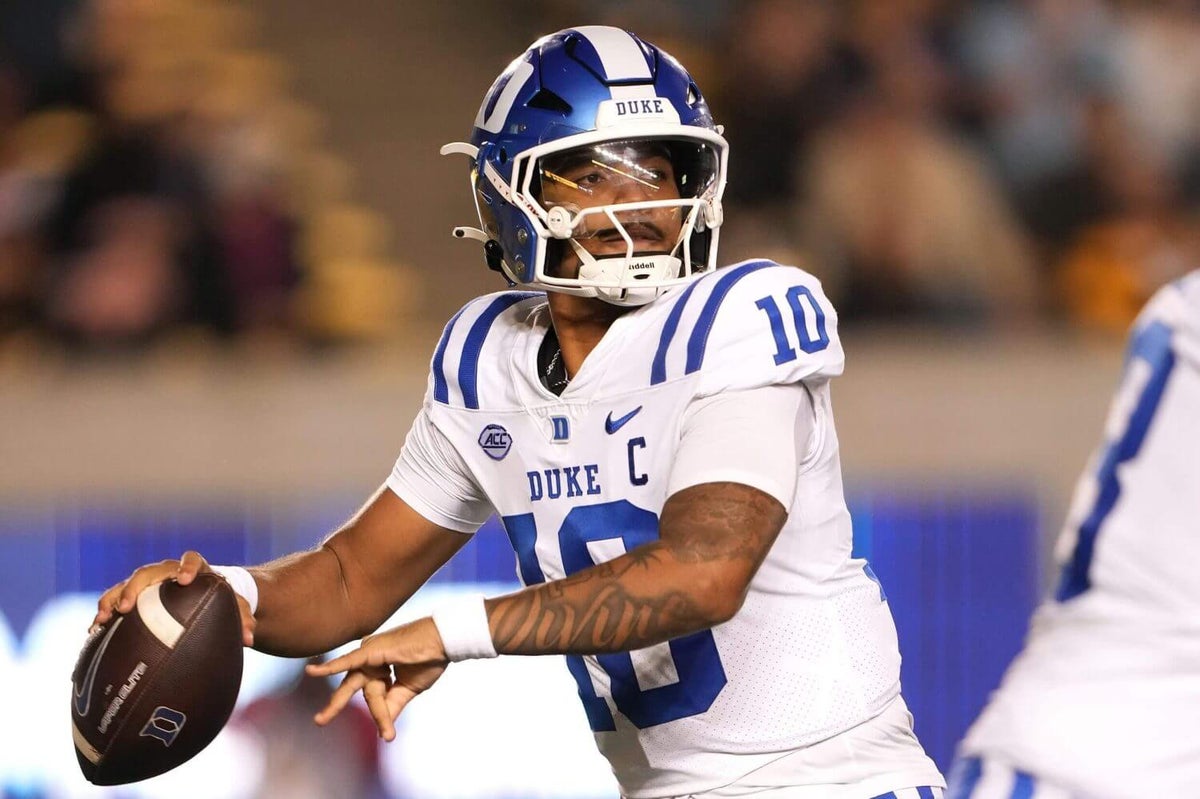
Duke University sued quarterback Darian Mensah on Tuesday, days after Mensah requested and publicly announced his intention to enter the transfer portal.
In a complaint filed to the Superior Court in Durham County, N.C., Duke claims that it has a multi-year contract with Mensah that ends Dec. 31, 2026, and includes exclusive rights to Mensah’s name, image and likeness “with respect to higher education and football.”
The complaint seeks a temporary restraining order and preliminary injunction that would prevent Duke from having to enter Mensah into the transfer portal while it seeks arbitration, which is a private method of resolving disputes outside of public court.
Darren Heitner, Mensah’s lawyer, told The Athletic that a judge indicated from the bench on Tuesday morning, pending a written ruling, that Duke’s request for a temporary restraining order restricting Mensah from entering the transfer portal would be denied. Heitner also said that the judge, a Duke basketball season ticket holder, recused himself from future proceedings.
However, Mensah cannot yet enroll at or play football for another school until the next hearing regarding a preliminary injunction, according to Heitner. The hearing has been scheduled for Feb. 2, but Heitner hopes to have it moved to an earlier date.
That hearing, in front of a different judge, will be to “flesh through the remainder of Duke’s requests,” according to Heitner, unless the two parties can come to a peaceful resolution prior to that. Despite being unable to enroll elsewhere, Mensah can still enter the transfer portal.
Heitner added that, in light of the judge’s ruling, there is nothing in Mensah’s contract that allows Duke to not comply with Mensah’s request to enter the transfer portal. If Duke does not process that request within two business days, it would be in violation of NCAA bylaws. Mensah submitted his request last Friday, the final day of the transfer portal window; because of the Martin Luther King Jr. Day holiday, Duke would have until Wednesday to enter Mensah in the portal.
Lawyers representing Duke University did not immediately respond to requests for comment.
Duke claims in the complaint that under the terms of the revenue sharing contract Mensah signed with the university, which was approved last summer, the parties are required to submit all disputes to arbitration. The complaint argues that if Mensah is allowed to break the contract by entering the transfer portal, enrolling at another school, playing football and/or licensing his NIL rights to another school, it would cause Duke “irreparable harm.” Mensah’s contract does not include an early termination, or “buyout”, clause.
The complaint also argues there is a “strong public interest” in this case and that allowing Mensah to breach the contract would “undermine the integrity of these agreements.”
In addition to seeking monetary damages via arbitration, Duke is also seeking injunctive relief by the arbitrator that would prevent Mensah from enrolling at another school to play football and/or license his NIL rights for the remainder of his contract with Duke.
“Duke University seeks this relief only until the end of the arbitration process, at which point the final decision of the arbitrator can be enforced by this Court,” the complaint reads.
Mensah has been linked to Miami since announcing his intentions last Friday. The Hurricanes lost to Indiana in the national championship on Monday night and have been in the market for a new quarterback for the 2026 season.
Mensah’s transfer decision comes less than a month after he announced his return to Duke for the 2026 season. A second-team All-ACC honoree in 2025, he led the Blue Devils to their first outright conference championship since 1962. Mensah initially transferred from Tulane to Duke ahead of the 2025 season, signing a multi-year deal worth more than $3 million annually. The deal, which began as a third-party NIL agreement, transitioned to a revenue sharing contract with Duke last summer under the terms of a multi-billion-dollar antitrust settlement known as the House settlement. As of July 1, 2025, colleges were allowed to distribute up to $20.5 million in revenue sharing directly to athletes across all sports for the 2025-26 school year.
This is college football’s second high-profile contract dispute in recent weeks. Earlier this month, Washington quarterback Demond Williams Jr. publicly announced plans to transfer despite having signed a $4 million contract with the Huskies for the 2026 season just days prior. (Williams also retained Heitner, a prominent NIL lawyer, as legal counsel.) Washington made it clear it had no intention of releasing Williams from that contract, and two days later, the quarterback announced that he would honor the deal and play for the Huskies in 2026.
That dispute raised questions about the enforceability of revenue sharing agreements, which are not traditional employment agreements, because college athletes are not legal employees. Williams remaining with Washington suggests that his contract worked as intended. Mensah and Duke look to be the next test case.
In January 2025, defensive back Xavier Lucas un-enrolled from Wisconsin and enrolled at Miami after Wisconsin refused to enter Lucas in the portal, claiming Lucas had a “binding agreement” with the university. Lucas played for the Hurricanes in 2025, including in Monday’s national championship. Heitner also represented Lucas in that matter.
At least for the time being, Mensah cannot do something similar until the contract dispute is resolved or the preliminary injunction is sorted out.
“There is nothing improper about a student un-enrolling from one school and enrolling at another,” Heitner previously told The Athletic. “My inclination is that no judge is going to [prohibit] an athlete from changing schools.”
In June, the University of Wisconsin sued the University of Miami for tortious interference, claiming Miami intentionally interfered with a contract between Wisconsin and Lucas. That case is ongoing.
Trade secrets and sports attorney Kevin Paule called it an “uphill battle” to win an injunction at this stage because of the standard in place. It’s not enough to show the harm Duke would suffer if Mensah leaves; the school has to show that money alone won’t be able to remedy the harm.
“It doesn’t mean that Duke won’t succeed (at trial),” said Paule, a shareholder at the Tampa law firm Hill Ward Henderson. “It doesn’t mean they won’t recover money from Mensah. But I think it would be difficult to make the argument they’ll suffer such harm that if he leaves, they won’t be able to figure out what the monetary amount would be from the NIL standpoint.”
Paule said this case is another precedent setter in the still-evolving space of college athlete compensation. It’s the first known instance of a school suing a player to prevent the athlete’s exit.
“If a school were able to do that,” Paule said, “obviously these contracts would have a lot more teeth.”
— The Athletic’s Stewart Mandel and Matt Baker contributed reporting.