
 Listen to this article
The Blueprint
Commanders unveil first conceptual renderings of their new RFK Stadium site venue.
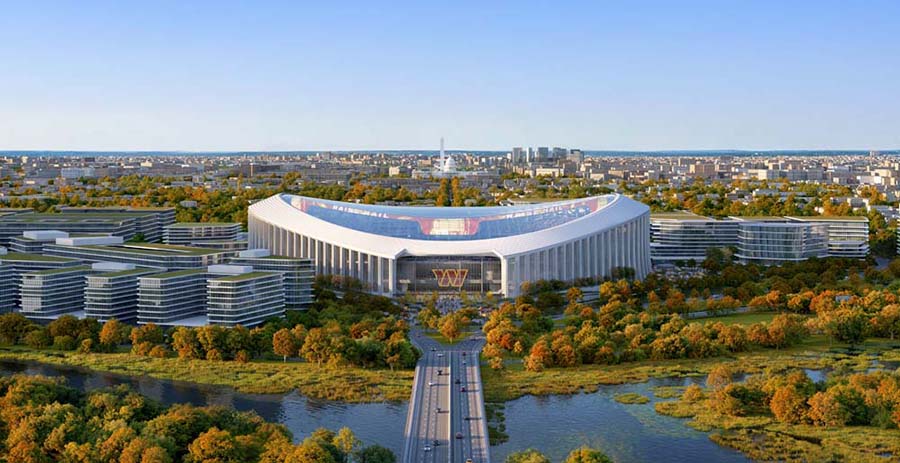
Stadium features a transparent domed roof, glass facades and monumental entryways.
Projected 70,000-seat stadium is slated to open in 2030, with construction as early as 2027.
Design aligns with the L’Enfant Plan and preserves sightlines to the Capitol and monuments.
A sweeping, translucent roof. Main entryways on the same axis as the Washington Monument and the U.S. Capitol. A grand colonnade.
Those are among the most striking features in the conceptual renderings of the Washington Commanders‘ new stadium released Thursday morning, the first glimpses of the structure that will be erected on the former RFK Stadium site.
The images, which show the exterior of the proposed stadium from different vantage points and in different lighting, are the first to be released by the Commanders since they hired HKS as their lead architect in November. While the design process is ongoing and changes are possible, the renderings reflect the major design principles agreed upon by the Commanders, including principal owner Josh Harris, and their lead architects.
In a statement, Commanders team president Mark Clouse described the public release of the renderings as “a defining milestone in the next phase of the development process.”
“We are deeply grateful to the District and [Mayor Muriel E. Bowser] for their leadership, collaboration, and continued support, which have been instrumental in bringing this vision to life,” he added. “… We’re designing a stadium that amplifies the energy of football, supports year-round events and becomes a place the community can be proud of. We look forward to hearing feedback from our community as the design continues to evolve.”
The new stadium, which is projected to be able to accommodate around 70,000 fans, is slated to open in 2030. Construction could begin as early as 2027.
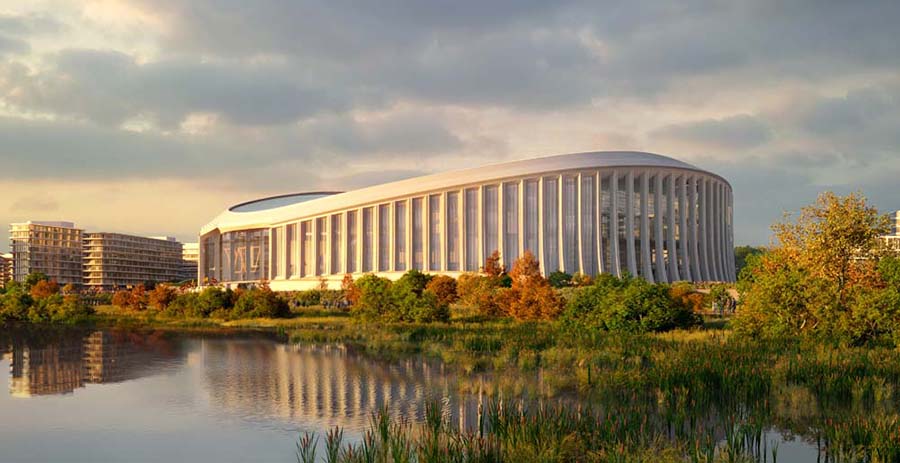 The proposed Commanders stadium, designed by HKS, is seen from the Anacostia River in Washington. HKS also designed U.S. Bank Stadium in Minneapolis and SoFi Stadium in Inglewood, California. (Photo: Washington Commanders and HKS)
In some ways, the renderings evoke memories of RFK Stadium, where Washington played its home games for 36 seasons before moving in 1997 to its current home in Landover, Maryland. The top of the upper deck appears to have a flowing quality to it, much like RFK. And the exterior projects a stately feel, with columns that appear in the renderings to offer open-air spaces, allowing visitors to walk through them outside the stadium’s walls.
The proposed stadium also has clear similarities to other HKS-designed NFL venues, including U.S. Bank Stadium in Minneapolis; SoFi Stadium in Inglewood, California; and AT&T Stadium in Arlington, Texas. Each of those venues features dramatic entryways and sprawling glass facades, ostensibly combining the feel of an outdoor stadium with the comfort of an indoor one. The Commanders’ renderings show plenty of glass — including a “sculpted, transparent domed roof” — and massive windowlike entryways.
Mark A. Williams, global venues director at HKS, said in a statement that the stadium will be “monumental in presence” and “a bold civic landmark that carries the city’s architectural legacy forward in a way that is confident, dynamic and unmistakably Washington.”
In their news release, the Commanders noted that the stadium site aligns with the L’Enfant Plan — the urban grid that governs the District’s layout — and sits on the “monumental axis,” with the Capitol to the west. The stadium’s highest points will be to the north and south, with a lower profile to the east and west “in deference to the U.S. Capitol and monuments.”
The release of the renderings comes a little more than a year after President Joe Biden signed a bill transferring control of the RFK site from the federal government to the District and altering the rules about how the space could be used. That move sparked negotiations between the team and District leaders, who finalized a $3.7 billion deal in September.
In the months since, workers have demolished the old RFK, where barely any of the previous structure remains, as the team worked on the new stadium’s design. The deal between the Commanders and the District not only involves the construction of the new stadium but also the development of housing, retail and park space on the land, which spans roughly 180 acres.
“I’m grateful for the shared commitment from both the Commanders and HKS to designing an iconic stadium that honors the history of our city — and our skyline — while also being a true catalyst for future opportunity at the RFK campus,” Bowser said in the Commanders’ news release. She counts the stadium deal as a major achievement during her tenure; she is not running for reelection and will leave office in January 2027.
In addition to seeking feedback at community meetings, the Commanders also will present the proposed renderings and design to the National Capital Planning Commission and the U.S. Commission of Fine Arts. The NCPC, chaired by White House staff secretary William Scharf, does not have the power to approve or deny the stadium design, but it does have advisory powers that allow it to provide input.