
The last name “Shula” carries as much NFL gravitas as “Rooney.” Don Shula, Art “The Chief” Rooney and son Dan Rooney are etched into football history. Art Rooney II serves as the Pittsburgh Steelers’ current president. In hiring Mike Tomlin’s replacement, those two names could converge.
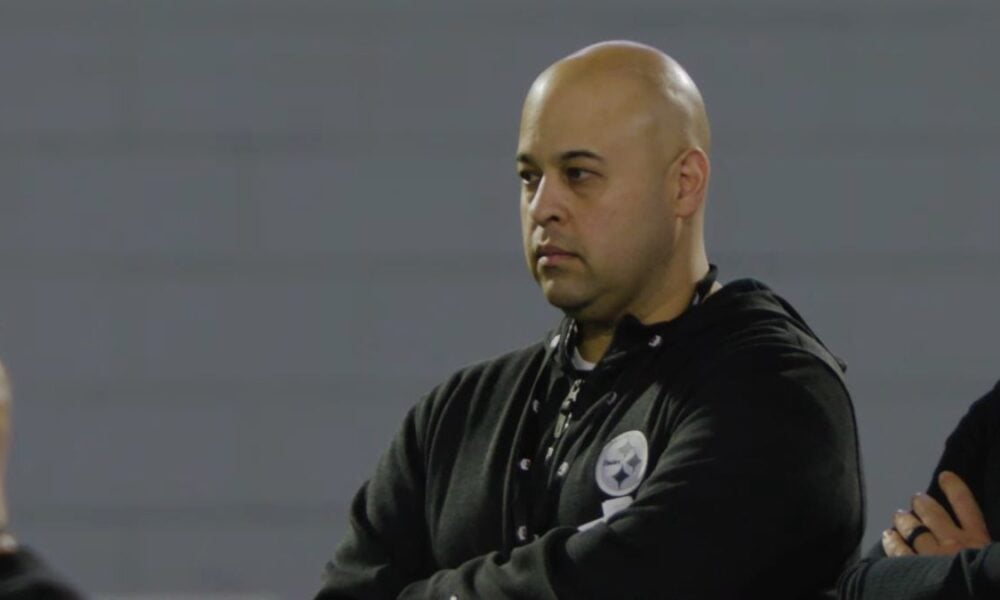
General manager Omar Khan sits alongside Rooney in that search. Pittsburgh has cast a wide and sincere coaching search net. They won’t shortchange this process, nor will they make a hire just off surname alone. But if you love playing the connection came, and I certainly do, there’s a heck of a one that exists between Khan and Shula. One that could lead to Los Angeles Rams DC Chris Shula becoming the Steelers’ next head coach.
On the surface, that might not be obvious. There are other clearer ties that bind. It was Baltimore Colts’ Don Shula who recommended that the Steelers hire his assistant, Chuck Noll, and Pittsburgh did, and never looked back. Before he became the Steelers’ general manager, Kevin Colbert worked for a decade as a college scout under Shula’s Dolphins. Even Chris has one connection to the Steelers’ current staff, serving as defensive coordinator at John Carroll, when QBs Coach Tom Arth was the school’s head coach.
But there is another link. It takes a couple of layers to reach but one worth exploring. It exists not in the NFL but at Dartmouth College. A school known more for academics than athletics, the Shula connection sits here.
Omar Khan has had multiple mentors, Kevin Colbert being one of them. But his first, in football anyway, was Buddy Teevens. A man Khan is on record sharing his immense respect for, Teevens was the first person to hire Khan to work in football. At Tulane, Khan was a student looking to break into the game. Teevens served as the program’s head coach and offered him a job as a grad assistant. Khan would soon move on to the New Orleans Saints, but the connection between him and Teevens remained.
“I would not be where I am if it weren’t for Coach Teevens,” Khan told Dartmouth Alumni magazine in the November-December 2023 issue. “He gave me my first shot in football and took the time to teach me not only about the game but how to conduct myself as a man. Buddy was first-class all the way around, and he always, always, always called to check up with me.”
When Buddy Teevens died after his bike was hit by a pickup truck, Omar Khan released a statement echoing the same sentiment.
After Tulane, Teevens bounced around college football. There was Illinois. And Florida, where he held multiple roles and coached future Chicago Bears starter Rex Grossman. For three years, he headed Stanford’s program. Three losing seasons did him in. So Teevens went back to where it all started: Dartmouth. He attended school there, played quarterback there, and in 2005, took over as the program’s head coach.
Success took time. Lots of it. In his first five seasons, Teevens went a crooked 9-41. A record virtually impossible today; any coach would’ve been fired well before those five years were up. Dartmouth stayed the course, and its patience was rewarded. For the rest of his tenure through 2022, Teevens went 82-38, including four 9-1 campaigns.
His legacy went far beyond wins and losses. He stressed improving technique, reducing practice physicality and even once testified in front of Congress on concussions in youth sports. Teevens is known as the coach who made football safer.
In October 2024, Dartmouth’s stadium was renamed in his honor.
****
Dave Shula broke into coaching with Miami in the early 1980s, soon overlapping with Colbert’s stint as a scout. After two years as the Dallas Cowboys’ offensive coordinator, the Cincinnati Bengals tabbed him as Sam Wyche’s successor. Shula, like Teevens, got more leeway than a modern-day coach. Only he wouldn’t turn the corner. After five seasons, Shula sported a 19-52 record. Fired, he’d never coach in the NFL again.
His interests pivoted from football to business. He joined the Shula family in the restaurant world with steakhouses and burger joints that still exist today. If you’re ever in the Fort Lauderdale-Hollywood International Airport, make your way to Gate C for a Shula Burger. But in 2018, 22 years since he last donned a whistle, Dave Shula went back to coaching. At Dartmouth.
The man who hired him? Buddy Teevens.
“Dave and his family are a wonderful addition to Dartmouth and our football program,” Teevens said at the time. “His love of the college, expertise in the game, experience and character will have a significant impact on everyone associated with Dartmouth Football.”
Shula had reason to come back. Not only did Shula, like Teevens, attend Dartmouth, but the pair were teammates. Teevens the starting quarterback, Shula the star receiver. Shula’s wife attended Dartmouth. Eldest son Dan followed in their footsteps to go there as a backup quarterback for the Big Green (the school’s official nickname; “Keggy the Keg” is the unofficial mascot).
Shula coached the school’s wide receivers through 2023 with a lost year in between due to COVID.
The Rooney family has its own ties to Dartmouth. Not as deep but still notable. Daniel Martin Rooney, widely believed to be Art II’s successor and visible face during 2025’s Dublin trip and sitting next to Omar Khan during Art’s post-Tomlin press conference, played quarterback at the school from 2008-2011. Here’s his one major highlight, a 69-yard touchdown pass late in a blowout win over Princeton.
Even if it’s much more minor, there are other Steelers connections. Minority owner Bruce Rauner earned his BA at Dartmouth. Thirty years ago, he and his wife made a $5 million donation that resulted in the campus library being named after them.
Whether it’s Omar Khan, the Shulas, the Rooneys, or the Steelers’ franchise, Dartmouth offers plenty of overlap.
This won’t be the reason why Chris Shula gets the job – if he gets it. These are just rabbit holes to get lost down for hours. But connections matter. The NFL is full of them. I-know-this-guy-and-he-knows-that-guy. That often provides an “in” for the job. Pittsburgh’s far from immune to that, a history that’s littered with examples. Shula’s last name helps, even if he’s shied away from resting on those laurels (which only makes him an even more impressive candidate). The rest of his resume is worthy of a head job. The parallels are hard to ignore.
There’s value in a mentor. There’s value in a Shula. Buddy hired the dad. Omar might hire the son.