
SANTA CLARA — I spent a lot of time on the practice fields at 4949 Marie DeBartolo Way this year, but whatever injuries I sustained will be chalked up to old age.
Or was it low-frequency electromagnetic waves weakening my body without even realizing it? I used sunscreen and wore a bucket hat during training camp, but didn’t line the hat in tinfoil.
The 49ers’ season-ending press conference with general manager John Lynch and coach Kyle Shanahan Wednesday afforded an opportunity to address the whole power/plant substation theory of why the 49ers make such heavy use of the injured reserve list.
Lynch diplomatically gave it his due as a member of the front office. That’s how he rolls. But he was one of the NFL’s most fearsome hitters for 15 seasons and he could barely hide his skepticism.
“Our guys have been reaching out to anyone and everyone to see, does a study exist other than a guy sticking an apparatus underneath the fence and coming up with a number that I have no idea what that means,” Lynch said while somehow managing to avoid sounding overly sarcastic. “That’s what we know exists. We’ve heard that debunked . . . I know a lot of games have been won at this facility since it opened.”
Shanahan avoided the topic, which is unfortunate. He’s so good at sarcasm sometimes people don’t even know he’s using it.
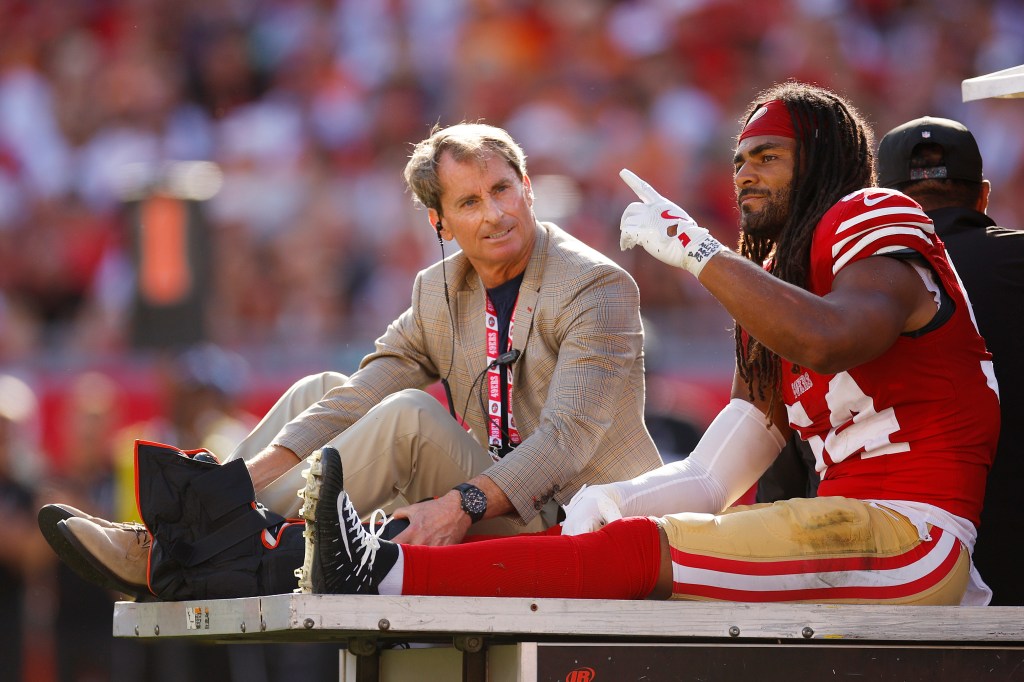
Nick Bosa (torn ACL), Fred Warner (fractured and dislocated ankle), George Kittle (hamstring, then Achilles), Brock Purdy (turf toe) and Mykel Williams (torn ACL) all missed significant time. When that kind of star power is on injured reserve or the sidelines, people are looking for answers other than bad luck.
“I think this year, probably because the star players that went down, there was a lot of attention given on that,” Lynch said.
Bosa’s ACL was his third, the first of which came in high school. Warner’s injury was a clear trauma, one that was extremely hard to watch because ankles don’t bend that way. Kittle recovered and was as good as ever until the wild-card game. Purdy’s turf toe wasn’t nearly as bad as the one I saw first-hand with Charles Woodson in 1999 with the Raiders. (Hey, the Raiders had some towers with wires adjacent to their practice facility and the Oakland Airport.)
It’s football, and with the money that’s paid out, players are careful with their bodies and teams are careful with their investments. As much as coaches laud those who play with injury, the long-term effect can be seen at alumni days with those in their 50s and 60s sometimes struggling to walk and talk.
For whatever reason, the electromagnetic waves didn’t appear to bother Christian McCaffrey, who with 413 rushes/receptions at age 29 was saddled with the greatest workload for a running back in franchise history. Or tackle Colton McKivitz or guard Dominick Puni, who played nearly every snap. Or tackle Trent Williams, who had his first hamstring pull at age 37 in Week 17 as he was chasing down an interception return for a touchdown at 320 pounds, then came back in two weeks, electromagnetic field be damned.
Williams occasionally missed games with Washington, too, and as far as I know, substations were not the cause.
But the story went viral, some former players such as Taybor Pepper and Jon Feliciano even fed into the topic on social media, said it was a topic of conversation in the locker room, and so on we go.
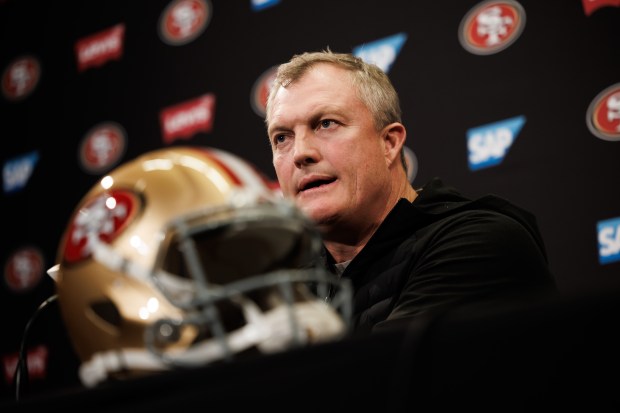 General manager John Lynch of the 49ers takes questions from the media Wednesday at a season wrap-up press conference. Dai Sugano/Bay Area News Group
The 49ers took up residence in Santa Clara in 1988 after moving from Redwood City, with Levi’s Stadium to follow on site in 2014. The NFL is so worried about the substation that Levi’s is hosting Super Bowl LX after doing so 10 years ago.
There’s no harm in attempting to get a scientific explanation for what may be no more than bad luck. But here’s where the impact of the substation goes off the rails — the idea that prospective free agents won’t come to the 49ers for fear of injury.
I’m old enough to have worked at the 1989 World Series and was at Candlestick Park during the Loma Prieta earthquake. It was a real, legitimate disaster and it seemed impossible to overstate how serious it was.
The aftermath included speculation that the earthquake would affect all professional sports in the Bay Area. Who wants to come someplace and be buried in rubble?
It didn’t stop Barry Bonds, a San Mateo native, from signing with the Giants in 1993. I can’t recall Stephen Curry explaining at his press conference in 2009 that he was worried about earthquakes. The list goes on as athletes came to the 49ers, Raiders, Giants, A’s and Sharks without a peep about the ground shaking.
And the earthquake wasn’t speculation. It was real.
In almost every instance, players report to the team that drafted them and sign because of money. Free agents come to a new team to get paid. They’re like anyone else. It’s not an accident that Nashville has become a popular destination on where to live. There’s no state income tax in Tennessee. Same with Texas, Nevada and Florida.
Players are influenced by how much of their income they get to keep, and in California, that’s much more of a hurdle than a power plant theory.
But when I go back to Levi’s Stadium for the NFL Draft, I’ll bring some tinfoil just in case.