
Usually, when preparing for the NFL draft, New York Jets fans find themselves debating over multiple quarterback prospects who could be chosen by the team in the first round. Think back to the Zach Wilson vs. Justin Fields debates of 2021, or the five-quarterback battle that ensued in 2018.
The 2026 class is shaping up much differently. There are only two quarterbacks with consensus first-round grades (based on the consensus big board).
Since the Jets are picking second overall, they will probably not get the chance to draft the higher-ranked prospect of that pair, Indiana’s Fernando Mendoza. It seems inevitable that the Las Vegas Raiders will select the Heisman Trophy winner first overall.
That leaves Alabama’s Ty Simpson as the only other first-round-worthy quarterback prospect.
The problem for New York is this: Simpson may be first-round-worthy, but he may not be quite special enough to justify the second overall pick. Simpson is the No. 23 overall prospect on the consensus big board.
Here’s the good news for New York: Thanks to the Sauce Gardner trade, the Jets own the 16th overall pick, courtesy of the Indianapolis Colts. Thus, the Jets might not have to reach for Simpson with the second overall pick. There is a chance that New York can wait until No. 16 and grab him there.
This scenario is not guaranteed to play out, as Simpson would have to make it past multiple quarterback-needy teams, including the Arizona Cardinals, Cleveland Browns, and Miami Dolphins. Nonetheless, it presents a feasible path for the Jets to acquire a potential franchise quarterback without being reckless.
But even if the Jets had a chance to take Simpson at No. 16… is he worth that pick?
There are multiple red flags suggesting he might not be, including a bright red one the Jets cannot miss.
The Simpson concern you can’t brush aside
It goes without saying that Simpson’s profile is littered with concerns, or else he would be considered a clear-cut top-two pick in a league where quarterbacks fly to the top of the draft board each year.
The most significant concern, though, might be Simpson’s lack of starting experience.
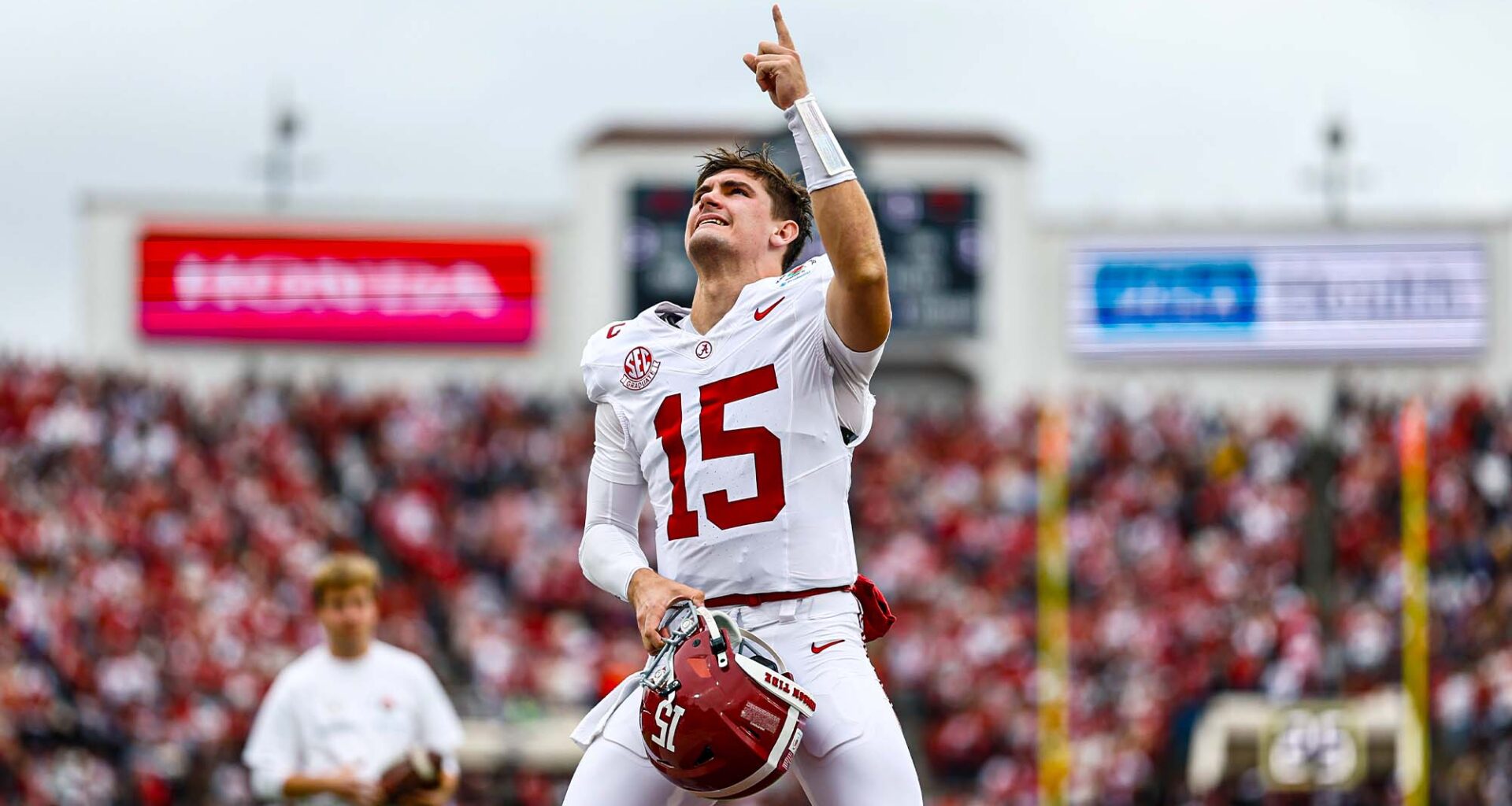
Simpson sat on the bench for his first three years at Alabama. He started all 15 games in 2025, and those are the only 15 starts he will take with him to the NFL.
This is a terrifying sign.
From 2015 to 2024, there were 32 quarterbacks drafted in the first round. Those quarterbacks came to the NFL with an average of 31 college starts under their belt—more than double Simpson’s total.
Simpson’s 15 college starts would be the fourth-fewest for a first-round quarterback since 2015. He would be just the seventh first-round quarterback over this span to enter the league with under 20 college starts, joining the following group:
Kyler Murray (17)
Trey Lance (17)
Mac Jones (17)
Ty Simpson (15)
Dwayne Haskins (14)
Anthony Richardson (13)
Mitchell Trubisky (13)
That is not the type of company you want to be in as a potential first-round quarterback.
Murray is a solid NFL starter, but he has been highly underwhelming relative to the expectations of a No. 1 overall pick. After seven seasons and no playoff wins, it appears likely that the Cardinals are about to part ways with him this offseason.
Outside of Murray, none of the other five quarterbacks has come close to being an average starting quarterback.
Simply put, using a first-round pick on a quarterback with under 20 college starts is a major risk. Six teams have done it since 2015, and six teams regretted it.
Overall, there is not a strong correlation between college starts and NFL success; it is not as if having a ton of college starts offers exceptional odds of success. But it is clear that players with minimal experience are riskier than those with at least two seasons’ worth.
Here is a list of the 32 first-round quarterbacks chosen from 2015 to 2024, with their college start total listed alongside their adjusted EPA (Expected Points Added) per dropback in the NFL.
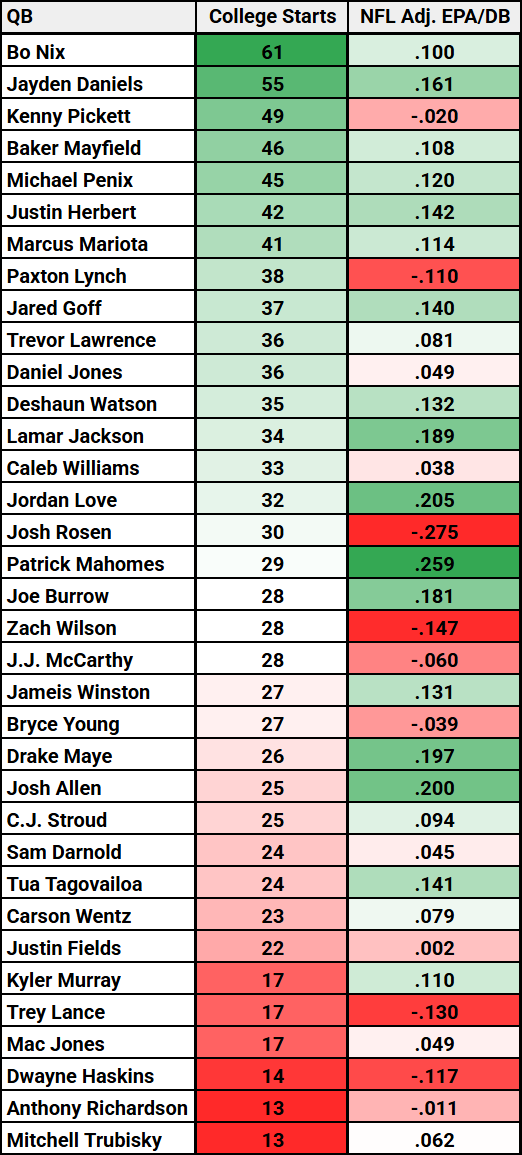
There is a large gap (five starts) between the sub-20-start group and the rest of the pack. Even once we cross the line, though, we see some more concerning names.
Justin Fields (22 starts) did not pan out. Carson Wentz (23 starts) was ultimately a one-season wonder. Tua Tagovailoa (24 starts) had high peaks from a statistical standpoint, but he seemed to be a product of Mike McDaniel’s system, as the Dolphins are prepared to dump him this offseason after no playoff wins in six seasons. Sam Darnold (24 starts) eventually found his way, but it took him until his seventh season and fourth team.
The sweet spot appears to be 25 starts. From there, we start to see some of the top stars in the NFL. Josh Allen (25), Drake Maye (26), Joe Burrow (28), Patrick Mahomes (29), Jordan Love (32), and Lamar Jackson (34) all logged two-plus seasons’ worth of starts.
This is not to say that starting a lot of games in college guarantees that the prospect will succeed. Zach Wilson started as many games as Burrow, and Josh Rosen started one more game than Mahomes. There is not a perfect correlation here.
Still, when looking at that chart, it seems clear that teams should avoid players at the very bottom of the list. Once a prospect gets to around the 25-start benchmark, they can be trusted to have a realistic chance of succeeding in the NFL, but for any quarterback beneath that threshold, the waters have been murky.
Out of the 10 quarterbacks on that list beneath the 25-start line, how many of those teams ultimately felt good about the pick they made? No more than two, certainly. Arguments can be made for Wentz and Tagovailoa, but that’s it. Tagovailoa is probably a “no” for Miami, although Wentz helped deliver a championship to Philadelphia, so we’ll call him a hit, making it one out of 10 teams.
Are those the odds of success that you want from the 16th overall pick?
This isn’t a plea for the Jets to completely write off Simpson, whose film paints a more promising picture than many of his critics are willing to acknowledge. But it’s a glaring red flag that the Jets will have to confront as they evaluate him.
To justify drafting Simpson, even with the 16th pick, the Jets would have to see enough in him to believe he can overcome the steep odds faced by quarterbacks who enter the NFL with minimal starting experience. The question the Jets must ask themselves is, “Do we truly believe that this player is special enough to do what none of the six guys before him could do?”
Murray, Lance, Jones, Haskins, Richardson, Trubisky—they all convinced an NFL team to use a first-round pick on them despite starting under 20 college games, and none lived up to their draft slot.
Why should the Jets think Simpson will be any different?
It would be foolish to say that he can’t or won’t be any different. The numbers we looked at today are simply food for thought… with a pungent aftertaste that is difficult to wash away.
Those who do not learn from history are doomed to repeat it, after all.