
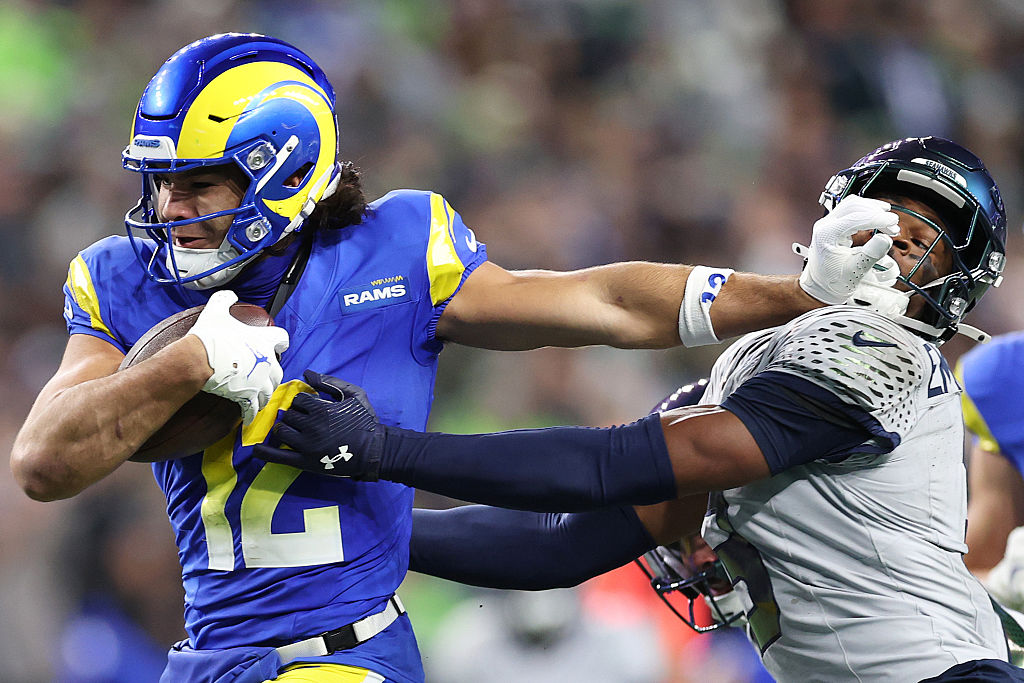
Dan Johnson takes you through his preview, prediction, and pick for the NFC Championship game between the Seattle Seahawks and the Los Angeles Rams.
This is the kind of NFC Championship that feels pre-written, because it’s Rams–Seahawks III with every old scar still fresh. This rivalry always turns into a down-to-down fight over leverage, spacing, and who blinks first in the red zone. Week 16 ended as a 38–37 brawl, complete with controversial officiating and a two-point conversion that people are still litigating. That’s the exact kind of sequencing swing that makes a better team lose in January. It’s heavyweights-only football: two elite efficiency profiles, one Super Bowl ticket, and zero room for “we’ll clean it up next week.” By DVOA standards, it’s the best NFL playoff game (period!) in the last 47 years. Seattle gets Charles Cross (OT) trending toward playing, and that matters for the protection geometry. It changes where the chips go, how often Seattle can release tight ends, and whether routes get into the pattern on time. But Zach Charbonnet (RB) is out, and that trims a real piece of their physical run menu. That’s less flexibility when the down-and-distance turns mean. Below is my prediction for the NFC Championship game between the Seattle Seahawks and the Los Angeles Rams.
Here’s how I’ll play it. I’ll be pumping out these predictions for individual games all season, with plenty of coverage here on DraftKings Network. Follow my handle @dansby_edits for more betting plays.
The cleanest spine is still the Rams’ down-to-down offense versus Seattle’s down-to-down defense, with the Rams’ recent form pushing the needle. Los Angeles sits at +0.102 offensive EPA/play for the full season and +0.109 over the last five. Seattle’s offense is +0.022 on the season and +0.008 over the last five, which is basically neutral living. Early downs widen it: the Rams are +0.147 EPA/play with a 51.7% success rate on first and second down. Seattle’s offense is +0.033 with a 45.0% early-down success rate, so the chains get heavier faster. Seattle’s defense is real, allowing -0.121 EPA/play across the season and winning early downs at a 60.3% success rate. But the Rams’ early-down advantage is so large it survives contact, and it feeds their identity as a possession-extending team. That’s where McVay lives: condensed splits, motion, and “declare your rules” route spacing that makes zone defenses communicate under stress. The rivalry tape backs that up: Week 11 was an efficiency rock-fight, and Week 16 turned into a volatility carnival.
Here’s what the head-to-head math actually says. In Week 11, both offenses were underwater (Rams -0.174 EPA/play, Seahawks -0.200), and Los Angeles won because Darnold’s four picks created a -15.77 EPA defensive swing. The key detail is the pocket was clean, and the turnovers still came. That’s coverage leverage, not just heat. In Week 16, the Rams’ offense detonated (0.244 EPA/play; Stafford +26.14 EPA on 457 yards), and Seattle still escaped 38–37 because the game got pushed into red-zone snaps, two-point math, and a few moments that went sideways late. Seattle’s offense was basically living near neutral in that shootout (-0.018 EPA/play), but the run volume and finishing swung the night anyway. That split is the thesis: Seattle’s defense can win a down-to-down grind, but the Seahawks’ turnover history and finishing volatility keep opening a Rams cover lane. And if I’m weighting “repeatable” versus “situational,” the repeatable part has been Rams early-down control plus Seattle offensive wobble.
Now get specific about how the points actually land. Matthew Stafford (QB) has been the more efficient quarterback across the season at 0.208 EPA/dropback versus Sam Darnold (QB) at 0.126. Stafford’s best trait in these games is he’ll take the boring throws until the defense over-tilts, then he’ll knife the intermediate window. Stafford also eats pressure looks for breakfast, posting +0.265 EPA/dropback versus the blitz. That matters against a defense that can hunt with the front, generating a 42.0% pressure rate and 56 sacks. Seattle’s front wins with rush-lane integrity and games up front, not just one guy dusting a tackle. This is where Cross matters most: if Seattle can protect without extra help, they can keep more eligible threats in routes. It also lets them stay in their preferred pass family without living in max-protect tells.
Stafford’s clean-pocket efficiency is +0.423 EPA/dropback, and the Rams line has allowed pressure on 29.2% of dropbacks. McVay’s 11-personnel spacing, condensed splits, and motion are built to force zone rules to declare early. That’s how you stress Seattle’s match rules: force the nickel to fit, then hit the void behind it. When Los Angeles gets into scoring range, the finishing gap becomes loud. The Rams have a 64.6% red-zone touchdown rate, while Seattle’s offense sits at 38.1%. Seattle’s defense helps with a 40.0% red-zone touchdown rate allowed, but that still asks the Seahawks to win every high-leverage snap all night. In a title game, that’s asking to thread needles for sixty minutes.
The playmakers tilt the matchup toward Los Angeles because the Rams have the bigger-play ceiling without the same drive-killing leakage. Puka Nacua (WR) is operating like a cheat code with 96 targets, 3.53 yards per route, and +0.955 EPA per target. He’s the exact problem for Seattle’s zone spacing: he turns “covered” into “late,” then he turns “late” into YAC. Seattle can play sound coverage for eight snaps, then one layered route concept cracks the shell for forty yards. Colby Parkinson (TE) has turned 45 targets into six touchdowns with +0.676 EPA per target, which changes red-zone math fast. That’s seam-body size against safeties and linebackers who have to respect Nacua’s in-breakers. The run game isn’t just volume, either: Kyren Williams (RB) is +0.067 EPA per rush, and Blake Corum (RB) is an absurd +0.177 EPA per rush. That combo matters because it keeps the Rams in second-and-manageable, where McVay can call his whole menu. Rams fans were clamoring for McVay to lean into exactly that gameplay in Chicago, but he didn’t, and he spent most of the postgame presser lambasting himself because of it.
The late-season offensive split I mentioned earlier widens harder (+0.109 vs +0.008) over the last five games. That’s not “small edge,” that’s possession economy—early downs stay manageable for McVay, while Seattle keeps flirting with third-and-long gravity. And yes, Seattle has real dudes now: Jaxon Smith-Njigba is the chain-mover with +0.715 EPA/target, A.J. Barner is a legit efficiency cheat at +0.807 per target, and Cooper Kupp is still a professional problem-solver underneath. Kenneth Walker’s receiving (85% catch rate, 11.5 YAC per catch) is the cleanest way to punish pressure, because it turns heat into cheap yards. Rashid Shaheed (59 catches, 687 yards; 23 punt returns for 339 and a TD; 15 kick returns for 447 and a TD, long 100) is the volatility injector, too—one clean shot or one broken leverage rep and the whole scoreboard tilts, even if the down-to-down offense is living near neutral. That’s also why the Seahawks’ win condition has a hidden-points smell to it: field position spikes, a return that flips the script, or a defensive touchdown off a pressured mistake. But with Charbonnet out, Seattle loses some of that body-blow run texture that makes play-action feel inevitable, even with Cross stabilizing the edge, and that matters because it narrows the number of repeatable ways they can stay out of third-and-long gravity.
Rams vs. Seahawks pick, best bet
Seattle’s counter is sturdy, and it’s the reason this isn’t a walk. The Seahawks can choke the run with a 3.75 yards-per-carry allowed mark and an 18.8% stuffed-run rate, and that can force Stafford into more pure dropbacks. If Seattle can win first down with a light box and keep the roof intact, they can drag this into a “seven-play drive” test. They also win “hidden points” more often: 85.4% on field goals, 100% on extra points, and a 15.4-yard punt return average. The Rams have leaked nine obvious points on kicks alone with six missed field goals and three missed extra points, and that’s exactly how a better team loses. And yes, the Week 16 ending still hangs over this, because one strange flag or one two-point ruling can swing the whole Super Bowl ticket. That’s the reality of a rivalry where both games already lived on high-leverage snaps.
The rebuttal is that Los Angeles has built structural insulation from that trap. The Rams go for it on fourth down at a 28.6% rate and convert 66.7%, while Seattle goes at 11.3%. When the Rams stay ahead of schedule at a 51.7% early-down success rate, those fourth downs are manageable, not prayers. That aggression reduces the number of must-hit”kicks and forces Seattle to defend one more snap per drive. It also forces Seattle’s coverage to hold up on the exact downs where communication breaks first.
So I’m riding the Rams to win the game, and I’ll gladly take the +2.5. You can, too. But I’m staking on the moneyline at +120, because the Rams’ win path is clean. I’m treating the two prior meetings as a warning label on variance, not a Rams downgrade. Seattle’s win required a track meet and late-game chaos. And the cleaner, more repeatable path is still Los Angeles winning early downs and making Seattle chase completions. I expect Los Angeles to live on early-down efficiency, keep the run honest, then attack Seattle’s zone spacing with deeper throws. If Seattle leans Cover 3, the Rams will keep hunting seams and deep-over windows off condensed looks. I expect the Rams’ defense to make Seattle earn drives, because Seattle’s offense has lived too close to neutral. Seattle’s best script is run-control into play action, because Darnold’s play-action EPA is +0.452 and the Rams allow 4.29 yards per carry. That script gets harder without Charbonnet, and even with Cross back. I still trust the Rams’ pressure surge to create the one or two drive-flippers that decide January games.
Rams 27, Seahawks 23.
Best bet: Rams (+120) at Seahawks
Tail it with me in the DKN Betting Group here!
I’m riding Puka Nacua 9+ receptions at +140 because the game shape screams chain-mover volume. He’s already at 96 targets with 3.53 yards per route and +0.955 EPA per target. When the Rams win early downs at a 51.7% success rate, his routes keep arriving on schedule. Seattle’s defense can be elite (-0.121 EPA/play), but Los Angeles is still +0.109 offensive EPA lately. That’s why nine catches feels like a workload bet, not a miracle. If Seattle stuffs the run, Stafford leans into quick game, and Puka cashes those boring throws. If Seattle blitzes, Stafford’s +0.265 EPA/dropback versus the blitz keeps the first read alive. I’d rather ride that catch floor than chase a touchdown market that needs one perfect snap. I’m comfortable at +140 and I’ll still play it at anything around +125.
Best prop lean: Puka Nacua 9+ receptions (+140)
Tail it with me in the DKN Betting Group here!