
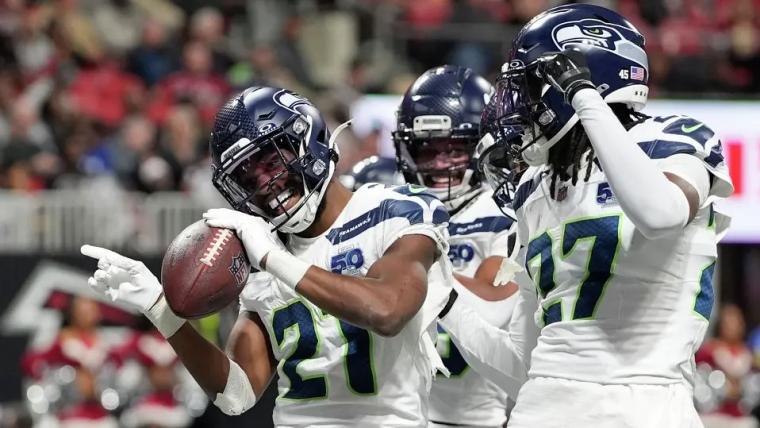
How Seahawks defense under Mike Macdonald compares to Richard Sherman, Kam Chancellor and Legion of Boom originally appeared on The Sporting News. Add The Sporting News as a Preferred Source by clicking here.
The Seattle Seahawks’ “Legion of Boom” is one of the most iconic defenses in NFL history, but as of January 2026, a new-age fortress is emerging in the Pacific Northwest that is beginning to eclipse even those legendary standards.
Advertisement
Under head coach and defensive architect Mike Macdonald, the 2025 Seahawks finished the regular season with the NFL’s No. 1 scoring defense, allowing just 17.2 points per game — the first time the franchise has led the league in that category since the peak Legion of Boom era. While the original Legion was defined by its Hall of Fame secondary and a physical Cover 3 shell, Macdonald’s unit has achieved similar dominance through a vastly different philosophy.
Here’s more on Macdonald’s defense that has Seattle fans thinking of the Legion of Boom.
MORE 2026 NFL PLAYOFF NEWS:
What is the Legion of Boom?
The Legion of Boom (LOB) was the nickname for the Seattle Seahawks’ legendary secondary during the early to mid-2010s. While the name originally described the defensive backfield, it eventually came to define an entire era of Seattle football characterized by physical dominance, trash-talking bravado, and historic statistical excellence.
Advertisement
The members of the Legion of Boom are among the best in Seahawks history, leading the franchise to its only Super Bowl.
Richard Sherman, cornerback
Sherman was the most vocal member and a cerebral “shutdown” corner. At 6’3″, he was unusually tall for the position, allowing him to jam smaller receivers at the line. He led the NFL in interceptions in 2013 and famously made “The Tip” to win the NFC Championship that year.
After that game, Sherman delivered one of the most iconic interviews in recent memory.
MORE: Revisiting 2013 NFC championship game
Kam Chancellor, safety
No. 31 on Seattle was the “boom.” Standing 6’3″ and 232 lbs, Chancellor hit like a linebacker but moved like a safety. He was the intimidation factor of the group; his massive hits often set the tone for the entire game.
MORE: Ranking the 15 greatest Seahawks players ever
Advertisement
Earl Thomas, safety
Thomas was essentially the “centerfielder” of the defense. He had world-class speed and instincts that allowed him to cover the entire deep part of the field by himself. This let the other defenders play closer to the line of scrimmage, essentially giving Seattle a “hidden” extra player in the run game.
MORE: What is Sam Darnold’s net worth?
Brandon Browner, cornerback
Browner, the team’s second cornerback, might have been the most physical. At 6’4″, he was a former CFL star who excelled at “man-handling” receivers. After the 2013 season, he left for New England but remained an honorary founding member of the Legion of Boom.
He was replaced by Byron Maxwell, who also had a critical role on the elite defense.
Advertisement
Outside of the four secondary members, Seattle had elite players all across the defense. This includes Bobby Wagner, a future Hall of Famer, and the cerebral heart of the defense. He was unique because he was equally elite at stopping the run and dropping back into pass coverage.
Also on the team was K.J. Wright, Malcom Smith, Michael Bennett and Cliff Avril.
MORE: Sam Darnold’s teams timeline
Seahawks 2025 stats vs. Legion of Boom
In 2026, the comparisons between Mike Macdonald’s defensive unit and the legendary 2013 Seahawks have reached a fever pitch. While the Legion of Boom remains the gold standard for intimidation and consistency, the 2025 unit (nicknamed “The Dark Side”) has produced a statistical profile that is, in several categories, actually superior to the Super Bowl XLVIII champions.
Metric
2013 Legion of Boom
2025 “The Dark Side”
Regular Season Record
13-3
14-3
Points Allowed Per Game
14.4 (1st)
17.2 (1st)
Yards Allowed Per Game
273.6 (1st)
267.0 (1st)
Rushing Yards Per Game
101.6 (7th)
75.7 (1st)
Passing Yards Per Game
172.0 (1st)
191.3 (8th)
Total Takeaways
39 (1st)
25 (6th)
Total Sacks
44 (8th)
47 (12th)
Yards Allowed Per Play
4.4 (1st)
4.5 (1st)
3rd Down Conversion %
37.3 (12th)
32.9 (1st)
While the Legion of Boom can never be replaced, there are stars on the 2025 Dark Side that might be comparable statistically.
Position
2013 Legion of Boom
2025 Dark Side
Key Comparison
Cornerback
Richard Sherman
Devon Witherspoon
Sherman was a “boundary” eraser; Witherspoon is a “slot” disruptor with more sacks and tackles for loss.
Middle LB
Bobby Wagner
Ernest Jones IV
Jones has matched Wagner’s 2013 tackle efficiency, leading the 2025 team with 126 total tackles.
Strong Safety
Kam Chancellor
Nick Emmanwori
Both 6’3″ enforcers; Emmanwori has recorded 4 interceptions as a rookie in 2025.
Defensive Line
Michael Bennett
Byron Murphy II
Bennett moved inside on passing downs; Murphy is a true interior force, tied for the team lead with 7 sacks.
Interior Force
Red Bryant
Leonard Williams
Williams offers more “pass rush” than Bryant did, finishing 2025 as a 2nd-team All-Pro while tallying seven sacks.
The comparisons reached a high after Seattle’s 41-6 demolition over the 49ers in the divisional round.
Advertisement
MORE: Where is Jaxon Smith-Njigba from?
How good was the Legion of Boom?
The Legion of Boom was not only good, it was historic.
They are the only team in the Super Bowl era to lead the NFL in scoring defense for four consecutive seasons (2012–2015). Their crowning achievement was a 43-8 demolition of the 2013 Denver Broncos, who had set the NFL record for the highest-scoring offense in history. The Legion of Boom held them to a single touchdown.
The secondary also had an impact on the way the game is played. They forced the NFL to change how it officiated “defensive holding” and “illegal contact” because their physical style of play was so disruptive to the league’s star wide receivers.
Statistically and culturally, they are widely considered one of the top three defenses of all time, alongside the 1985 Bears and the 2000 Ravens.
Advertisement
MORE: Sam Darnold’s family tree