
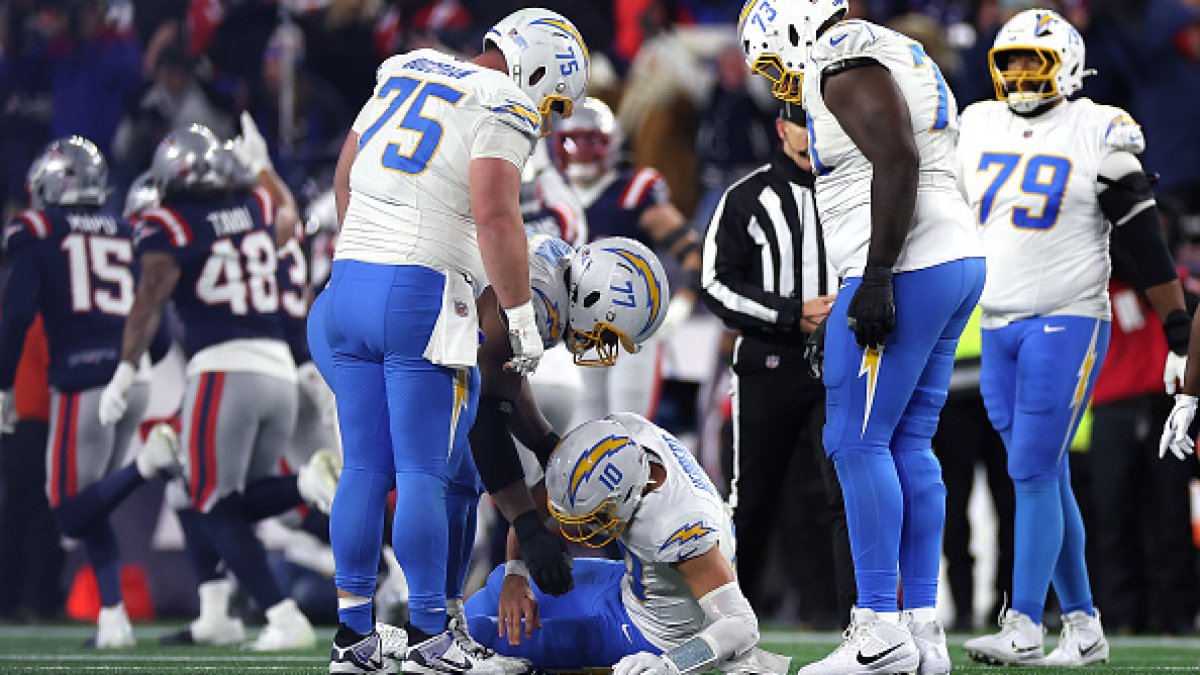
Gillette Stadium, draped in cold and expectation, felt like it was holding its breath from the opening kickoff. Prime-time playoff football has a way of turning the air heavier, the margins thinner, the mistakes louder. And for the Los Angeles Chargers, every step forward felt met by a wall dressed in navy blue.
This AFC Wild Card matchup never became the shootout some anticipated. Instead, it unfolded as a slow-burning struggle — one defined by defensive resolve, missed opportunities, and a familiar postseason ache for Los Angeles. The Chargers offense went missing as the Patriots defense dominated 16-3 to advance to the AFC Divisional Round.
The Chargers didn’t arrive timid. Their opening possessions showed flashes of intent, movement, belief. On their second drive, Los Angeles marched deep into New England territory and stood at first-and-goal, inches from changing the tone of the night.
Then the field shrank.
On fourth-and-goal from the two-yard line, Justin Herbert took the snap, scanned, and fired — the ball falling harmlessly to the turf. Incomplete. Turnover on downs. A chance swallowed whole by the Patriots’ defense, which stiffened like steel when the goal line came into view.
It was a moment that lingered. In Foxboro, moments linger.
If there was no fault to be found, it lived on the Chargers’ defensive side of the ball. Ranked fifth in the NFL during the regular season, that unit carried its weight and then some, holding New England to just 16 points in a playoff environment designed to expose cracks.
They tackled cleanly. They closed windows. They forced the Patriots to earn every inch. Time and again, they gave Herbert and the offense a chance to find rhythm, to tilt the game back toward balance.
That rhythm never arrived.
What followed was a night of frustration and stalled momentum. Five punts. Empty possessions. A sense that timing and trust were just a beat off. The Patriots’ defense — disciplined, physical, and patient — dictated the pace, never allowing Los Angeles to settle in.
Late in the game, with the Chargers driving into New England territory and hope flickering once more, disaster struck. A fumble — sudden, cruel — erased the drive and all but sealed the outcome. In January football, those are the plays that become chapters in long memories.
The Chargers never recovered.
When the clock finally bled dry, the silence felt heavy for Los Angeles. It was a familiar ending for head coach Jim Harbaugh and Herbert. This loss marked the second straight AFC Wild Card defeat for the head coach and his quarterback, following last season’s 32–12 loss to the Houston Texans.
Two seasons. Two early exits. Two nights defined less by what the Chargers lacked in talent, and more by what they couldn’t summon when the stage demanded it most.
Herbert stood again at the center of the questions — not because of failure, but because greatness invites expectation. Harbaugh, brought in to harden a culture and sharpen January edges, now faces a familiar offseason truth: potential is meaningless if it never blooms when it matters.
For the Patriots, this was vintage playoff football. Control the trenches. Win the moments that matter. Let defense carry the narrative.
They advance to the AFC Divisional Round, where they’ll host either the Houston Texans or the Pittsburgh Steelers next weekend — another cold night, another chapter, another chance to lean into who they’ve always been.
For the Chargers, the journey ends where it always seems to — with questions unanswered and promise deferred. The talent remains. The defense is real. The quarterback is elite.
But January doesn’t care about résumés.
It only remembers results.
And Sunday night in Foxboro, the Chargers were left with the same haunting feeling: close enough to touch it, far too distant to keep it.