
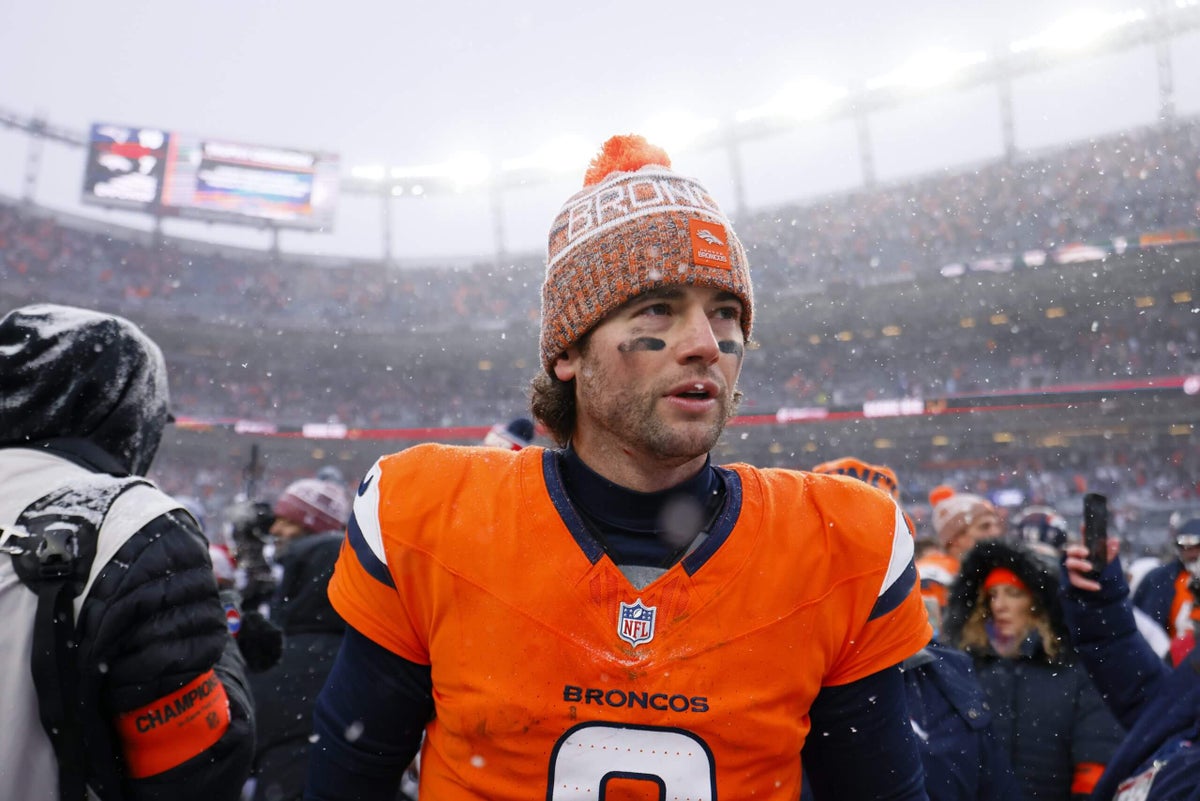
DENVER — Gifted the opportunity of a lifetime — the chance to help the Denver Broncos reach the Super Bowl some 749 days after his last start — Jarrett Stidham endured the roller coaster that is NFL quarterbacking on Sunday.
Pressed into duty a week after franchise quarterback Bo Nix suffered a season-ending fractured ankle, Stidham — the 29-year-old journeyman in his sixth NFL season — dazzled on his second possession of the AFC Championship Game against the New England Patriots. He directed his team to a crisp scoring drive capped by his first touchdown pass since Jan. 7, 2024. The momentum dipped a quarter later. While orchestrating another promising drive, Stidham scampered towards daylight and dove for a first down at the New England 14, only to come up short by a yard and throw an incompletion on the next play for a loss of downs.
But of all of the hundreds of decisions and split-second reactions that comprised Stidham’s high-stakes cameo, none felt as low as the painful sequence in the closing minutes of the second quarter that largely defined the Broncos’ 10-7 loss to the Patriots.
And so, Stidham found himself on the wrong side of the razor-thin margin of error that comes with NFL quarterbacking, and a Denver Super Bowl drought that has lasted for a decade is guaranteed to extend further.
For much of the game, Stidham demonstrated why in the days leading up to the conference championship, Broncos coach Sean Payton professed undying confidence in the quarterback to anyone who would listen. For the first quarter and a half, he delivered crisp passes, moved well in the pocket and even extended plays with his legs. He had bright spots off and on throughout the game. The positives provided optimism that maybe, just maybe, Payton was right: that the kid could indeed play, and given the backing of one of the most dominant defenses in the league, the Broncos could punch their ticket to Santa Clara, Calif.
But then New England coach Mike Vrabel started to get a bead on how Payton, Stidham and the Broncos’ offense hoped to attack and dialed up the pressure while also snuffing out Denver’s rushing attack. Stidham’s effectiveness started to wane, and his lack of poise — the poise quarterbacks develop through extensive playing time — became evident. And then, on Denver’s fourth possession of the game, came the crack that the Patriots needed.
Overwhelmed almost as soon as he took the snap from his own 33-yard line with 2:59 left in the second quarter, Stidham went on the retreat — back-pedaling 19 yards in hopes of eluding linebacker Christian Elliss. But as the 6-foot-2, 231-pound Elliss bore down on Stidham, the quarterback tried to chuck the ball to running back Tyler Badie, who squirted away from defenders in hopes of catching a screen pass.
But Stidham’s awkward desperation heave came nowhere close to the back and bounced around on the grass near the left sideline before Patriots linebacker Elijah Ponder scooped it up. Initially, it appeared as if Stidham and the Broncos would avoid disaster as the whistle blew and an incomplete pass was signaled by referee Alex Kemp, who also threw his flag and assessed an intentional grounding call. That would have translated into a loss of yardage and downs, but Denver would have still maintained possession and could have punted.
But then, after a conference among the game officials, Kemp changed his call.
“The down judge and the umpire came and talked to me and provided more information. The down judge explained that he extended his right arm to signal that he had a backward pass, and at that point, we determined that New England picked up the backward pass,” Kemp explained in a pool report. “We awarded possession to New England with no advance, because at that point, we are not allowed to permit an advance. … The whistle stopped the play, but it was after the New England player picked up the ball.”
Until that point, the Patriots had punted on four straight possessions. Quarterback Drake Maye couldn’t find comfort behind a line that struggled to fend off Denver pass rushers, including Nick Bonitto and D.J. Jones, and New England managed just 36 yards over the first 27 minutes.
But the gift in the form of the ball at the Denver 14-yard line proved sufficient enough as, two plays later, Maye darted 6 yards and into the end zone for a game-tying score — and New England’s only touchdown.
Stidham regretted his decision to try to salvage the broken play.
“Obviously, I can’t put our team in a bad position like that,” he said. “I was trying to throw it away to (Badie). He was in the area, and, yeah, the pressure, (Elliss) just got up on me real fast, and I was just trying to get rid of it. … That was completely on me. … I thought I’d thrown it forwards, and then obviously the replay, or whatever, said differently. So yeah, like I said, just, probably should have just eaten the sack anyway, and let Jeremy Crawshaw and the punt team punt it down the field and flip the field.”
The Patriots reached the red zone only once more after that — on their 9 1/2-minute drive to open the third quarter — but had to settle for a field goal that gave them a 10-7 lead. But Denver never reached the red zone again itself. The time-consuming field-goal drive translated into a game of keep-away from the Broncos, who managed only 7 yards of offense in the third quarter. And as winds swirled and snow blanketed Empower Field, the Broncos struggled to move the ball as receivers and running backs struggled with footing, Stidham struggled to grip the ball enough to throw with accuracy and kicker Wil Lutz missed a 45-yard field goal with 4:46 left.
New England held on for the win, and Stidham’s gaffe loomed large. But so too did Payton’s decision to pass on a second-quarter field goal that would have given his team a 10-0 lead. As did a handful of dropped passes and an underthrown pass by Stidham that New England’s Christian Gonzalez picked off with 2:18 left.
Payton refused to saddle the quarterback with the loss, however.
“I thought he fought hard in tough conditions,” the coach said. “I think we’re going to look at the film and I know this. I’m going to look at it and be critical of myself. And I think there were a number of things that we just had to do better.”
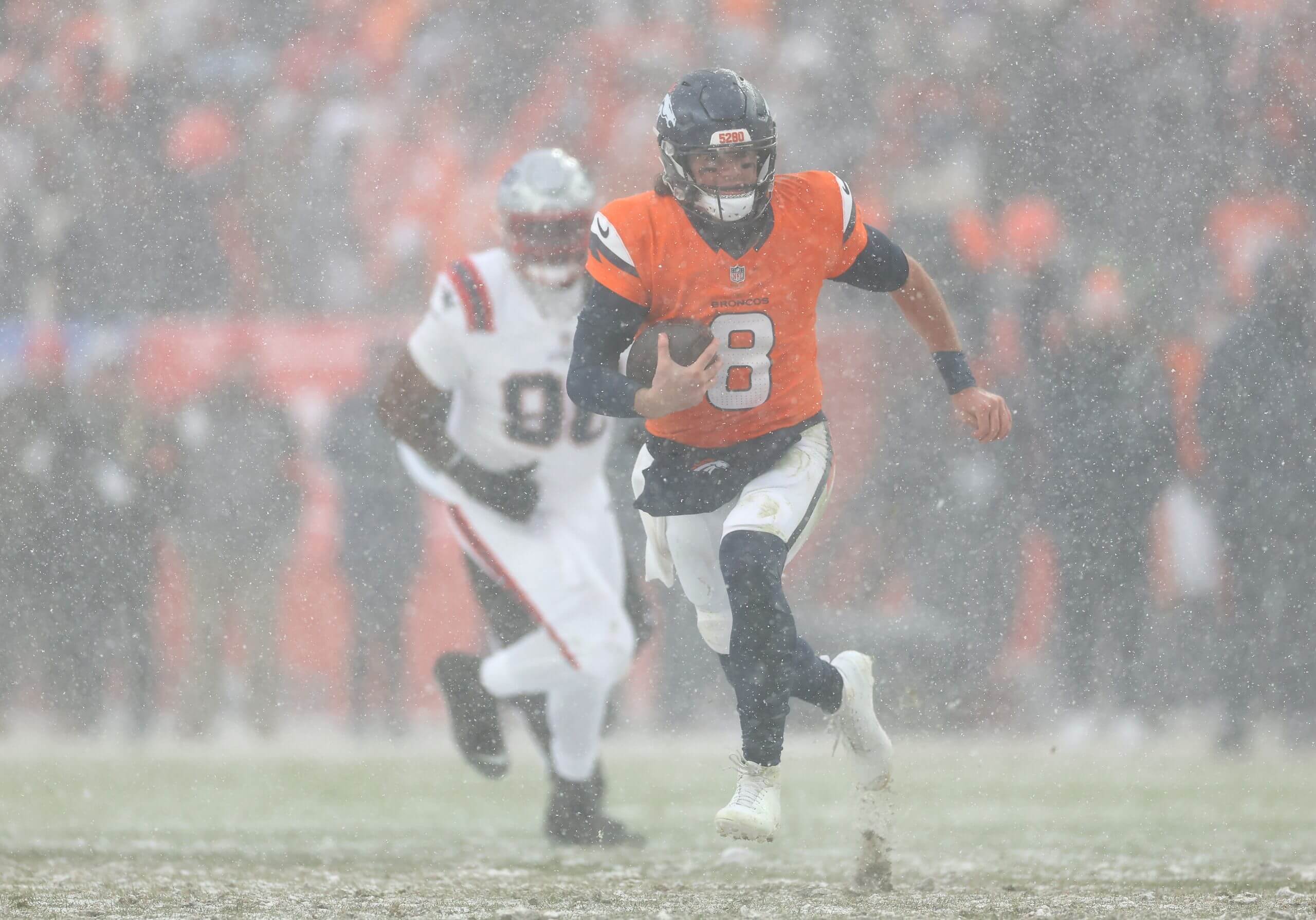
Once the weather conditions worsened, it made things even tougher for Jarrett Stidham in his first start in two years. (Matthew Stockman / Getty Images)
Right tackle Mike McGlinchey agreed with his coach’s assessment.
“I don’t know, as a team, we didn’t get this done,” he said. “If anybody’s gonna try to put this on Stiddy, that’s bulls—. … He had a good day given the circumstances — obviously it starts snowing and (getting) windy and makes it impossible to kind of throw the ball forward. And that was, that’s kind of the bummer about being down before that started.”
The injured Nix huddled with Stidham as soon as he got to the locker room and worked to encourage his teammate, and other players echoed his sentiments.
The support helped, but the sting of defeat left Stidham with a range of emotions. While grateful for the chance, he was sick over the missed opportunity and unsure of when his next shot will come.
“I mean, obviously, it was fun to get back out there with the guys,” said Stidham, who completed 17 of 31 passes for 133 yards, the touchdown and the interception. “I mean … this is why you grow up playing the game of football. And, all the long hours that you put into it, offseason, in-season, all those things. And this is, this is why we do what we do. So, I was obviously super excited for the opportunity today. And I just hate that we fell short.”