
The 2025 NFL Playoffs have been entertainment central.
Game after game has come down to the wire. Last-second winners all over the place. Drama galore.
There is, however, a lesson hiding in plain sight that these playoffs are teaching the NFL.
Advertisement
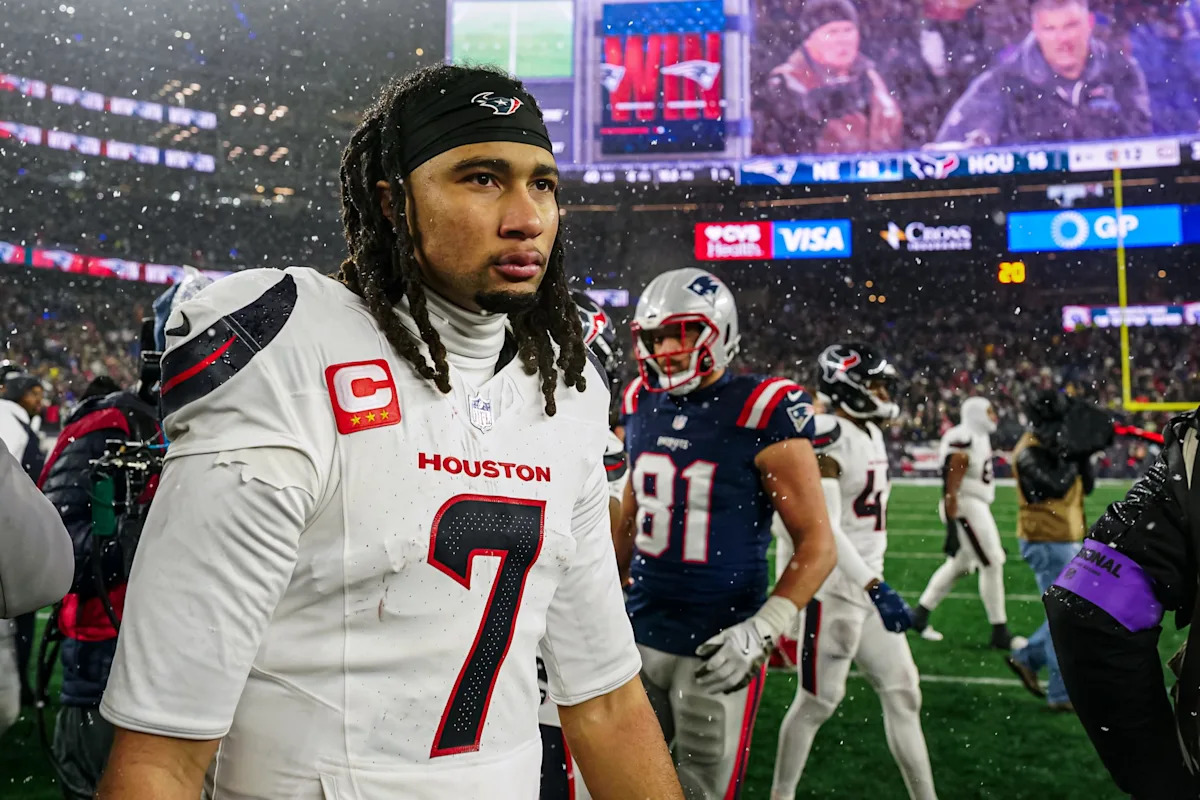
CJ Stroud won a game 30-6 despite fumbling five times and throwing two picks. Caleb Williams beat the Packers while turning the ball over three times. Sam Darnold didn’t even need to play football against the 49ers – someone off the street could’ve been the Seattle QB, kneeled on 1st-3rd down, forcing a punt on 4th, and the result would’ve been the same. Matthew Stafford, just this past Sunday, won a game without a touchdown.
If these playoffs have taught us anything, it’s this: wins have never been, should never be used as, and never will be a quarterback stat. Ever.
Why Do People View Winning As A QB Stat?
The premise itself carries a bit of merit.
Advertisement
The QB is seen as the heart of the team, the central piece – the offensive side of the ball runs through him. The team that scores the most points wins. Hence, wins are attached to the quarterback.
This notion completely omits the impact of the other 10 players and coaches. But it is this notion that shapes some of the most salient narratives in the NFL today. Being the center of attention equals being the center of success, according to some.
Some quarterbacks have helped reinforce this notion with elite play. The likes of Tom Brady and Patrick Mahomes come to mind immediately. However, even there lies a problem. Of course, the greatest find ways to win – it’s by definition what makes them great.
But using the greats to prove that winning is a QB stat is using the exception to prove the rule.
Advertisement
The all-time greats are outliers.
The Statistics Stifling The Narrative
There are an abundance of statistics that disprove that winning is a quarterback stat.
A personal gem is Eagles QB Jalen Hurts, who is 4-1 in postseason games in which he throws for less than 200 yards. His first loss? That’d be the one he suffered this year against the 49ers. Furthermore, Hurts’ 304-yard game in SB 57 is his only 300-yard playoff game to date. The result of that game was a 38-35 Eagles defeat.
Ok, that’s just one person. Here’s another – CJ Stroud’s defenses in his three playoff victories have matched their opponents for scoring by themselves:
One last individual stat – this one involves retired QB Trent Dilfer. Dilfer is perhaps the poster child of win/loss numbers lying. He made exactly one Pro-Bowl in his career and never threw more than 25 passing TD’s in a season. Dilfer even has more career INT’s than TD’s. However, Dilfer has a playoff winning percentage of .833 (5-1), which is better than the following QB’s:
Advertisement
That is a list of five quarterbacks who are either already in Canton or are going to be in 10 years.
All but Allen are locks to be 1st-ballot.
Only a cynic would entertain putting Trent Dilfer in that conversation, yet that’s what using wins as a QB stat allows and even encourages.
The Team Side
Looking at the bigger picture, the league itself has evolved into a league where quarterback quality matters less.
Volume passing numbers all around are down from 10 years ago – yards, attempts, it’s all down. It’s not a lack of receiving talent, either –the position is probably as rich for talent as it has ever been. Conversely, all volume rushing statistics are up from 10 years ago – rushing yards/game, attempts, and yards per attempt.
Advertisement
Teams have simply figured out that having a strong run game to control time helps win football games more often. Shivam Sharma put that discovery into data in a piece covering play styles, like the picture below:
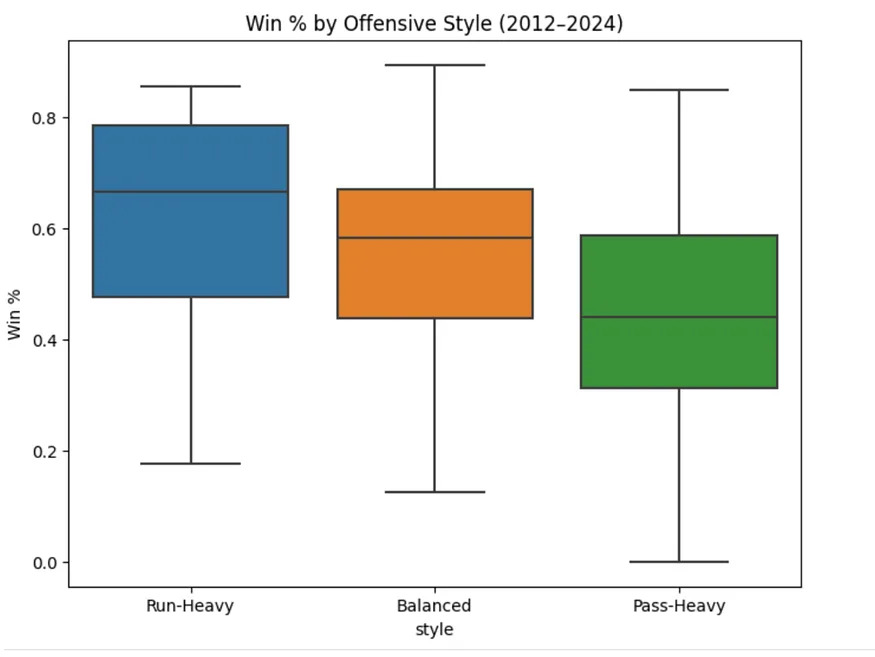
A passing phenom isn’t necessary under center. Nice to have? Yes. But a necessity, it is not.
This is partially why running QB’s are so valuable now. It’s also why average passers in several categories can still be serial winners.
It’s why wins are such a no-go as a QB stat. The QB is being asked to do less, so it’s no longer squarely on their shoulders. Ergo, the wins shouldn’t be either. The defensive side of the ball hasn’t even been mentioned in this article, but it’s largely the same premise – defenses that force punts are more efficient than those that force turnovers, because turnovers are more volatile. More stops = less room for error.
Advertisement
All in all, quarterbacks are being presented with better, more efficient supporting casts than ever before. There is less weight on their shoulders, and way more room for error. A game where a QB didn’t throw a TD or, say, turned it over four times would be a three-score loss back in the day. Now, such performances win games 20-17 in overtime, and 30-6 on the road.
Those afforded that luxury shouldn’t be applauded for hitching a ride, and those not afforded it can’t be ridiculed for missing their stop.
The NFL has never been more of a team sport, and the final score should be treated as such.
The post 2026 NFL Playoffs Prove Wins Aren’t A QB Stat. appeared first on The Lead.