
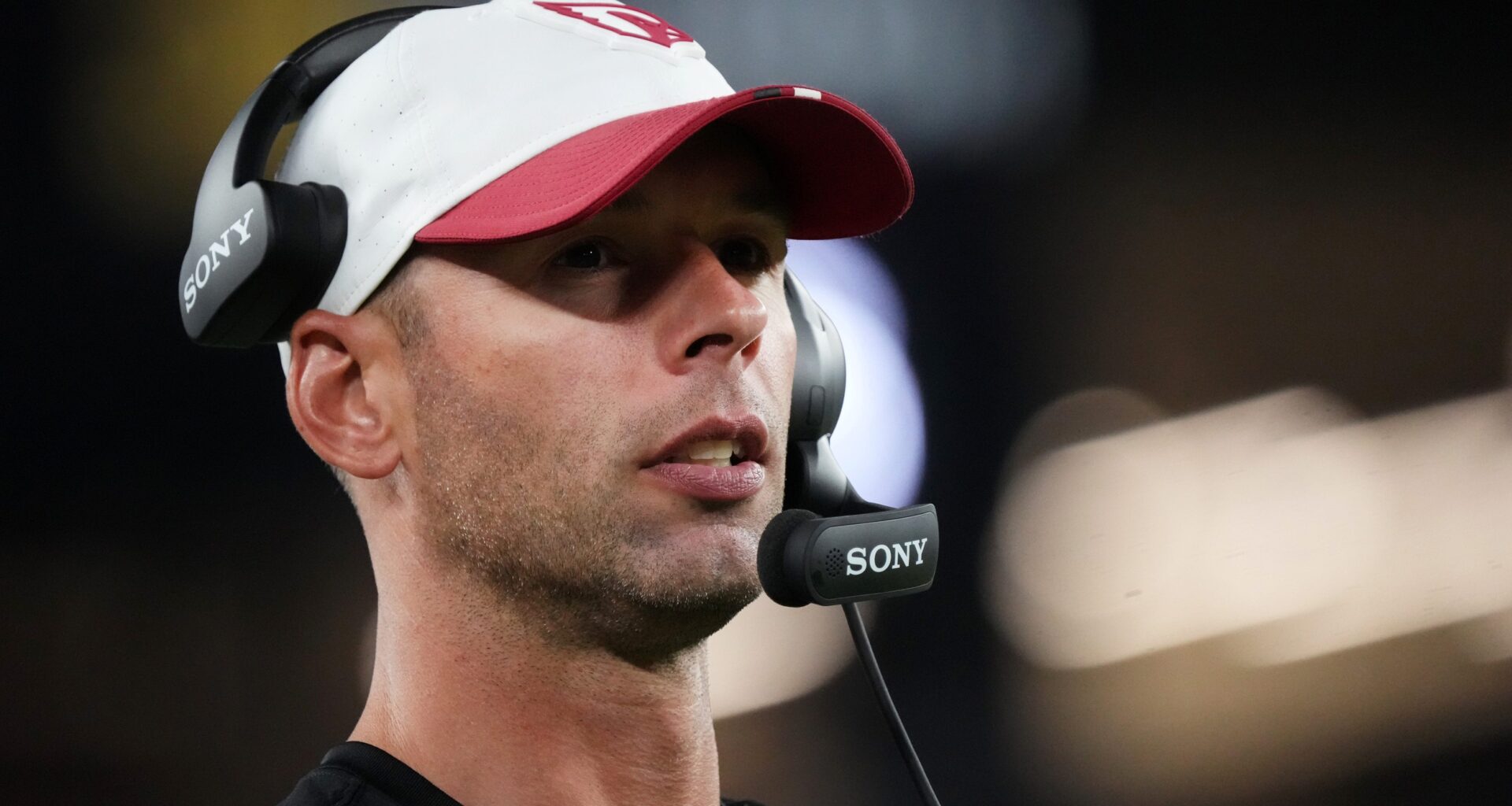
The Green Bay Packers have braced for unpredictability after hiring former Arizona Cardinals head coach Jonathan Gannon as their defensive coordinator. Gannon developed his defensive foundation during his two seasons in Philadelphia. There, he used a Vic Fangio-inspired system built around a four-man front and split-safety coverages during a run that culminated in a Super Bowl appearance.
Packers are hiring former Cardinals HC Jonathan Gannon as their defensive coordinator, per source.
— Adam Schefter (@AdamSchefter) January 25, 2026
The Philadelphia Eagles consistently operated out of a 4-2-5 structure, leaning heavily on match-quarters concepts that disguised coverage intentions before the snap and transitioned smoothly into man responsibilities as routes developed. That structure emphasized discipline and efficiency over all-out aggression. They coached linebackers to gain depth in coverage and rally downhill once the ball was released, while the secondary focused on squeezing throwing windows in the intermediate middle of the field.
With coverage integrity on the back end, Gannon trusted his front four to create pressure through rotation, stunts, and complementary pass-rush pairings instead of heavy blitzing. During his two-year stretch in Philadelphia, Gannon’s defense ranked eighth in EPA per play and 19th in success rate while piling up 70 sacks.
The Eagles finished in the top 10 in total defense in both seasons, peaking in 2022 when they ranked second overall, led the NFL in fewest passing yards allowed and sacks, and finished tied for fourth in interceptions. However, that stability disappeared the next season. After Gannon departed for Arizona in 2023, Philadelphia’s defense slid to 29th in EPA per play and 27th in success rate.
Gannon didn’t have anything close to the same level of personnel in Arizona that he enjoyed in Philadelphia, particularly along the defensive line, and that reality forced him to adapt. Without a dominant four-man rush, disguised pressures and coverage rotations became a much larger part of his defensive identity with the Cardinals. Arizona leaned more on simulated looks, late-safety movement, and manufactured pressure to compensate for limited talent in the trenches.
Because I’m a nerd, I have watched a ton of Arizona Cardinals tape since ’23.
Here are some resources:
… pic.twitter.com/zoVWQVgCOD
— Cody Alexander (@The_Coach_A) January 25, 2026
The results were rough. Over Gannon’s three-year tenure in Arizona, the Cardinals ranked third in most points allowed, 30th in EPA per play, 31st in dropback EPA per play allowed, and 32nd in success rate.
Still, context matters. Arizona has been one of the league’s most dysfunctional franchises during that stretch, and expecting immediate defensive competence was unrealistic given the roster he inherited. Considering the personnel at his disposal, particularly up front, the expectations placed on Gannon were never entirely fair.
Green Bay’s decision to hire Gannon as defensive coordinator is ultimately a wager that roster limitations, not coaching shortcomings, were to blame for Arizona’s results. According to Next Gen Stats, Gannon’s Cardinals never finished higher than 23rd in pressure rate and 27th in EPA per play. In Philadelphia, his defenses ranked fifth in both pressure rate and EPA per play.
We don’t know whether Green Bay will shift from a 4-3 to a 3-4 defense under Gannon. Still, the distinction is largely cosmetic in today’s NFL, where nickel is the true base defense. What matters far more is how a coordinator deploys personnel within those sub-packages, and Gannon has already shown he can tailor his structure to his roster each year.
Still, the early version of Green Bay’s defense under Gannon will be shaped more by availability than alignment, with Micah Parsons’ health looming as the biggest variable. How quickly he returns — and at what level — will likely dictate how aggressive and complete the first on-field product looks.
When Parsons was on the field, Green Bay’s pass rush held its own, generating pressure with just four rushers. The Packers may not have had the kind of wave-based rotation Philadelphia once did. Still, their starting front showed it could consistently affect quarterbacks without Jeff Hafley having to dig deep into his pressure package.
That changed abruptly after Parsons tore his ACL in Denver. The rush evaporated, pressure became scarce, and the defense unraveled down the stretch. It allowed at least 30 points in three of the final five games as Green Bay limped to an 0–5 finish.
A Micah Parsons stat.
Packers’ defense success rate:
Weeks 1-14: 11th
Weeks 15-18: 30th
— Wendell Ferreira (@wendellfp) January 22, 2026
Regardless of when Parsons returns, the Packers are likely to lean into more five-man fronts, a familiar feature of Gannon’s defenses. Those looks help dictate protections and reduce the number of clean double teams off the edge. Even so, the foundation of Green Bay’s defense will naturally evolve, shaped by the personnel on hand and the realities of a new environment rather than a strict commitment to what Gannon ran at previous stops.
Gannon has said before that he “doesn’t have a scheme,” and that mindset gets to the point of what Green Bay is buying. His defenses are built to be hard to predict, adjusting week to week rather than living in a fixed identity, and that’s likely where the core of this unit begins.
It’s also why judging him solely on Arizona misses the mark. The personnel there was poor, and while he wasn’t a successful head coach, he became one because he was a strong defensive coordinator. In Green Bay, with a more stable roster and a narrower focus, Gannon has a chance to remind the league of that.