
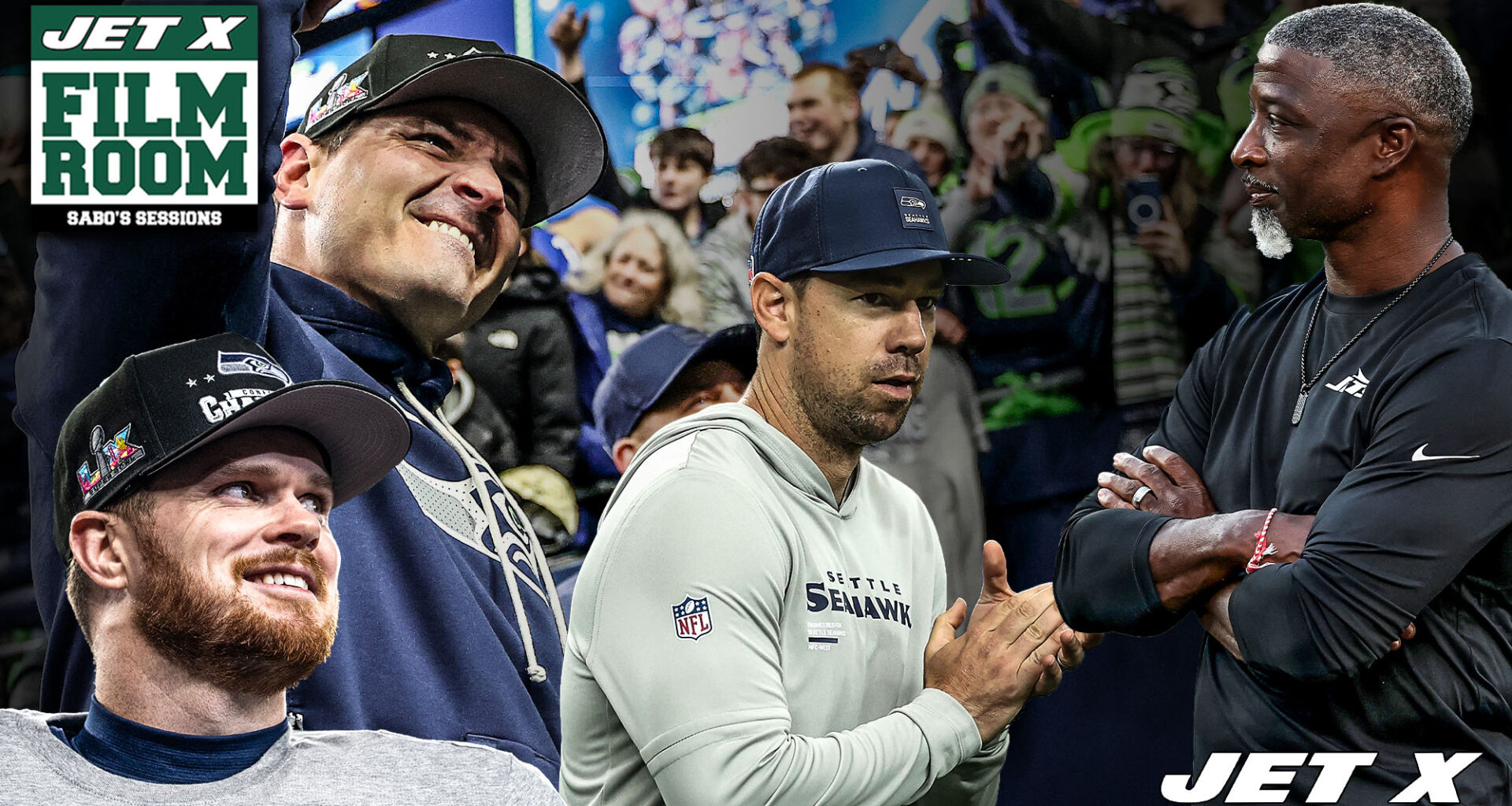
Try to immerse yourself in the following scenario…
You’re holding the clipboard for the Seattle Seahawks, clinging tightly to a 31-27 lead with just over eight minutes remaining in the NFC championship game. On the other side is a Super Bowl-tested Los Angeles Rams squad led by quarterback Matthew Stafford, and they’re driving the field.
They’re driving your field, Lumen Field.
Equipped with two Hall of Fame weapons in Davante Adams and young Puka Nacua (who’s a Canton shoo-in, save for disaster), Sean McVay is effortlessly dialing up calls that are cutting through your defense like butter.
You remember what you’re up against, even though you’re certain you’re not stupid enough to forget. But hey, such is life as a human. Such is life as a football coach, as the myriad of thoughts that enter your brain over the course of a football game are infinite.
With McVay’s offense facing a fourth-and-1 situation at your 26-yard line, the clipboard naturally raises up to your mouth, while your MIKE stares attentively from the field. What do you dial up in this situation?
One monster stop can change the entire game. Your offensive coordinator, Klint Kubiak, has been masterful all day, and your quarterback, Sam Darnold, has executed to a near-perfect level.
If your defense can make this one short-yardage stop, your offense would have the opportunity to put this puppy away, making your next stop the Super Bowl.
So, with Seattle’s 12th Man going nuts while smashing the decibel meter, energy is high, and emotions are strong. Whatever you tell your defensive captain, through that headset, is ultra-critical for your team’s championship aspirations.
What does Mike Macdonald, the defensive-minded head coach, do to answer the chaotic and hectic moment with everything on the line?
He concedes the first down…
Conceding the first down
That’s right. Mike Macdonald pretty much told Sean McVay, “Go ahead; take the first down.”
John Madden surely rolled in his grave on Sunday night.
Seattle’s defensive look was anything but a short-yardage call. Sure, Macdonald deployed a single-high safety, which both helped the box with an extra defender and prompted off-coverage on the outside, but sticking with the base over front in this particular situation is akin to conceding the first down.
Not a joke.
See, in Macdonald’s world, the only critical item at that very moment was not to give up a touchdown. Time, although always important in this version of the NFL, wasn’t nearly as important as red-zone defense, which focused on not relenting six.
Had Macdonald loaded up the box and played short-yardage there, he would have understood what that meant. The newly minted NFC champion head coach knew that McVay would look to take advantage of it.
A fourth-and-1 scenario is a perfect down to rip the heart out of the defense. Though high-risk in nature, taking advantage of a thin on-top look would have allowed McVay and Stafford to take a shot with Nacua or Adams.
Interestingly enough, the Rams didn’t even run the ball. McVay was already thinking pass in that short-yardage spot, and you better believe that Nacua’s deep-crossing route was ripe for the taking (had Stafford not tucked it).
Remember, the one featured a hectic game flow where defenses couldn’t do much. Seattle finished with 396 yards of total offense, whereas Los Angeles gained 479. Unless the weather is impacting the game in a significant way — such as the AFC championship between the New England Patriots and Denver Broncos — offensively bananas game flows like this one are commonplace in today’s NFL.
The results from conceding
Although Stafford did pick up the first down, the Seahawks ultimately bowed up near the goal line, stopping the Rams on downs.
Think about the calculation for a moment: Not only is Macdonald’s decision to concede the first down smart in terms of not giving McVay a juicy chance to hit them over the top for a big chunk (or touchdown), but it also forces more time off the clock.
At that moment, 8:16 remained on the clock. By the time the Seahawks got the ball back after the Rams failed on fourth-and-4 from the 6-yard line, just 4:54 remained in regulation.
From that point forward, Kubiak featured his usual modern play-calling, passing on second down. Despite Tom Brady’s shock in the FOX broadcast booth, the Seahawks entrusted their offensive play-caller and quarterback to take advantage of early downs that are more balanced (run-pass).
The old-school mind runs it on first, runs it on second, and then has a decision to make. The new-school mind uses those perceived rushing downs to throw a dagger in the opposition’s heart — especially in this type of high-flying game.
Not only does it give the offense a better chance to run time off the clock by moving the ball, but it creates higher-percentage passing downs — thanks to the defense’s insistence on stopping the run (loading the box).
Incredibly, Macdonald entrusted Kubiak, a man who then entrusted his quarterback, the very same man who was once the next great hope of the Jets. Darnold, who struggled in New York and then fell flat on his face in Carolina, found his way after spending some time with a couple of quarterback gurus — Kyle Shanahan and Kevin O’Connell.
Coincidence?
Oh yeah, and make no mistake about it: When Macdonald feels it’s appropriate for his defense to make a short-yardage stop, he dials up the right front:
This is an example of a short-yardage look that aims to stop the rush (all gaps).
The Jets’ perspective
The difference between the NFL coach who is firmly attuned to what’s happening these days and the coach who remains convinced in a predisposed version of coaching is stark.
Perhaps the best way to put it is by using the board game Risk (the game of global domination).
The old-school football mind has a plan. This individual believes there’s a certain way to win football games, and in an effort to move troops across the board, he may hold the firm belief that taking North America first is the best (and only) route forward.
The North America-first strategy has always been great, and he feels it’s always served him well, as well as his mentors (in the days of yesteryear).
The new-school mind takes a different approach. This person moves and shakes with the board. As much as he would love to take North America, he realizes the figurative cards he was dealt make that incredibly difficult.
He never wants to target Europe, a place surrounded on all sides. Yet, based on how things look, that very well may be the best path forward.
In many ways, the new-school mind is playing a different game entirely. This strategic objective fundamentally contrasts with the old-school mind.
Thanks to a particular set of rules that have changed over time, the new-school strategy wins more times than not. Better yet, he ultimately captures North America; it just happens to come later in the game.
Based on everything New York Jets’ head coach Aaron Glenn has said, done, and put on tape this past season, there’s a lot of work needed to move into the new-school state of mind. The more Glenn preaches about his brand of football, the more it signals to Jets fans that he doesn’t understand the NFL is a brandless league.
Worse yet, this is a topic rarely discussed in NFL circles, which means it’s tough for folks to identify what’s gone awry for the Jets as an organization.
Coaching has far surpassed the value of players, thanks to the current landscape, yet nobody can really discuss that to a needle-driving degree. Why? Well, it’s bad for business.
That’s the National Football League’s dirty little secret these days. Unfortunately, for New York Jets fans, it feels like their team isn’t even in on that secret.
Yet again, we turn our attention to another offseason headlined by free agency and the NFL draft, in an effort to increase the roster’s overall talent. In other words, we turn our attention to another season of hope.
The only chance hope turns into tangible results is if Aaron Glenn’s Jets realize they’re playing the wrong game.
If Sam Darnold, the fresh-faced kid who came down with a curious case of mono, isn’t cursed, neither are the New York Jets.