
The 2026 NFL draft is expected to start at No. 2, where the New York Jets will likely select the first non-Fernando Mendoza prospect of the draft.
The debate regarding who New York should select will rage on until draft day. Do they go with an edge rusher? Do they snag an offensive weapon? Or, do they take the plunge and select a quarterback, even if it is considered a reach? Could they strike a trade-down deal?
Whatever the Jets decide to do, they must keep one overlooked factor in mind.
It’s not just about the No. 2 pick
This decision is about more than just picking the best player at No. 2.
It’s about getting the most value out of the first round as a whole.
Remember, the Jets also possess the 16th overall pick in this year’s draft, courtesy of the Indianapolis Colts via the Sauce Gardner trade.
For that reason, New York needs to approach the No. 2 pick with the No. 16 pick in mind. Their goal should be to get the most value out of both picks, rather than treating them as independent decisions. The Jets are unlikely to select the same position twice with their two top-16 picks, so they must use their draft board to project how the first selection might affect the outcome of the next one.
New York must think not just about the grade of the prospect they’re picking at No. 2, but also how steep the talent drop-off is at that player’s position from No. 2 to No. 16. Perhaps selecting a marginally lower-graded prospect at No. 2 could be worthwhile if it helps the Jets land a significantly higher-graded prospect at No. 16.
Which combination yields more overall talent for New York: EDGE at No. 2 and WR at No. 16, or vice versa?
This is the question that must be discussed at 1 Jets Drive, rather than simply stacking up the options at No. 2.
What is the best one-two punch?
The debate for the second overall pick mostly revolves around five players:
Ohio State LB/EDGE Arvell Reese (No. 2 on consensus big board)
Miami EDGE Rueben Bain Jr. (No. 3)
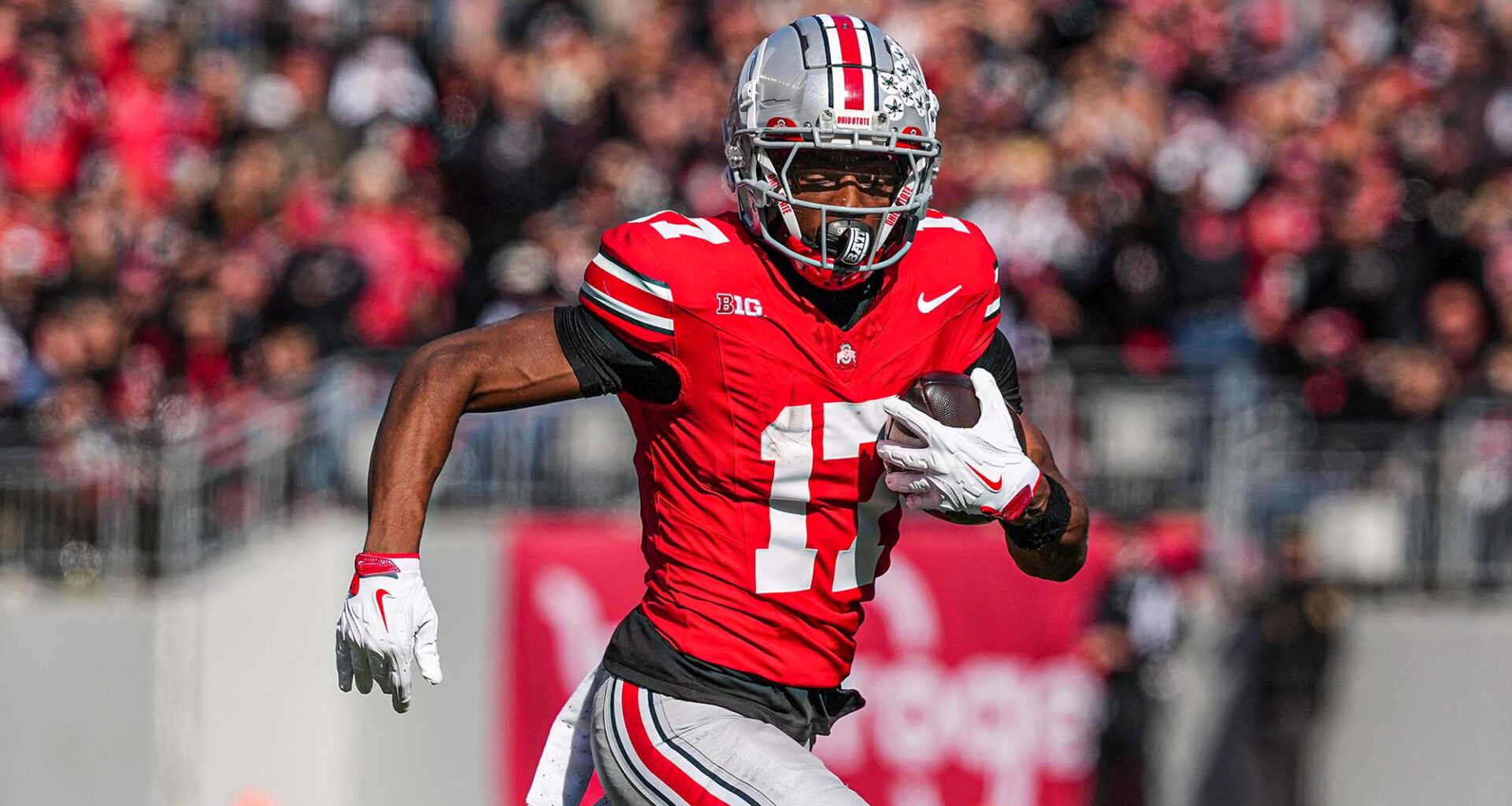
Ohio State WR Carnell Tate (No. 4)
Texas Tech EDGE David Bailey (No. 8)
Alabama QB Ty Simpson (No. 17)
Let’s analyze how each decision at No. 2 could affect the Jets’ outcome at No. 16.
QB Ty Simpson
Of the five players, Simpson is clearly the lowest-rated overall prospect by the consensus. If the Jets were to take him at No. 2, it would be with the idea that the value of a quarterback trumps the overall talent, and that they love Simpson enough to not want to risk losing him if they wait until later in the round.
After taking Simpson, the Jets would be left with just one non-QB in the first round, taken 16th overall. It would be an underwhelming haul for a historically bad team that needs plenty of help around the quarterback position before that quarterback can be expected to succeed.
The good news is that the Jets could probably still land a wide receiver at No. 16, giving them a piece that could directly aid the quarterback.
It’s on the edge where the Jets would likely miss out. After Reese, Bain, and Bailey, there is a significant drop-off, and the Jets would probably have to reach for an edge rusher if they want one at No. 16. At wide receiver, though, the Jets should have options.
USC’s Makai Lemon (No. 16 on consensus big board), Washington’s Denzel Boston (No. 23), and Texas A&M’s KC Concepcion (No. 26) are late-first-round talents who would represent justifiable picks in the 16th slot. If the Jets take Simpson second overall, there is a good chance they can pair him with a solid weapon on the outside.
The downside of this scenario is that the Jets would not allocate any first-round picks to their atrocious defense, which arguably has even less talent than their offense at the moment. However, the Jets have plenty of cap space to address their defense in free agency. They also would not have to wait long after the first round to start filling defensive holes, as they possess the 33rd and 44th overall picks in the second round.
Ultimately, though, the outcome of this scenario comes down to whether Simpson justifies the second overall pick.
The Jets have an opportunity to come out of this year’s draft with two high-percentage non-QB prospects between Nos. 2 and 16. It would be an extremely beneficial haul for a roster that has, at best, one star (Garrett Wilson). If they are going to pass up on an elite prospect at No. 2 for a QB who is not viewed as a can’t-miss guy, they had better be darn sure they have a plan to help that QB exceed expectations.
Given Simpson’s low-percentage profile, this does not seem like the smartest bet for the Jets. They might be better off punting on the QB position in the first round this year, or at the very least, taking their chances that they can get Simpson later.
WR Carnell Tate
There is an argument to be made that Tate is the best prospect in the draft. His profile is outstanding, giving him a high chance of becoming a star receiver at the level of players like Ja’Marr Chase and Jaxon Smith-Njigba.
New York has an obvious need for wide receiver help, and it’s a premium position, so that should put Tate firmly in the conversation at No. 2, right?
Well, this is where the importance of the 16th overall pick comes in.
As we alluded to earlier, the drop-off at edge rusher is much steeper than the one at wide receiver. If the Jets take Tate at No. 2, they will probably have to reach if they want an edge rusher at No. 16. However, if the Jets take an edge rusher at No. 2, there is a good chance they will still be able to grab an appealing wide receiver like Lemon or Boston with the 16th pick.
EDGE: Reese, Bain, or Bailey
If the Jets are choosing between Tate and one of the top three edge rushers, the choice basically comes down to this question: Which of these two scenarios do the Jets prefer?
(2) Carnell Tate and (16) Keldric Faulk/Cashius Howell/T.J. Parker
(2) Arvell Reese/Rueben Bain/David Bailey and (16) Makai Lemon/Denzel Boston/KC Concepcion
This is a completely subjective question with no definitive answer, but based on how things are shaping up at the moment, it can be argued that the second scenario is preferable for New York.
Like Tate at wide receiver, all three of Reese, Bain, and Bailey are phenomenal prospects with high chances of becoming stars. However, the next-best options at wide receiver seem more appealing than those at edge rusher.
Lemon and Boston have very appealing profiles in their own right, even if they’re not quite at Tate’s level. At edge rusher, though, the next-best prospect (based on the consensus big board, which is not gospel) after the top three is Keldric Faulk, whom we recently highlighted as a player whose profile suggests he has a relatively low chance of hitting for a high-first-round prospect.
Even if the Jets like Tate slightly more than their favorite edge rusher, it is probable that they project a better outlook at wide receiver than edge rusher down at No. 16. If that is the case, it should encourage them to take an edge rusher at No. 2 and target the wide receiver position at No. 16.
In fact, NFL Network’s Daniel Jeremiah projects a scenario in which the Jets take Reese at No. 2 and still land Tate at No. 16. That would be a dream outcome for the Jets.
Even if that does not transpire, the combo of Reese/Bain/Bailey at No. 2 and either Lemon or Boston at No. 16 seems preferable to Tate at No. 2 and someone like Faulk at No. 16.
Of course, though, this is all a matter of opinion. There are no right or wrong answers here, at least not for a few years down the line. For now, the goal is to map out the potential paths forward as best we can, using the information at our disposal to estimate which path offers the greatest odds of success.