
Winning the press conference won’t matter because it never does. What matters is winning on the field, and those results are about eight months away.
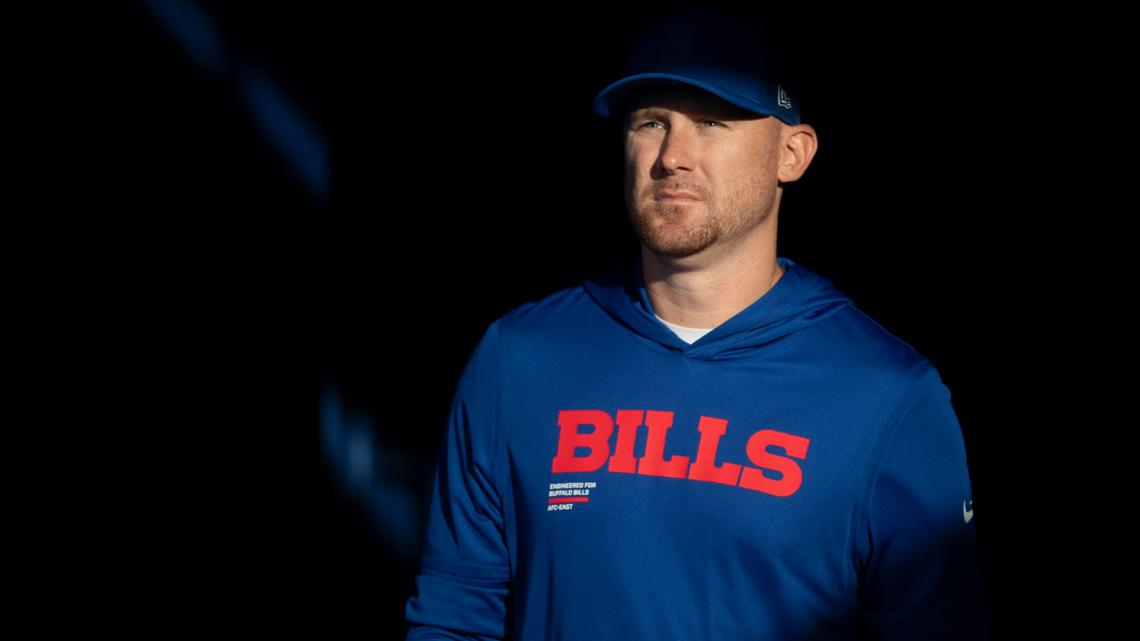
ORCHARD PARK, N.Y. — When Joe Brady is officially introduced as the Buffalo Bills’ new head coach on Thursday, there’ll be a predictable search for clues by most people watching and listening.
Does he look/sound like he’s ready to be the man in charge of an entire team rather than only one side of the ball?
Is he the kind of leader who inspires, who grabs and holds the attention of the room?
Can he get full buy-in from a roster whose core players were invested in a program that generated far more success than failure?
Will he lay out a plan that shows genuine promise to finally break through that “proverbial playoff wall” club owner Terry Pegula mentioned last week?
My guess is that most, if not all, of those questions will linger after Brady steps away from the microphone and disappears from the view of the cameras. That’s not a knock on his skills in front of microphones and cameras. It’s simply the reality of the situation.
Winning the press conference won’t matter because it never does. What matters is winning on the field, and those results are about eight months away.
In the meantime, there will be all sorts of judgments about whether the Bills made the right choice in replacing Sean McDermott. The majority won’t come from what he says on Thursday.
It will come from what we already know about Brady, because he has been a member of the Bills’ coaching staff since 2022, and what we already know about Brandon Beane, who is the more prominent figure in the franchise’s football operation and who will conceivably have the larger role in achieving what never happened in his pairing with McDermott.
Brady might be a first-time head coach. However, he’s far from a novice when it comes to having a deep understanding of the club and all that has gone into where it finds itself — entering another offseason with the bitterness of falling short of the Super Bowl with Josh Allen as quarterback. It’s that feeling Pegula vividly described in explaining the decision to part ways with McDermott despite his eight playoff appearances in nine seasons and seven consecutive years in the postseason.
The selection of Brady leaves itself open to plenty of second-guessing for being more of the same after hearing Pegula and Beane make it clear change was in order, and no stone would be left unturned in a search that included interviews with nine candidates. The heavy fan backlash directed at Pegula and Beane for McDermott’s firing has done little to enhance the popularity of his replacement coming from within.
Brady already had his detractors who were frustrated by play-calling that too often leaned on screens thrown behind the line of scrimmage. But he’s the same OC who guided an offense that ranked fourth in the National Football League last season in points (28.5) and yards (376.3) per game, who guided James Cook to the league rushing crown in 2025, and who guided Allen to an NFL Most Valuable Player award in 2024.
I believe Brady, who was the first to interview to become the Bills’ head coach, had the inside track from the beginning because he was a safe pick. For one, he has a great relationship with Allen, who was part of the hiring process. For another, he’s comfortable with an organizational structure in which Beane has added president of football operations, including oversight of coaching, to his general manager title. Perhaps some of the other candidates would have been comfortable with it, but none of the other possibilities was particularly intriguing beyond being outsiders (besides the semi-outsider that was Brian Daboll, whose work as OC during Allen’s rise to superstardom led him to become head coach of the New York Giants).
As an entry level head coach, Brady is bound to value Beane’s considerable experience and having Beane lighten some of Brady’s work load by managing all things on the football side.
It seems reasonable to think the arrangement will help allow Brady to keep his focus on the vast number of duties that go with being a head coach. Additionally, it should provide a better opportunity for him to inject more of his personality into the entire team, delivering tone-setting messages and the different energy that existed with McDermott at the helm.
Going from the guy up in the booth, staring down at his computer tablet and play sheet while communicating with the QB and other coaches through a headset, to the main guy on the sideline with his attention pulled in many more directions is a massive step.
It also would make perfect sense for Brady to continue to be the primary designer of the offensive scheme and call plays, both of which he did in his previous job as offensive coordinator. The Bills’ next OC will likely be more of an administrative aid to Brady, taking care of details but not putting a stamp on the offense as Brady did under McDermott.
The Bills’ choice of a defensive coordinator figures to be the more significant hire because it brings a far greater prospect of actual change. The scheme of McDermott and former DC Bobby Babich, who reportedly will become the defensive pass game coordinator of the Green Bay Packers, relied heavily on zone coverage and the prevention of big plays through the air. It still had a nagging habit of allowing third-down conversations and fell woefully short when it came to stopping the run.
Those and other shortcomings also can be traced to a clear need to upgrade personnel. That falls squarely on the lap of Beane, who will also be present at Thursday’s news conference. He’ll answer questions about why Brady was chosen as the Bills’ head coach.
The more important answers about this move are about eight months away.