
One of the main reasons the Green Bay Packers have remained competitive for so long is their ability to plan several years ahead. They rarely make their draft and free-agency decisions in isolation. Instead, they build them around a long-term vision.
That approach allows Green Bay to move on from players who no longer make sense to retain, whether due to scheme fit or cap constraints, without scrambling. The replacements are often already on the roster before those decisions become necessary.
Green Bay drafted Jordan Love years before eventually moving on from Aaron Rodgers. Meanwhile, Rashan Gary was already in position to assume a larger role when Za’Darius Smith departed in 2022. That same forward-looking approach could surface again in 2026, with Quay Walker set to become one of the team’s key unrestricted free agents. Even in that scenario, the Packers have a succession plan in place rather than facing a reactive decision.
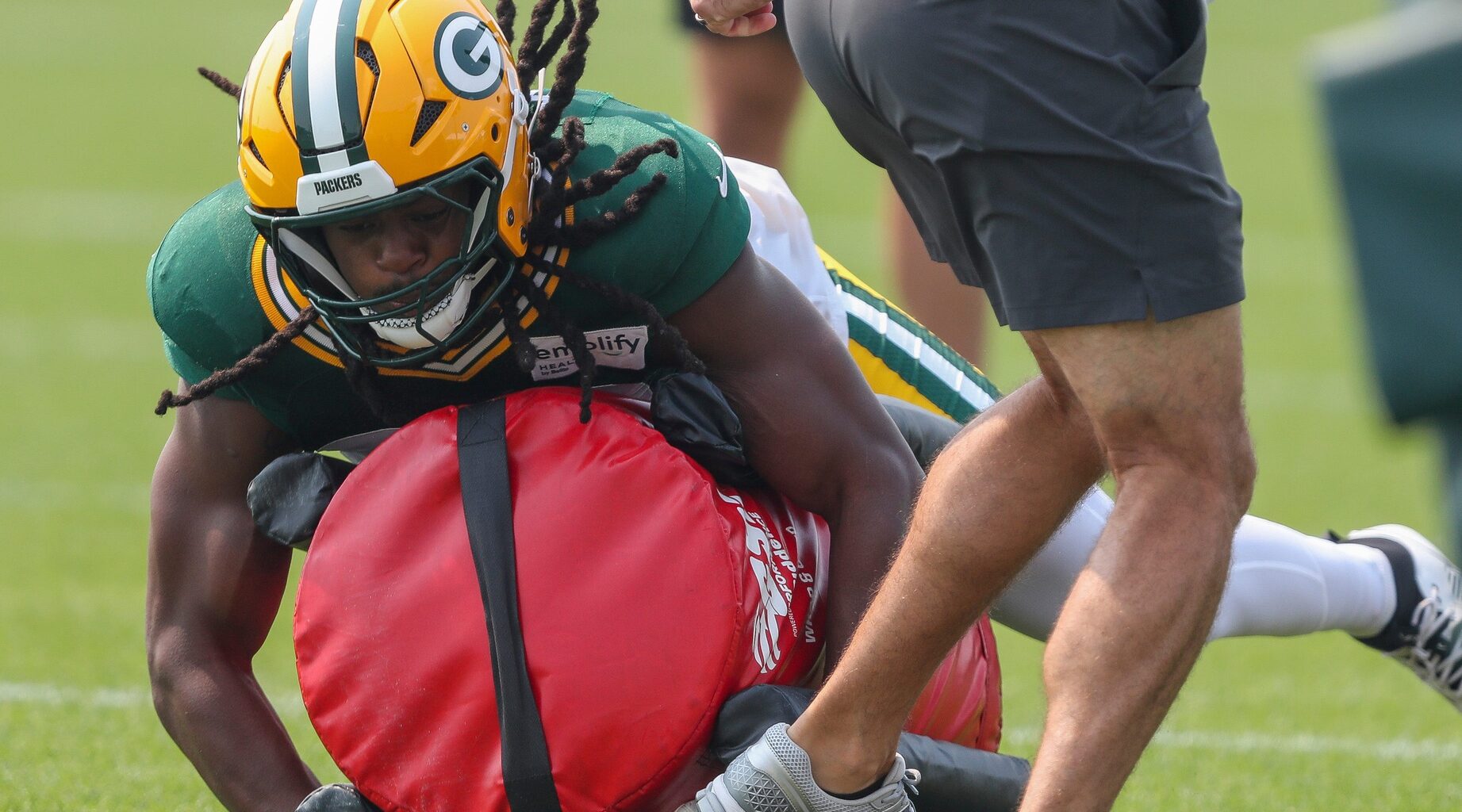
Based on the current roster, that plan points to Ty’Ron Hopper.
Hopper saw limited action as a rookie, logging just 18 snaps. He played 133 snaps in 2025, though roughly half came in Week 18 against the Minnesota Vikings, a game in which Green Bay rested most of its starters. He played just one snap against the Pittsburgh Steelers in Week 8 – a two-point conversion he broke up. Hopper then recorded his first career interception against the Chicago Bears in the Wild Card round.
Brooks and Hopper with that 1-2 PUNCH!
📺: Prime Video pic.twitter.com/7XVsy49N0e
— Green Bay Packers (@packers) January 11, 2026
By no means is Hopper a finished product, but he’s now entering his third season in the NFL. Green Bay invested a Day 2 pick in him, and the timeline aligns for the Packers to begin seeing a return on that investment, especially if he’s asked to step into a starting role.
According to Pro Football Focus, Quay Walker finished 2025 with the lowest grade among Green Bay’s linebackers. Interestingly, he was the only first-round pick in that group. Spotrac projects him to command a three-year, $29 million deal in free agency. That may not be prohibitively expensive on its own. Still, it would represent a significant investment for Green Bay, particularly given the team’s current projected cap space of over $10 million.
From a roster-building standpoint, it becomes difficult to materially justify committing close to $10 million per year to Walker when the Packers could reasonably expect comparable on-field results from Ty’Ron Hopper on a rookie contract. Given the marginal difference in projected performance compared to the cost gap, extending Walker would be an inefficient use of resources.
It would be difficult to justify bringing the former first-rounder back even if the Packers opt to keep Hopper in a more measured role, particularly given that Walker has not even been the team’s second-best coverage linebacker. With most NFL teams now operating primarily out of nickel personnel, linebacker value is increasingly determined by performance in space rather than by early-down snaps in base defense. As a result, base personnel is no longer the driving factor in decisions about whether to retain or move on from linebackers.
In that context, Walker’s coverage limitations are hard to overlook. He allowed a 120.8 passer rating when targeted and posted a 44.9 PFF coverage grade, compared to Isaiah McDuffie’s 83.9 passer rating allowed and 63 coverage grade.
The cleanest path forward is to let Walker test the open market – potentially reuniting with Jeff Hafley in Miami – while allowing Hopper to step into a larger role. Whether that ultimately comes at Mike or Will can be sorted out later. Still, the broader logic is straightforward: prioritize playing time for a recent draft investment and preserve future cap flexibility rather than overthinking the decision.