
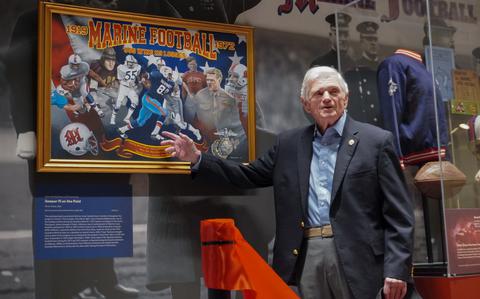
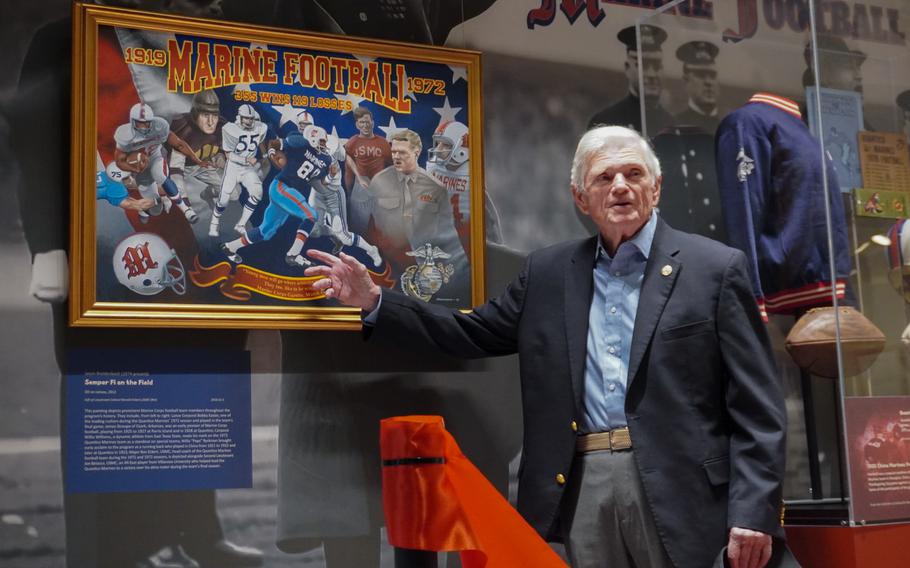
Retired Marine Lt. Col. Ronald Eckert stands by the new ”Marine Football” exhibit at the National Museum of the Marine Corps in Triangle, Va., on Jan. 28, 2026. (Kaylyn Barnhart Batista/Stars and Stripes)
TRIANGLE, Va. — The final head coach of the Marine Corps football team in Quantico took part in the unveiling of a new exhibit at the National Museum of the Marine Corps on Wednesday, featuring artifacts representing more than 50 years of football in the Marine Corps.
Among the items in the “Marine Football” exhibit are several donated by retired Marine Lt. Col. Ronald Eckert, who led the Quantico Marines Devil Dogs in 1971 and ‘72, the year the Marine football program ended.
These include a Quantico Marines warmup jersey, the final version of the team’s football helmet featuring the letter “M” from the Marine emblem adopted in 1859 and a 1971 commemorative football highlighting the team’s record against mostly college opponents during its second-to-last season.
Before Eckert and his wife, Cathy, cut the red ribbon to officially open the museum’s newest exhibit, Eckert reflected on his seasons with the Quantico team and the players he coached. His team roster included players who went on to notable careers in the Corps and professional football, such as Terry Murray, who reached the rank of major general, and Les Steckel, who became head coach of the Minnesota Vikings in 1984, according to the NMMC.
“I was honored to have the job because there were so many people who would’ve liked to have the job,” said Eckert, who served as an officer for 20 years, including two tours during the Vietnam War. Eckert also served as a consultant for the then-Washington Redskins and officiated NCAA football and basketball games.
At the centerpiece of the exhibit is “Semper Fi on the Field,” a painting by artist Jason Breidenbach depicting notable Marine Corps football players throughout the program’s history. Also on display are a football used by the 1935 China Marines team in Shanghai, and a commemorative football honoring the undefeated 1939 Marine Corps Recruit Depot San Diego team, which finished 11-0 under head coach Elmer Hall.
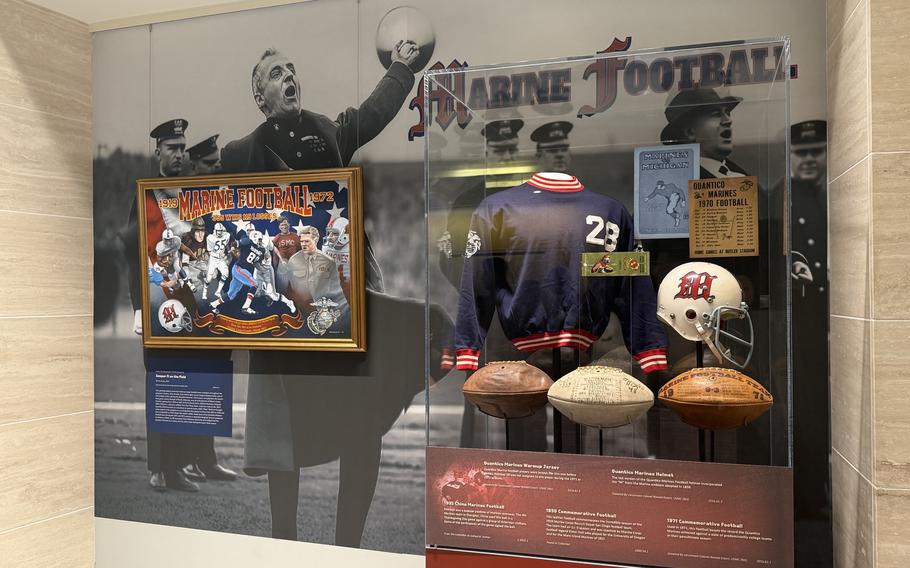
The “Marine Football” exhibit at the National Museum of the Marine Corps in Triangle, Va., on Jan. 28, 2026. (Kaylyn Barnhart Batista/Stars and Stripes)
“A lot of people who visit the museum hadn’t served in the Marine Corps, but football is a touchstone for every American,” said Keil Gentry, director of the National Museum of the Marine Corps. “Hopefully people understand the things that go into football such as the discipline, the grit, and they’ll better understand those qualities in their United States Marines.”
The Marine Corps football program began in 1917 at Mare Island, Calif., and it was composed of mostly officers. In addition to Quantico, bases such as Marine Corps Recruit Depot Parris Island, Marine Corps Recruit Depot San Diego, Marine Corps Base Camp Pendleton and Marine Corps Base Camp Lejeune fielded football teams that competed against one another, other military branches and numerous collegiate teams.
“They (San Diego, Parris Island, Camp Pendleton and Camp Lejeune teams) eventually folded because they didn’t have enough extra manpower to build teams, and they didn’t have the extra money with the Vietnam War going on. Quantico was kind of the last bastion of the football program,” said Kater Miller, the museum curator.
Gentry added that the “Marine Football” exhibit is a teaser for a future gallery highlighting Marines in sports, which is planned to open in a later year.
Museum curators and staff have been working on the “Marine Football” exhibit since 2015. Challenges delayed its opening, including a leak in the storage building that forced them to carefully pack and protect all artifacts. In addition, extensive conservation and research were necessary to preserve the items and accurately present the history and importance of football to the Marines at the time.
“It’s an important legacy to remember that it wasn’t just a game to these guys, it wasn’t just an opportunity to go blow off some steam and have fun. There was a genuine belief that the athletes made better Marines and better leaders,” Miller said.
Eckert led Quantico’s football team in its final game against Xavier University in November 1972, securing a 34-0 victory and bringing to a close over 50 years of Marine Corps football. The Quantico team officially concluded the Marines football program that year, finishing with a record of 355 wins and 119 losses.