
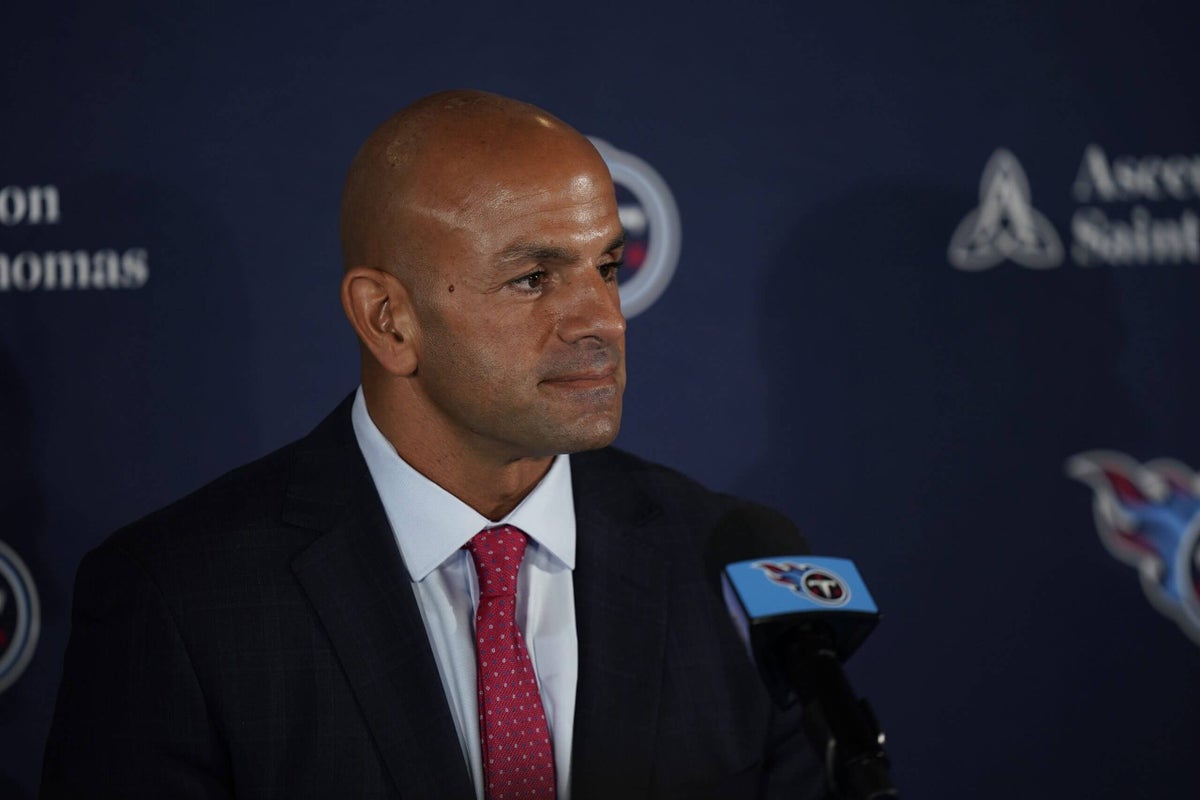
NASHVILLE, Tenn. — Robert Saleh sat at a small folding table, draped in a cloth with the Tennessee Titans logo, and stared out into a crowd of reporters. The large room felt much smaller with all the Titans players crammed in at the back. There were opening remarks from general manager Mike Borgonzi — Saleh calls him “Borgo” — and as he spoke, Saleh sometimes appeared as if in a trance, staring straight ahead, lost in his thoughts. He’s thought a lot about being in this spot, in this chair, after everything he went through in New York — how he felt when he was fired, all the days he spent moping around after that, how he pulled himself together, how he self-reflected and found his way back to San Francisco and how that all led him to here, to now, named the sixth head coach of the Tennessee Titans.
Five years ago, Saleh was introduced as the New York Jets’ head coach. At his news conference, he sat in front of a computer screen and took questions from dozens of floating heads staring back at him. It was over Zoom, a victim of the COVID-19 era of the NFL. So he didn’t get a crowd, or a jersey with his name on it — like the Titans gave him.
The crowd of reporters didn’t scare him.
“In New York,” Saleh said later, laughing, “that’s just a normal press conference.”
He went through the New York wringer — the Jets went 20-36 in his tenure and never won more than seven games in a season — and came out of it a different person. And now he’s part of an exclusive club: the fired coaches of the New York Jets Club. Many of them got second jobs. Eric Mangini went to the Browns after owner Woody Johnson fired him. Rex Ryan went to the Bills. Todd Bowles went to the Buccaneers. And now Saleh has landed in Tennessee, at the head of an organization searching for a leader to bring it to the heights it felt in 2019, when the Titans reached the AFC Championship Game with Mike Vrabel as coach. They haven’t made the playoffs since 2021 — the same year Saleh was starting his tenure with the Jets. They never made the playoffs when he was there, either.
This, to him, felt like the best opportunity to get back there.
Building culture pic.twitter.com/zCrB63hmpo
— Tennessee Titans (@Titans) January 29, 2026
“I’m grateful,” Saleh told The Athletic as he walked down a hallway in the Titans facility. “I’m ready to get this thing popping to prove that where we (the Jets) were going was real.”
Out of all the job openings this cycle, this was the one he targeted — no matter what anyone has to say about his new boss, Amy Adams Strunk, who has fired two head coaches and two general managers since 2022.
It’s no secret that things didn’t end great with Saleh and Johnson, his old boss. Before Saleh took this job, he dug into how things ran here. He looked into Strunk — and felt comfortable and excited about what he learned — that “she’s pouring her heart into this thing, and that’s all I need to see.”
Saleh said he researched everything about the Titans — including their general manager, their front office, quarterback Cam Ward, players on the roster and others in the building. He researched them even more, he said, than the Titans researched him. And so he learned:
This is where he wanted to be.
There is a feeling when you feel a chair falling out from under you. It’s sudden. It can feel as if time has stopped, as if the brain is processing what’s happening in slow motion. Eventually, you hit the ground. It hurts.
That’s how Saleh felt after Oct. 8 in 2024, as if someone ripped a chair out from under him. And so he floated, in slow motion, for a while. Eventually, he landed. And it hurt.
That was the day Woody and Christopher Johnson, the Jets’ vice chairman, walked into his office in Florham Park and told him he was being fired. Saleh was in the middle of preparing for the next game and did not see it coming. The Jets were 2-3 and Saleh thought, even coming off a loss, that they were on the right track. That this team would look better at the end of the season than it had at the beginning. He knew he was on the hot seat coming into the season, but he thought he had more time.
Now, all of a sudden, it was over — and he was convinced that the team that just fired him was going to go on to glory without him. (The Jets finished 5-12.)
“It took a couple weeks just to deal with all the emotion and all that stuff,” Saleh said. “Like anybody, you get knocked down, you gotta pick yourself back up. The world is not going to sit around and wait for you to stop moping.”
As time passed, he tried to look inward. He asked himself hard questions. He knew, right away, that he wanted to do this again, to be a head coach in the NFL. He felt that even in those low moments.
“I’ve always been my greatest critic, and I’ve always been self-reflective,” Saleh said. “I always debrief myself, every moment. So it was not necessarily about what I would do different (as head coach) but what I needed to ask myself to get what I needed to do.”
A little over two weeks after he was fired, Saleh flew to Green Bay, Wis., and worked as a consultant for Packers coach Matt LaFleur, one of his closest friends. That experience was “therapeutic,” he said, and helped him get back on track.
“That really signified the moment I was off the map,” Saleh said. “Just to be in a place where my family and I could root for something rather than root against something, if you will. But going to Green Bay and being around him, being around that positive energy was something that I needed.”
Then he went and rejoined the San Francisco 49ers, coached up a defensive unit beset by injuries and had them playing well enough to help San Francisco go 12-5 and get back to the playoffs. And then his process started for trying to get into another chair — to be a head coach again. He interviewed with a few teams last year — and was a finalist for the Jacksonville Jaguars’ job, which went to Liam Coen — but he felt even more ready this year, with the benefit of time.
Despite everything he went through in New York — the barrage of criticism, behind-the-scenes dysfunction and turmoil, the losing — he knew he wanted another shot at this.
Why would he want to put himself through all that again?
“Right?” he said, laughing. “All the abuse?”
“I like to think that I’ve always been a really competitive person, and my goal has always been to reach as high as I could in whatever it was I was doing,” Saleh said. “If I’m on the golf course, I’m going to try to score as low as I can. If I’m competing with my kids in basketball, I’m trying to shut them out. In this particular space, my profession is to coach football. My goal is to hoist the Lombardi Trophy as the leader of the organization. My desire to lead is to compete at the highest level — and really it’s to prove to myself of what we’re capable of. Being a head coach, getting a second opportunity and being in this place with all the positive things that are happening around it, I couldn’t be more excited.”
He still has the same passion, the same fire burning inside of him that he had when the Jets hired him five years ago — but it sounds a little different now. At his Jets introduction, he talked about winning multiple Super Bowls as their head coach. He toned down the hyperbole in Tennessee.
“Every team wants to win a Super Bowl,” Saleh said. “But the realistic expectation is that this team understands what proper process looks like, attacking every moment, attacking every day, finding ways to get better every day. … What being successful looks like, I’ll leave that up to you guys. But in this building it’s going to be about how we attack those moments.”
Five years ago, he spent time in his opening statement explaining his signature catchphrase: “All Gas, No Brake,” what that meant to him and what it would mean to everyone who worked in that organization. How they would live it.
“We’ll always be all gas, no brake,” Saleh said Thursday. “But words are just words.”
Some of Saleh’s harshest criticism in New York came in response to his stoic, stone-faced demeanor on the sideline during games. Fans hated it. After one loss in 2023, a reporter asked Saleh why he wasn’t showing more emotion after a loss. Saleh’s response: “Do you want me to throw the podium on the floor?”
In reflection, and through his experience back with the 49ers as defensive coordinator, Saleh was quickly able to diagnose how to fix that. For the Jets, Saleh didn’t call plays, passing off that duty to defensive coordinator Jeff Ulbrich — and it worked, since the Jets had one of the NFL’s best defenses during Saleh’s tenure. But in doing that, he felt less connected to what was happening, the emotions of a game, of each play. In San Francisco, he was always known for his energy, for running up and down the sideline, for screaming in elation. That didn’t happen as much with the Jets. So that’s how he plans to change that: He’ll be calling plays for the Titans on defense.
“On game day, when I didn’t call plays, I felt like I was just the timeout and red flag guy,” Saleh said. “I had the greatest seat in the house as a fan.”
Another thing Saleh grew to understand: He sometimes let outside noise — namely, criticism, of which there was plenty — get to him as the Jets’ coach. He used to say that, in New York, anytime you lose, it feels like the apocalypse, and anytime you win, you’re going to the Super Bowl. Nashville is a smaller market, but that doesn’t mean there isn’t, or won’t be, noise. Ex-Titans coach Brian Callahan felt it during a terrible 2025 season and then he was fired after only six games.
Saleh feels better suited now to handle all of that than he did the last time.
“A lot more,” he said. “It was a tremendous learning experience because at the end of the day, it’s not personal; everyone has a job to do. The biggest learning lesson is that winning or losing will write the story, and there’s nothing you can do to control it. That’s pretty much it. When you look at it, wins and losses, there is no context. If you win, you’re a winner. If you lose, you’re a loser. At the end of the day, I 100 percent learned none of that really matters. What matters is what’s in the building. What matters is ball, what matters is getting our guys prepared to play a football game, and the rest will take care of itself.”
And so, despite everything that happened — the losing, the controversies, the public outcries when he’d make a mistake, the mockery and the way he was fired — Saleh actually looks back fondly at his time in New York.
“I am so lucky, and I mean this,” Saleh said. “There are only 32 of these jobs in the entire world, and to do it in New York on the biggest stage with one of the most passionate fan bases in the entire league — I am as lucky as lucky gets. … I still talk to (some Jets staffers). The people at 1 Jets Drive — the people — are such great people. And so I’m incredibly grateful for that experience.”
He’ll get to see some of those people in 2026: The Jets will play the Titans in Nashville.
Saleh laughed.
“I can’t wait,” he said.