
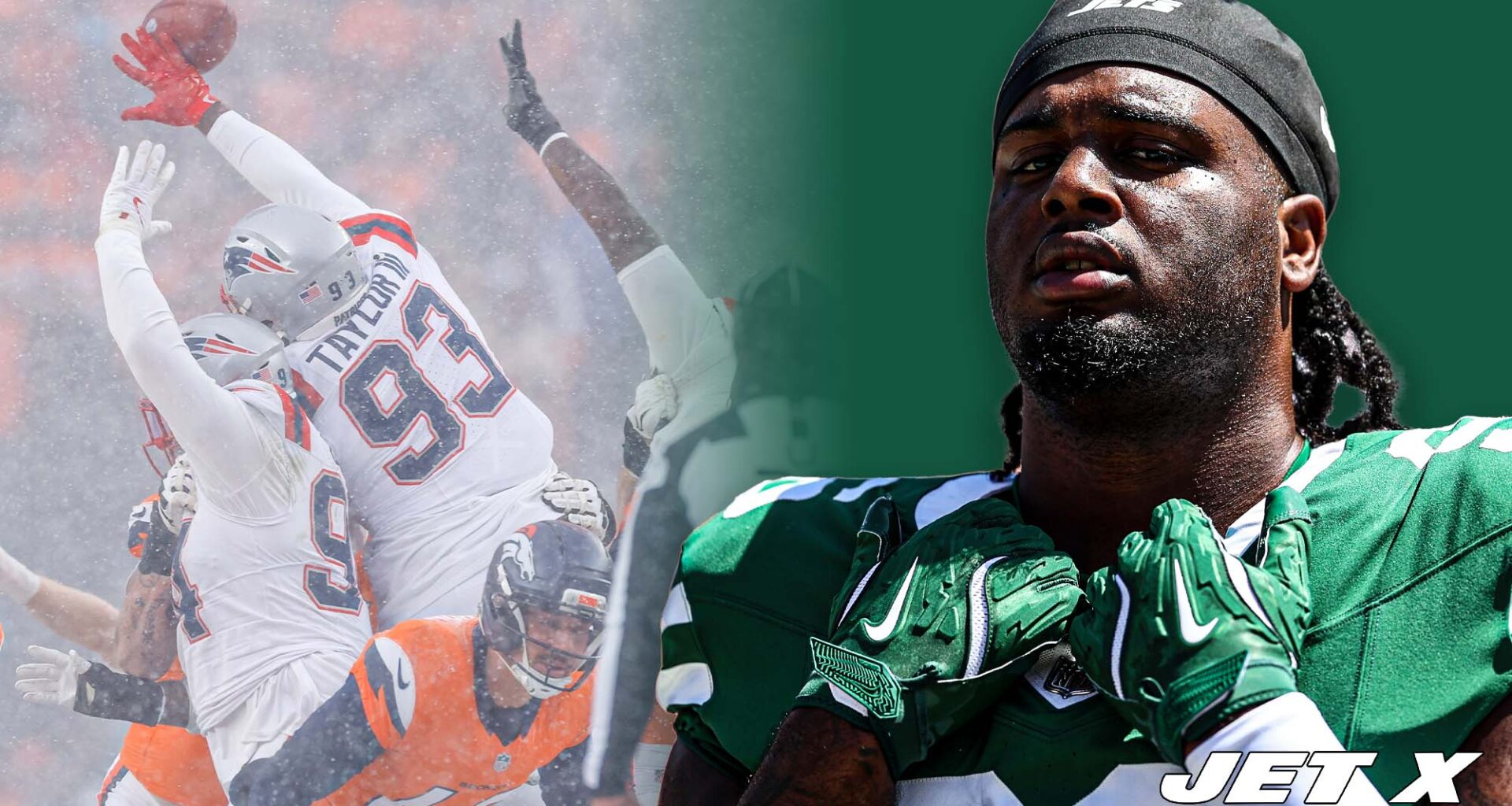
Ever heard of Leonard Taylor III?
Most of America had never been aware of the former Miami Hurricanes defensive tackle until he blocked a field goal in Denver, all but sealing the New England Patriots’ trip to Super Bowl LX.
Die-hard New York Jets fans, though, could not help but cringe when Jim Nantz identified Taylor as the man responsible for blocking Wil Lutz’s potential game-tying field goal late in the fourth quarter of last week’s AFC championship game. Until that moment, many Jets fans probably did not even know that one of their team’s former young prospects had been making noise for a playoff-bound division rival.
Taylor is just the latest former Jet to find playoff glory with another team. In an unheralded story that has seldom been highlighted around the nation, the Seahawks’ quarterback is some guy named Sam Darnold, who once played for the Jets, to the knowledge of few.
The Darnold story, though, goes a long way back. No member of New York’s current coaching staff or front office had a hand in Darnold’s Jets tenure. That discussion has little to no relevance as it pertains to the present-day Jets.
Taylor, though, was a member of the Jets as recently as October. And despite his status as an undrafted free agent in the 2024 class, Taylor was far from a random back-of-the-roster player who fans were unaware of.
After an intriguing rookie season, Taylor entered the 2025 season as one of the team’s most promising young defensive linemen. There was optimism within the fanbase that Taylor might have a breakout year.
As it turns out, Taylor did wind up making big-time plays in 2025… for the Patriots.
The Jets’ squandering of Leonard Taylor is one of the more underrated gaffes from Aaron Glenn’s much-maligned debut season as the Jets’ head coach. While it is a small mistake, it encapsulates many of the issues with Glenn’s tenure.
How did the Jets screw this up?
A former five-star recruit out of high school, Taylor got off to a hot start over his first two years with the Hurricanes. He was getting first-round buzz entering his 2023 junior year.
However, a steep decline in production, coupled with rumblings about Taylor’s character and work ethic, caused him to free-fall out of the draft in 2024. New York scooped him up as an undrafted free agent.
Taylor made a statement in his rookie preseason, racking up four sacks in three games. It was enough for him to make the team’s 53-man roster.
In his rookie year, Taylor appeared in 14 games for the Jets (no starts), playing a situational role on the defensive line. Taylor logged 261 defensive snaps, an average of 18.6 per game.
Taylor made the most of his limited opportunities. In the run game, he racked up nine run stops and led the team’s defensive tackles with a 6.1% run-stop rate, even beating out Quinnen Williams (6.0%).
As a pass rusher, Taylor collected 1.5 sacks and nine total pressures on just 114 pass-rush snaps. His 7.9% pressure rate was well above average for defensive tackles (42nd out of 125 qualifiers), and his 69.9 pass-rush grade from Pro Football Focus was even better (28th).
The film was just as tantalizing as the numbers. Taylor demonstrated impressive explosiveness and strength in both phases.
Going into 2025, Taylor was expected to compete for the Jets’ starting defensive tackle spot next to Quinnen Williams. The Jets’ second starter in 2024, Javon Kinlaw, had left in free agency, and instead of adding a clear-cut replacement, the Jets opted to accumulate a plethora of defensive tackles who could fill out specialized roles on the depth chart and battle for snaps next to Williams.
The door to a starting spot seemed to be wide open for Taylor, who was arguably the Jets’ second-best defensive tackle on a per-snap basis in the 2024 season. He was an ascending young player whose only competitors were backup-level veterans, such as Jay Tufele and Byron Cowart.
Strangely, though, the Jets’ new coaching staff never took a liking to Taylor. He was buried on the depth chart throughout training camp practices and preseason games, yielding reps to Tufele, an underwhelming veteran player.
Across four NFL seasons, Tufele had never been nearly as productive as Taylor was in his rookie year. Taylor’s rookie-year pressure rate of 7.9% was almost double Tufele’s career rate of 4.1%. In addition, Taylor’s rookie-year run defense grade of 56.9 (good enough for 52nd out of 125 qualified defensive tackles) was already nearly 10 points better than Tufele’s career-best mark over four seasons (47.2).
Even if Taylor did not improve at all, he would still be a significantly more talented player than Tufele.
As expected, Taylor outperformed Tufele in the preseason. Taylor accrued an overall Pro Football Focus grade of 62.9 compared to Tufele’s 50.1.
Both players made the 53-man roster, but the Jets defied all of the evidence available to them by prioritizing Tufele over Taylor. Tufele played 17 snaps in the season opener, while Taylor was a healthy scratch.
An injury to Tufele yielded a two-game run for Taylor to stake his claim from Weeks 2-3. Taylor did not do much with the opportunity, collecting three tackles (one for loss), one batted pass, and zero pressures on 47 snaps. His overall PFF grade was 52.7.
Tufele returned in Week 4, and that was all she wrote for Taylor’s Jets career. Taylor was a healthy scratch until the Jets waived him on Oct. 14. Two days later, New England scooped up their future AFC championship hero.
While Taylor did not receive national attention until the fateful block in Colorado, he had quietly been making plays for the Patriots throughout the end of the regular season and into the playoffs.
Taylor made his Patriots debut on Dec. 14 against the Bills. Across six total games (three regular season games and all three playoff games), Taylor has racked up eight tackles and seven total pressures on just 104 defensive snaps (17.3 snaps per game).
Since joining the Patriots, Taylor has a 5.8% run-stop rate, similar to his rookie-year mark in New York, and an 11.5% pressure rate, an elite-level mark (albeit on a small sample size).
Lo and behold, a 23-year-old second-year player is building on his rookie-year success after being given more than two games to figure things out. Who could have seen this coming?
Not the Jets, who were too busy holding out hope that Jay Tufele, a 26-year-old fifth-year player who had never shown jack-squat in his career, would maybe become half of the player Taylor already was.
Tufele ended up playing 229 snaps for the Jets across 12 games in 2025. He finished with zero sacks, zero quarterback hits, six total pressures, and 12 total tackles, with a 6.0% run-stop rate and an abysmal 4.7% pressure rate. He also had a 25% missed tackle rate, nearly double Taylor’s career rate (13.2%).
A decision that boggles the mind
How could the Jets have possibly sided with Tufele over Taylor? Quite literally, every piece of tangible evidence pointed to Taylor being the better option.
In his rookie year, Taylor was better as both a pass-rusher and a run defender than Tufele was at his peak in either phase across four NFL seasons. The expectation should have been that the gap would grow even wider with Taylor’s projected Year 2 leap, but even if Taylor’s development stalled, he was already a substantially better player.
Maybe the Jets didn’t like something about Taylor off the field? Maybe Taylor struggles in practice while Tufele looks like a beast?
We will probably never know, but regardless of how the Jets try to explain it away, there is no conceivable excuse for their decision to overlook such a stark discrepancy in the career production of two players at the same position, especially with the better player being three years younger. It is talent-development malpractice.
The fact that Taylor wound up having success with the Patriots, of all teams, is simply poetic justice, helping to bring much-deserved light to the situation. But this would have been an equally ghastly mistake if Taylor had gone on to succeed for the Titans.
Even if Taylor did not go on to do anything of note in 2025, the Jets would still deserve criticism for their decision-making process.
In what world should a fifth-year player with consistent bottom-of-the-barrel production be prioritized over a second-year player who established a high floor and a high ceiling in his rookie year? Especially on a team that was trying to get younger and set a foundation for a long-term rebuild?
Regardless of what Taylor went on to do elsewhere, the Jets got absolutely nothing out of Tufele, which was entirely predictable based on what he did for four years. Choosing the player with more upside should have been a no-brainer, whether he panned out or not.
And, to the surprise of no Jets fan who watched Taylor in 2024, it seems like he is most certainly panning out.
Can Aaron Glenn be trusted to develop young talent?
Mistakes like this one are why it is nearly impossible for Jets fans to contrive reasons to have faith in Aaron Glenn moving forward.
Perhaps fans can do mental gymnastics by pinning the Taylor-Tufele fiasco on former DC Steve Wilks, along with other defensive blunders. Maybe it was Wilks who adored Tufele, to Glenn’s dismay, but Glenn let it slide. And now, with Glenn calling the shots, those mistakes won’t happen anymore.
This could be true. Even if it were, though, Glenn is the head coach, so every roster and depth-chart decision is ultimately his call. Not to mention, he hired Wilks in the first place.
It’s also not as if Glenn had no say in the defense. Even though Glenn was not calling plays, he was still instrumental in building the scheme and crafting the weekly game plans.
There isn’t a way for Glenn to completely escape blame for the squandering of Taylor, nor for any of the Jets’ most baffling slip-ups in a 3-14 season. He’s the head coach. It’s his job to make sure the team develops young talent. In this case, he dropped the ball with a player who could have made a difference for their defense.
Of the Jets’ many issues in 2025, their inability to develop young talent was among the most problematic for their long-term outlook. It not only leaves the Jets with few players to be excited about moving into 2026, but it also reduces confidence that a Glenn-led staff will make the most of any future talent that walks into the building, no matter how many top-45 picks and big-money free agents New York brings in.
Glenn’s mishandling of Leonard Taylor did not single-handedly ruin the Jets’ 2025 season, nor did it single-handedly send the Patriots to the Super Bowl, even if Taylor made one of the decisive plays. Still, it serves as a microcosm of the Jets’ befuddling decision-making throughout Glenn’s reign as the head coach.