
One of the most underrated aspects of team-building in the NFL?
Catering to the style of football played within your division.
The NFL is unique in that divisional games make up a larger chunk of each team’s schedule than other major sports. Currently, NFL teams play six of their 17 games against divisional opponents, which represents more than one-third of the season (35%). Compare that to the other North American leagues:
MLB: 52 of 162 (32%)
NHL: 26 of 82 (32%)
NBA: 16 of 82 (20%)
Not only do divisional games make up one out of every 2.8 games that an NFL team plays, but those games carry significantly more importance than they do in other sports.
While the NFL is a 32-team league, all you need to do to make the playoffs is perform better than a select group of three teams, whom you play twice each.
When you put it like that, professional football seems pretty straightforward.
The NFL is a divisional sport. In the end, all that really matters is those six games against your rivals. Dominate those six games, and you’re probably going to be hosting a playoff game.
Host a playoff game, and you’ve got a darn good shot at winning a championship in a league where home-field advantage is paramount and the playoff tournament features a one-and-done format.
Of the 59 Super Bowls in league history, 52 were won by a division champion, a whopping 88%.
Simply put, those six division games are a hell of a lot more important than the other 11 games on a team’s schedule.
That’s why it’s critical for NFL teams to build their roster with the intention of exploiting their division rivals’ strengths and weaknesses.
With that in mind, here are two prospects (one on each side of the ball) in the 2026 NFL draft who would help the New York Jets win games against their AFC East rivals.
Ohio State LB/EDGE Arvell Reese
Whether he’s rushing the passer with his hand in the dirt or standing up and dropping into coverage, you can always count on one thing with Arvell Reese: He’ll be one of the fastest men on the field.
There is a lot of projection involved with Reese, who is expected to be an edge rusher in the NFL after rushing the quarterback just 140 times in his college career. However, during his stint in Columbus as one of the nation’s best off-ball linebackers, Reese made it clear that his ranginess in the open field will always be an asset.
That would play extremely well in the AFC East.
The Jets are burdened with playing nearly a quarter of their schedule against Josh Allen and Drake Maye for the next decade-plus. As two of the top four rushers among quarterbacks in 2025, both are tremendous athletes who must be accounted for on every play.
When facing Allen or Maye, there is no situation where the defense can afford to live without accounting for the quarterback’s legs. Both signal-callers can break the pocket to extend passing plays, charge up the middle and scramble for big yards, or keep the ball and run to the edge on designed run plays—which Maye did last Sunday to seal the Patriots’ AFC championship victory.
As you can see on Maye’s game-sealing run, the edge rushers are paramount in the effort to contain a mobile quarterback. Defenses need elite athletes on the edge to keep up with today’s athletic passers and the creative ways that coordinators like Josh McDaniels weaponize them.
For years, Allen and the Bills have exploited the Jets’ lack of mobility on the edge. Whenever the Jets have had the clunky Micheal Clemons on the field, Allen has run straight at him for effortless first downs.
If you have edge defenders who change directions like a tractor-trailer, quarterbacks like Allen and Maye will exploit them. You need edge defenders who can flip their hips on a dime in the open field, and Reese is that kind of guy.
That rep perfectly encapsulates how the Jets could use Reese as their counter to Allen and Maye.
If Reese goes second overall, it will be for his pass-rushing upside, but his experience as an off-ball linebacker and his elite ranginess in that role are added bonuses that only raise his ceiling as an all-around defensive weapon—especially in the AFC East.
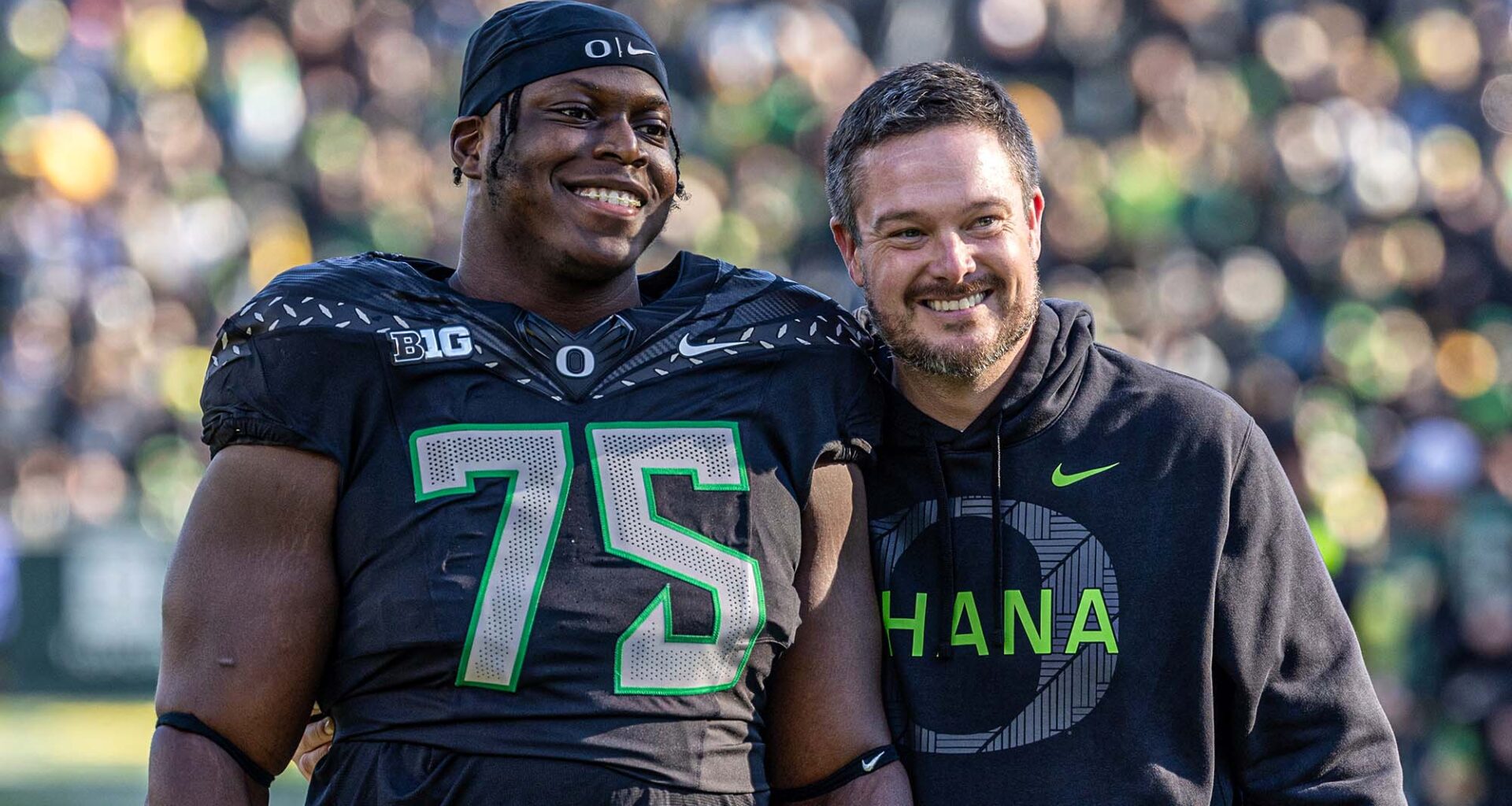
Oregon G Emmanuel Pregnon
As the Patriots gear up for Super Bowl LX while the Bills are in the midst of ushering in a new head coach, one thing is clear: The AFC East no longer runs through Orchard Park.
It runs through Foxborough.
After years of chasing the Bills in the post-Tom Brady era, the Jets must turn their focus back to an all-too-familiar goal: Taking down New England.
And if they’re going to do that, they have to be able to run the ball.
For all the hoopla directed at Drake Maye, the main reason New England shredded through the AFC playoffs is their run defense.
Maye has not had a good postseason. In three games, he’s completed 55.8% of his passes for 533 yards, four touchdowns, and two interceptions (84.0 passer rating), while taking 15 sacks for -90 yards and fumbling six times. The Patriots’ offense is averaging 15.7 points per game.
Like Tom Brady experienced many times, Maye is fortunate to have a defense that can carry him to the Super Bowl despite his lackluster production. The Patriots are allowing 8.7 points per game in the playoffs, and it’s thanks to their run defense, which is giving up 71.3 yards per game on 3.1 yards per attempt.
New England’s stingy run defense has forced all three opponents to rely on faulty passing attacks. The Chargers and Texans had extreme issues in pass protection, while the Broncos had a backup quarterback playing in the snow. All three teams would have loved to rely on their run games, but the Patriots did not allow it, forcing their opponents into extremely uncomfortable situations.
The Patriots’ burly defensive tackles, headlined by Milton Williams, are the heart of New England’s stout run defense. They hold their ground at the line of scrimmage and gobble up blockers to clear lanes for the linebackers, similar to how offensive linemen block for the running back.
Milton Williams STRAINING against a double-team and gets in on the tackle for no gain. https://t.co/QysCk0H6HE pic.twitter.com/2cHytkHabc
— Nate Tice (@Nate_Tice) January 19, 2026
If you want to win games against Mike Vrabel’s Patriots late in the year, you need a forceful offensive front that can move the line of scrimmage against a physical, nasty defense that thrives on stopping the run and burying opponents in obvious passing situations.
Running the football is one thing the Jets were decent at in 2025, as they finished 10th in rushing yards per game and eighth in yards per rush attempt. However, they need to be even better if they want a chance of beating New England in 2026.
The Jets’ offensive line has some talented pieces, but it is far from complete, especially on the interior. While tackles Olu Fashanu and Armand Membou are intriguing building blocks, the only interior starter who played at an above-average level in 2025 was right guard Joe Tippmann. Left guard John Simpson and center Josh Myers were liabilities.
You’re not going to move the line of scrimmage on a team like New England with two of your three interior linemen being below-average.
Oregon’s Emmanuel Pregnon could be the difference-maker New York is looking for.
Pregnon, a 6-foot-5, 320-pound enforcer, had the second-best run-blocking grade among Power Four guards in the 2025 season (85.8), per Pro Football Focus. His 93.0 zone-blocking grade was particularly dominant, and projects well to a league that is becoming increasingly reliant on zone-blocking.
Emmanuel Pregnon (6’4 320) Oregon
+ High-level athleticism
+ Quickness off the snap
+ Blocking on the move
+ Over 3,200 career snaps
+ Just 5 pressures allowed in 2025
+ 88.1 pass block grade
+ 85.8 run block grade
+ Active hands
– Maintaining blocks
– Strike timing consistency… pic.twitter.com/IDN3wgrhIc
— Bengals & Brews (@BengalsBrews) January 28, 2026
Currently projected as a high second-round pick in the 2026 NFL draft (No. 34 on the consensus big board), Pregnon could be a perfect target for the Jets with the 33rd overall pick, which kicks off the second round.
The Jets’ offensive line looks “solid” at the moment, but it doesn’t look “elite”. If they want to win the battle of the trenches against the team that runs their division (and conference), they need the line to be elite.
They can give their line a chance to reach that level by using a top-40 pick to upgrade one of their two weak spots on the interior, especially with a guard like Pregnon, who has excellent size and his known for his run blocking (particularly zone).