
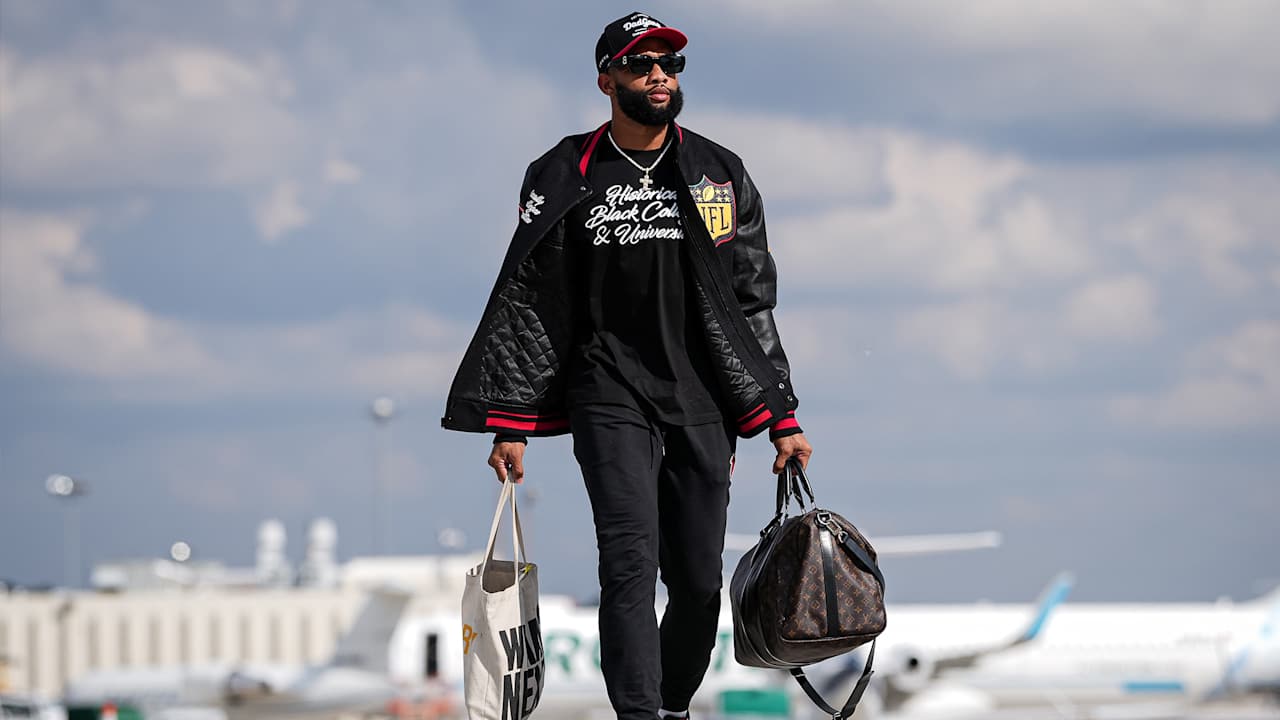
Hodge went undrafted in 2018 — a reality he says he expected. Since 2010, only 36 HBCU players have been selected in the NFL Draft.
“I know that HBCU athletes are slept on,” Hodge said. “You just gotta take that to heart and you have to look at it like I’m just as good as those guys, no matter how much work I gotta put in, I’m going to keep proving to you and whoever else said I can’t do it, to show that I can do it and I am good enough.”
He has done exactly that.
Hodge spent time with the Rams, Browns and Lions before landing in Atlanta in 2022, where he has carved out a role as both a reliable depth receiver and one of the league’s standout special teams contributors.
His journey is proof that talent — regardless of exposure or resources — can flourish when given an opportunity.
“We’re D1 just like y’all are D1,” Hodge said of HBCU players like himself. “(Other programs) probably have a little more resources than we have right now, but we are just as good as you are. We are prideful about what we do.”
Times, however, are slowly changing.
More HBCUs are receiving increased funding and resources, aided by organizations like HBCU Elite, which Hodge partnered with during My Cause My Cleats week in December. Opportunities for HBCU athletes are also becoming more visible. In 2022, the NFL launched an annual HBCU Combine to provide additional exposure for draft-eligible players.
Still, there is work to be done.
According to the league, HBCU players represent only a small portion of the overall football population, yet nearly 10% of the Pro Football Hall of Fame attended HBCUs — 35 of its 371 members.
Some of the game’s greatest legends trace their roots back to HBCU campuses.
Jerry Rice, the NFL’s all-time leader in receptions, receiving yards and touchdowns, starred at Mississippi Valley State.
Michael Strahan, the former single-season sack record holder before Myles Garrett broke the mark in 2025, attended Texas Southern.
Bob Hayes — the only athlete to win both a Super Bowl ring and an Olympic gold medal — went to Florida A&M. And the league’s most prestigious honor, the Walter Payton Man of the Year Award, is named after a Jackson State alum.
HBCUs are essential threads in the fabric of the NFL’s history — institutions that have shaped generations of players. Prairie View A&M did that for Hodge. It’s why he wears his HBCU pride so visibly.
“I came here lost,” Hodge said. “I didn’t really know what I was going to as far as my football career or academically so this is where I grew up, where I found who I was. I disciplined myself. So, when I come back here it’s always smiles, good times. I get chills every time I walk on the field.”