
Aaron Glenn’s intent on calling the New York Jets defense in 2026 has people talking. Fans wonder exactly what it will look like and how often he’ll use odd fronts that feature a more traditional nose tackle (0-tech).
Perhaps more importantly, how will Glenn’s vision impact the Jets’ offseason personnel outlook? Does the free agency period and NFL draft have to favor a specific defensive front, one that differs from the Steve Wilks scheme in 2025?
While the questions are many, the answers are simple…
Nah. Fans shouldn’t worry a bit about how incoming personnel will fit any perceived change in Glenn’s defensive style. At least that’s how it should be viewed.
Defensive front overhauls are extinct
New York Jets fans remember the days of a defensive front overhaul. In fact, one such remembrance remains painful.
After the 2007 season, the Jets traded young linebacker Jonathan Vilma to the New Orleans Saints. One of the perceived reasons for the trade was due to a poor fit in Eric Mangini’s 3-4 defense.
Although that reason was far from the only factor that made the trade happen, the issue of overhauling rosters to move from the 3-4 to the 4-3, or vice versa, was undoubtedly a realistic notion back then. Defensive architects were far more stubborn in their beliefs, and their philosophies followed suit, showcasing an undeniable philosophy that was hard to mistake.
That’s no longer the case.
Today’s brand of ball features 11 personnel as the norm, meaning nickel (five defensive backs) is the true base defense. While that truth doesn’t preclude defensive coaches from utilizing 3-4 principled fronts in a nickel package, it’s nearly impossible to do so exclusively.
In other words, almost every defensive coach today has to have even fronts in the playbook (4-3-principled fronts) purely because today’s game demands it.
What’s Glenn’s preferred front?
Aaron Glenn’s preferred defensive front is 4-3. Period. If his time as Detroit Lions defensive coordinator is worth anything of substance, Glenn is a 4-3 defensive architect, first and foremost.
Glenn also uses 3-4-principled fronts at times, but the majority of these looks come out of nickel. If he’s more concerned about the rush game out of 11 personnel, Glenn might throw a Tite or Penny look at the offense (equipped with a true nose tackle).
At the end of the day, however, 4-3 rules the roost, and two-gapping against the run is tougher to execute.
This isn’t surprising, as that’s usually the case these days. It doesn’t matter if your two EDGE players are standing on the line; if there are just two defensive linemen in between them, it’s an even front, which means it’s a four-man front.
Go ahead and call it a 2-4-5 all you want; it’s still a 4-3-principled look (identical to 4-2-5).
That is to say, the following: Arvell Reese, a prospect who can play like a monster in the open field, could have as many open-field (drop off in coverage/space) opportunities while playing within a 4-3 (defensive end), as he would in a 3-4 (outside linebacker).
It all depends on the defensive play-caller.
Yet it’s critical to note that this would not have been the case in the Eric Mangini, Herm Edwards, or even early Rex Ryan days. Unlike those days, when some fondly remembered Jets coaches and defensive minds were in charge, today’s defensive minds must approach the game in a hybrid fashion.
Glenn’s defensive mindset
Instead, consider what Aaron Glenn’s philosophical mindset may be when calling the New York Jets’ defense. This is far more critical than the specificities of his preferred fronts and defensive line structures.
Take the Mike Macdonald film breakdown we did recently as an example. Macdonald is generally recognized as a 3-4-rooted defensive coach, yet most of the fronts seen in the NFC championship game were rooted in even looks.
At the end of the day, he’s a hybrid schemer, and it’s this versatile nature that allows him to call the game in a way that gives him the best odds of success.
Macdonald pretty much conceded the first-down rush to the Los Angeles Rams on a fourth-and-1 situation on the fringe of the red zone. He realized, while up four points in nut-cutting time, that keeping the Rams out of the end zone was the only critical goal.
Playing tough and loading up the box in that situation would give Sean McVay and Matthew Stafford a golden opportunity to hit something over the top. So instead, he conceded the fourth-and-1 rush attempt (had Los Angeles taken it), while keeping his eye on the true goal of the drive: bowing up at the goal line.
In this vein, it’s tough to fully grasp how Glenn thinks.
For one, the Lions enjoyed plenty of big leads, which placed their defense in more advantageous positions. Secondly, there isn’t another example of a defensive unit whose scheme he designed.
Glenn’s defensive front examples
Week 1 is always a unique game in football. It’s the start of a fresh season, which means nothing official is on tape.
With that in mind, it’s usually the best week to get a feel for what a coach’s intentions are, as a whole.
In 2022, the Lions took on the Philadelphia Eagles. Glenn, the second-year defensive coordinator who was coming off a tough first year, came out with a 4-3 front to open the game:
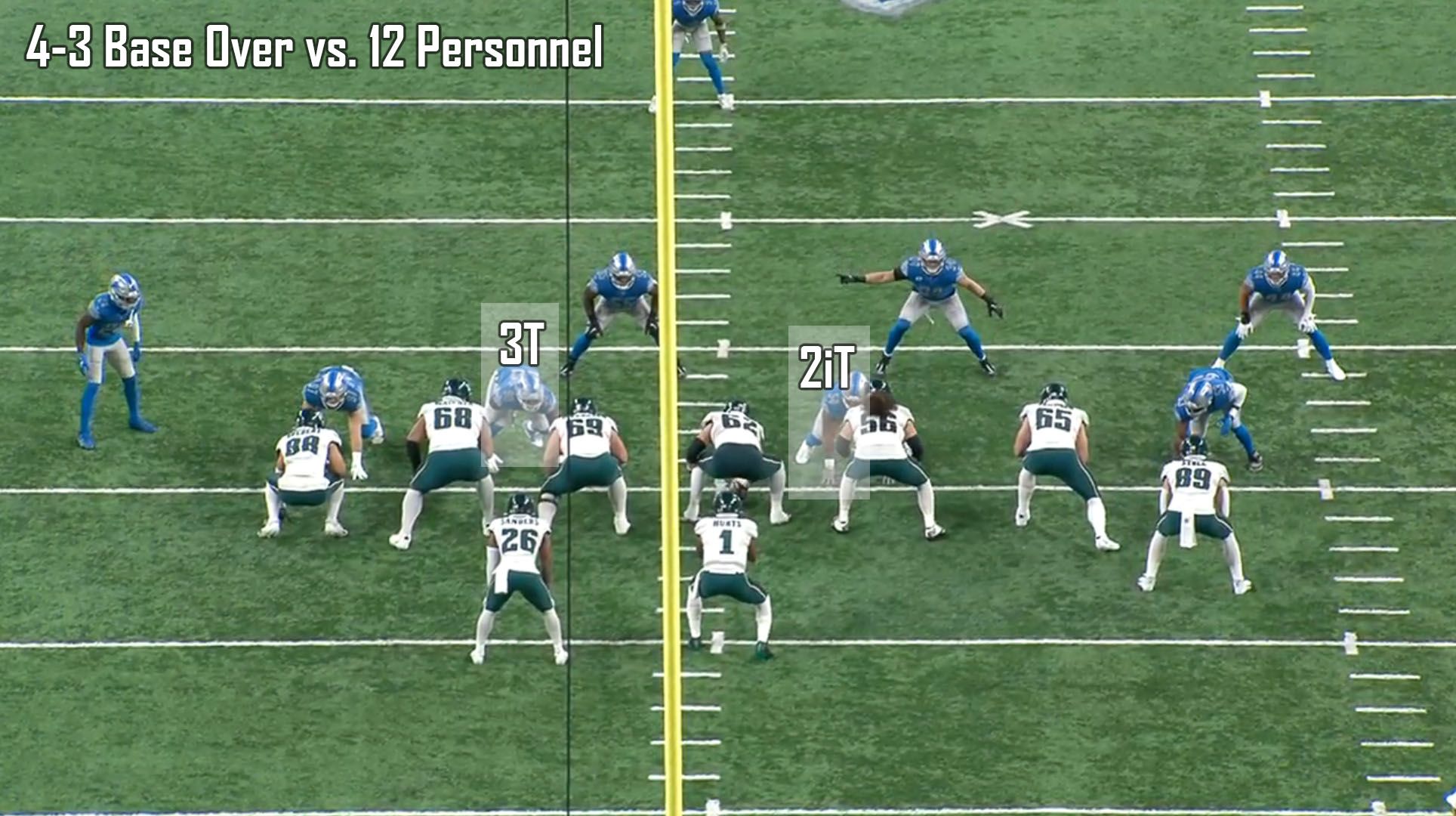
Each of these examples is the first defensive play of the season. While it’s hardly a body of work that can visualize what Glenn is about as a play-caller, each screenshot provides a solid idea of his intentions.
A year later, Glenn comes out with a nickel look (3-3-5) against Patrick Mahomes:
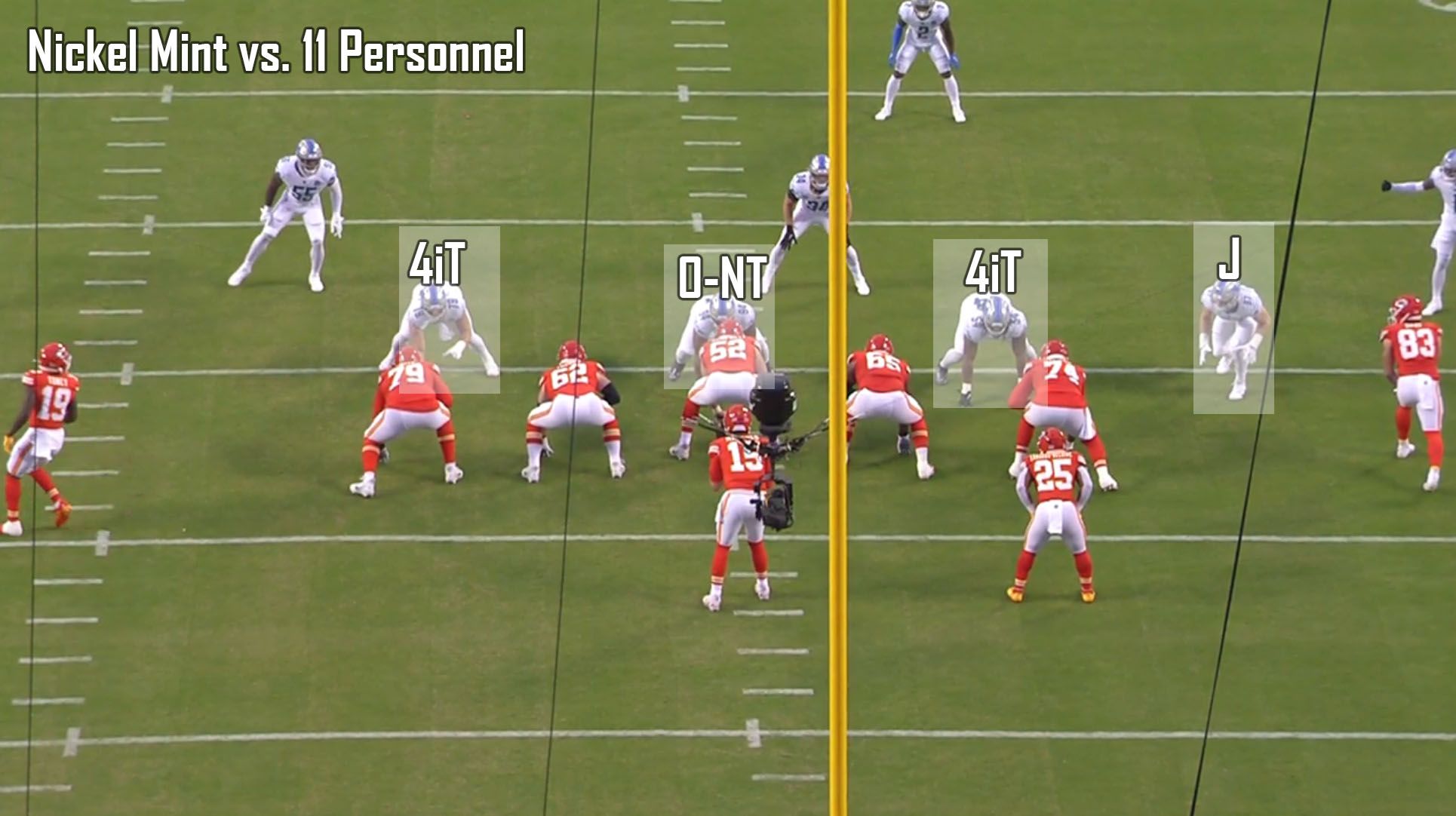
Aidan Hutchinson is standing here, something that he’ll do from time to time, despite his locked-in 4-3 defensive end status of a prototype. This look, despite coming out of the nickel, is a 3-4-principled front.
The traditional nose tackle (0-tech), coupled with the dual-4i-techs and the JACK (Hutchinson) on the line, is what many classify as a Mint front. (I have no idea how Glenn classifies this front, only that it’s of the 3-3-5-type variety.)
The third example is another 3-4 look, yet this one is much more traditional:
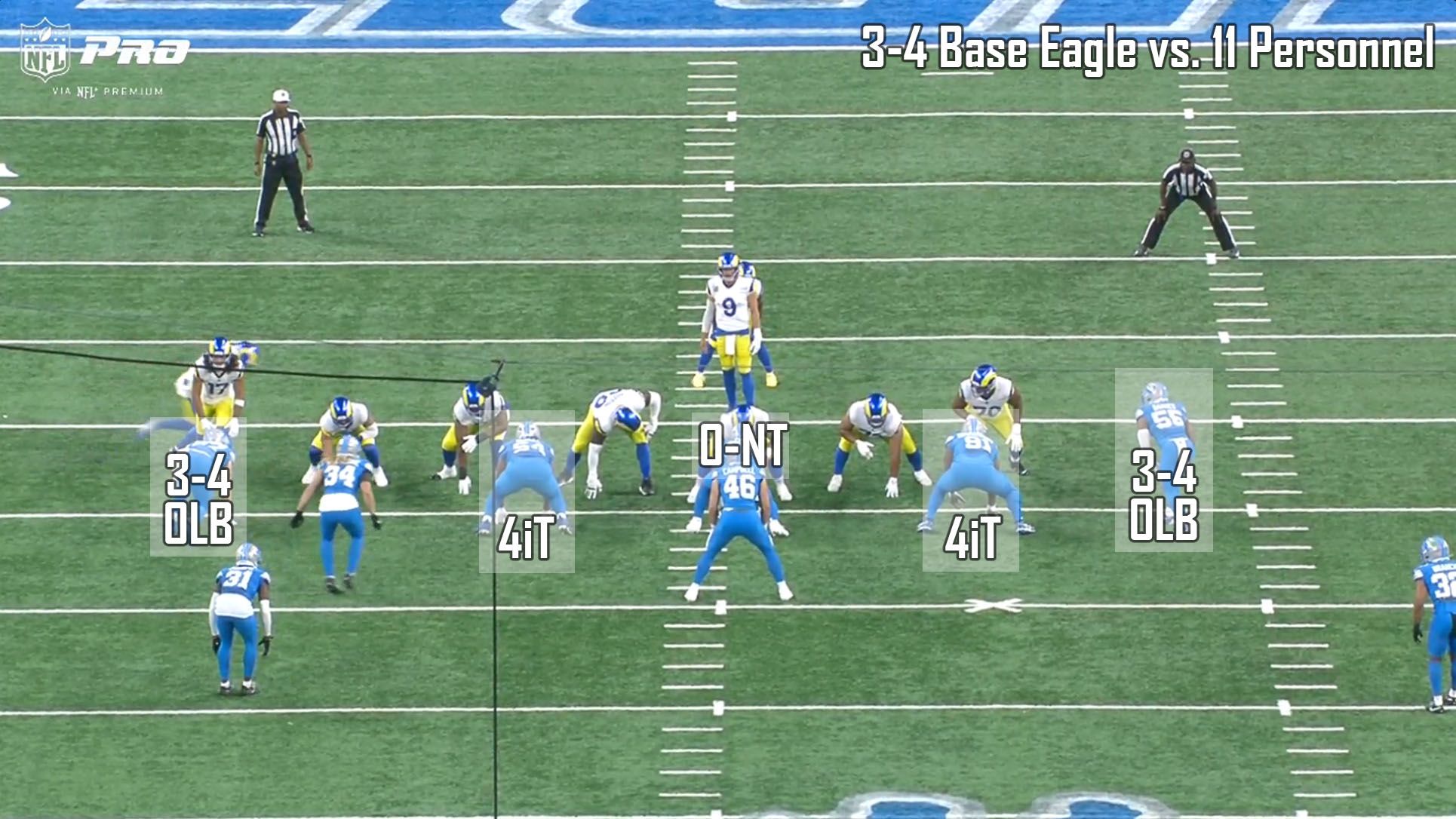
In 2024, while facing the Los Angeles Rams, Glenn actually sticks with his base defense despite the offense going with 11 personnel (three wide receivers). Detroit is clearly in a traditional Eagle-type front, eager to shut down the Rams’ early-down rushing intentions.
Still, the 3-4 front above resulted in a one-gap defense. The nose tackle slanted to the field side (right side of our screen and passing weak side), whereas the 4i-techs expanded outward. More traditional 3-4 schemes utilize two-gapping principles in rush defense, something that is becoming rarer with each passing NFL season.
The dying two-gap philosophy is simply the nature of the beast — the emphasis shifting from physicality to speed, with offenses utilizing jet motion and east-west concepts to move defenses sideline-to-sideline.
On the next play, the second play of the season, Glenn rolls with a traditional 4-3-principled subpackage on second-and-11 (after successfully stuffing the first-down rush and creating the second-and-long):
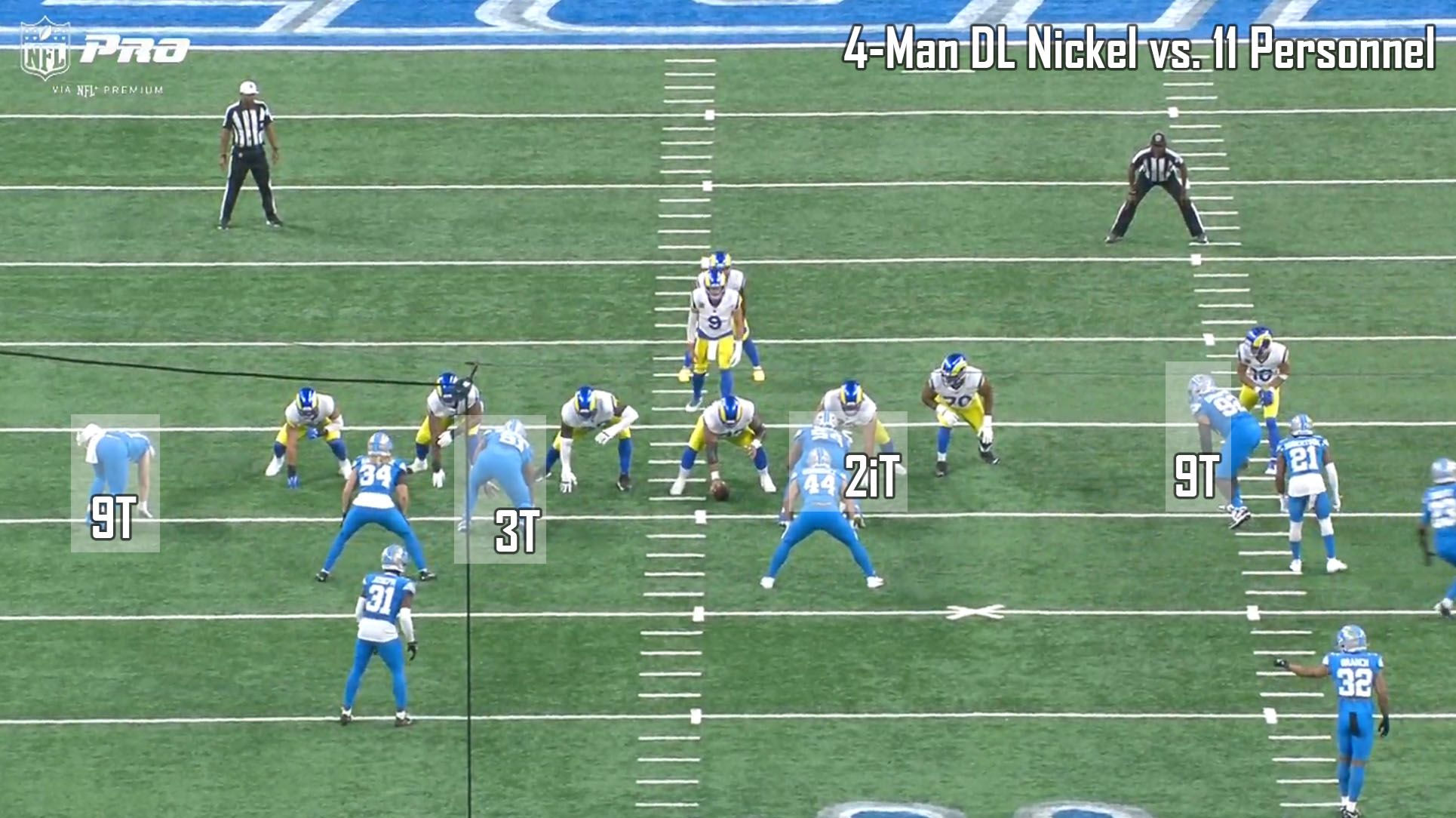
For the most part, the Lions were largely a 4-3 team under the Jets’ current head coach. However, a strong case can be made that he’s a 3-4 defensive mind at heart (see his mentor, Bill Parcells’s, preference).
Along with the 3-4 look, Glenn’s play-calling tendencies are heavy on man coverage and sending extra pressure — both of which are legitimate concerns in the modern NFL. Yet, it should only be a concern, not a strategist’s guaranteed failure (by way of projection).
At the end of the day, in today’s game, whether or not Aaron Glenn prefers 3-4 or 4-3 doesn’t matter much (if at all). The way football is played today forces every defensive architect to use both principles, and defenders are asked to be fluent in either system.
Somebody like Jermaine Johnson, for instance, wouldn’t have an issue playing EDGE in either front.
Here’s how to answer anybody who’s curious about what the New York Jets’ 2026 front will look like: “Aaron Glenn runs a hybrid front that ultimately leans on even-front/one-gap principles, something that is largely prevalent in today’s NFL.”