
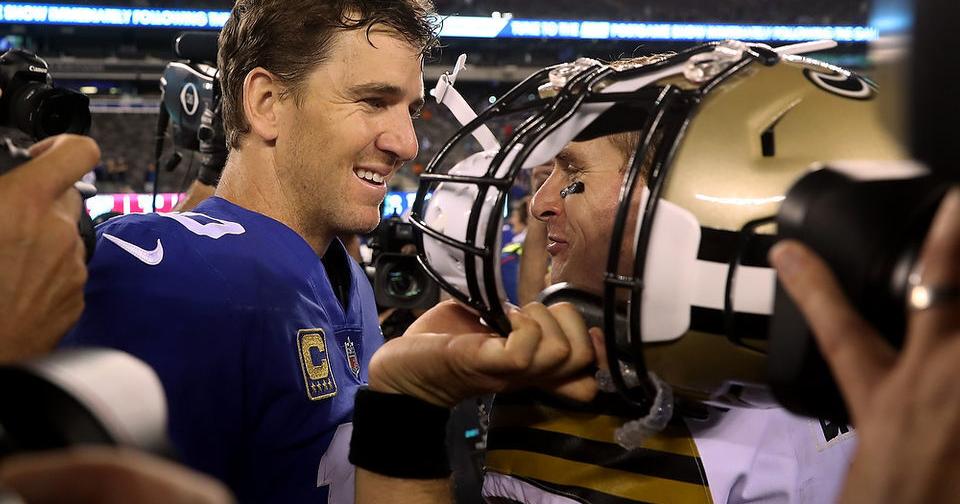
Editor’s note: Information for this column was compiled from the presentation made by Gary Meyers of the Pro Football Hall of Fame selection committee.
The debate over Eli Manning’s Hall of Fame candidacy is one of the most polarizing in recent memory.
There’s little middle ground when it comes to Manning, the former Isidore Newman School standout who starred for the New York Giants from 2004-19 and is one of 15 finalists for the Class of 2026.
You’re convinced he’s a no-brainer for Canton. Or you’re doubtful and dubious.
Skeptics point to Manning’s career 117-117 regular season record and lack of All-Pro selections. They cite his mediocre 84.1 passer rating and 366-244 touchdown-to-interception ratio.
While those numbers are part of his story, they don’t capture the essence of his greatness. Manning was a quarterback defined by durability, legendary postseason performances and a knack for delivering under the most intense pressure. A closer look reveals a career not just worthy of Canton but also one that embodies the very definition of a Hall of Famer.
Manning’s critics fixate on the .500 record, but it didn’t stop Dan Fouts (86-84-1) and Warren Moon (102-101) from earning gold jackets. Manning’s record in his first eight seasons (2004-11) was 69-50, a healthy 58% winning mark.
The subsequent eight seasons, where his record fell to 48-66, were a product of organizational decay. The infrastructure around Manning collapsed as general manager Jerry Reese dismantled two championship rosters and was forced to trade the team’s best offensive weapon, Odell Beckham Jr., to Cleveland after the star receiver grew disgruntled.
The true, undeniable argument for Manning lies in the postseason. He is one of 13 quarterbacks to win two or more Super Bowls. But Manning didn’t just win two Super Bowls. He was the MVP both times, orchestrating dramatic fourth-quarter comebacks to upset Tom Brady and the mighty New England Patriots twice.
The first one prevented the 2007 Patriots from completing an unprecedented 19-0 season. Trailing 14-10 with less than three minutes left, Manning marched the Giants 83 yards for the go-ahead score, throwing the game-winning 13-yard touchdown pass to Plaxico Burress with 35 seconds left.
In the 2011 Super Bowl, he erased a 17-15 deficit with less than four minutes left by orchestrating a nine-play, 88-yard drive that ended in a 6-yard touchdown run by Ahmad Bradshaw with 57 seconds remaining.
“(Manning) played his best football in the biggest games — most notably in the Super Bowl,” former Patriots coaching legend Bill Belichick said. “He had two game-winning drives at the most critical times of the season; otherwise, we would have won eight Super Bowl titles.”
In those two Super Bowl runs, Manning threw 15 touchdown passes and just two interceptions. He set an NFL postseason record during his 2011 postseason run with 1,219 yards passing.
Manning’s postseason legend is bolstered by his 5-2 career record in road playoff games. He remains the only quarterback to beat both Brett Favre and Aaron Rodgers in the playoffs at Lambeau Field. He survived subzero temperatures to beat Favre in overtime in the NFC championship and endured a physical beating against the 49ers to win the 2011 title game, also in overtime.
“Eli is one of the toughest players I’ve ever been around,” former Giants coach Tom Coughlin said. “Great player in the big moments, an unbelievable teammate, and a hard worker. I just can’t say enough about the guy, and I know there’s no way we win those championships without him.”
Beyond the statistics, Manning epitomized the intangible core principles of the Hall of Fame — commitment, integrity, courage, respect and excellence. His 210 consecutive starts rank third all-time for a quarterback and speak to his commitment. His legendary performances in hostile conditions in those NFC championship games speak to his courage. As do his 42 game-winning drives, which are more than 23 Hall of Fame quarterbacks, including Joe Montana and Roger Staubach. Five of those were in the playoffs.
“He was a great player in this league for a long time,” Hall of Fame coach Bill Parcells said. “Highly productive and had a lot of great moments. And playing in New York is different. Believe me, I know. It’s not like other places. But he dealt with it, and he beat the best team in the history of the league twice in the Super Bowl. I mean, what more do you have to do?”
Fair or not, quarterbacks are judged by wins, losses, championships and moments — the kind that define careers and forge legacies. Manning ranks 11th all‑time in passing yards and touchdowns. He won multiple Super Bowls. And on top of it all, he delivered two of the greatest moments in NFL history.
He didn’t just participate in history. He wrote it.
That’s not a borderline résumé.
That’s a Hall of Fame résumé.