
There was once a day, believe it or not, when the college football industry believed the transfer portal was mainly for new coaches and quick fixes, but the elites would still mostly build the old-fashioned way.
The final stake in that belief might have come in this past year’s College Football Playoff, when 10 of the 12 participants ranked in the top 25 of last year’s transfer portal rankings, per 247Sports. The only exceptions: Tulane and James Madison.
So it might be with great interest and concern for some that The Athletic’s transfer portal top 25 this year is missing two brand names: Alabama and Georgia.
Nine other SEC teams were in the rankings, and eight of last year’s CFP teams were. The exceptions: Those same two Group of 6 teams … plus Alabama and Georgia. The SEC’s last two teams to win a national title, the dominators of the old recruiting ways, now dinosaurs, doomed to extinction from elite status?
That would be way too premature, if for no other reason than Kalen DeBoer’s and Kirby Smart’s teams were in last year’s portal rankings, so it’s not a philosophical hang-up.
But for both, their offseason approach and how they do in 2026 is a test case, and in Alabama’s case, it’s an effort — perhaps an unwanted one — to buck a trend.
Alabama
Scholarship players added/lost: 18/21
Career snaps added/lost: 12,169/8,810
Career starts added/lost: 150/55
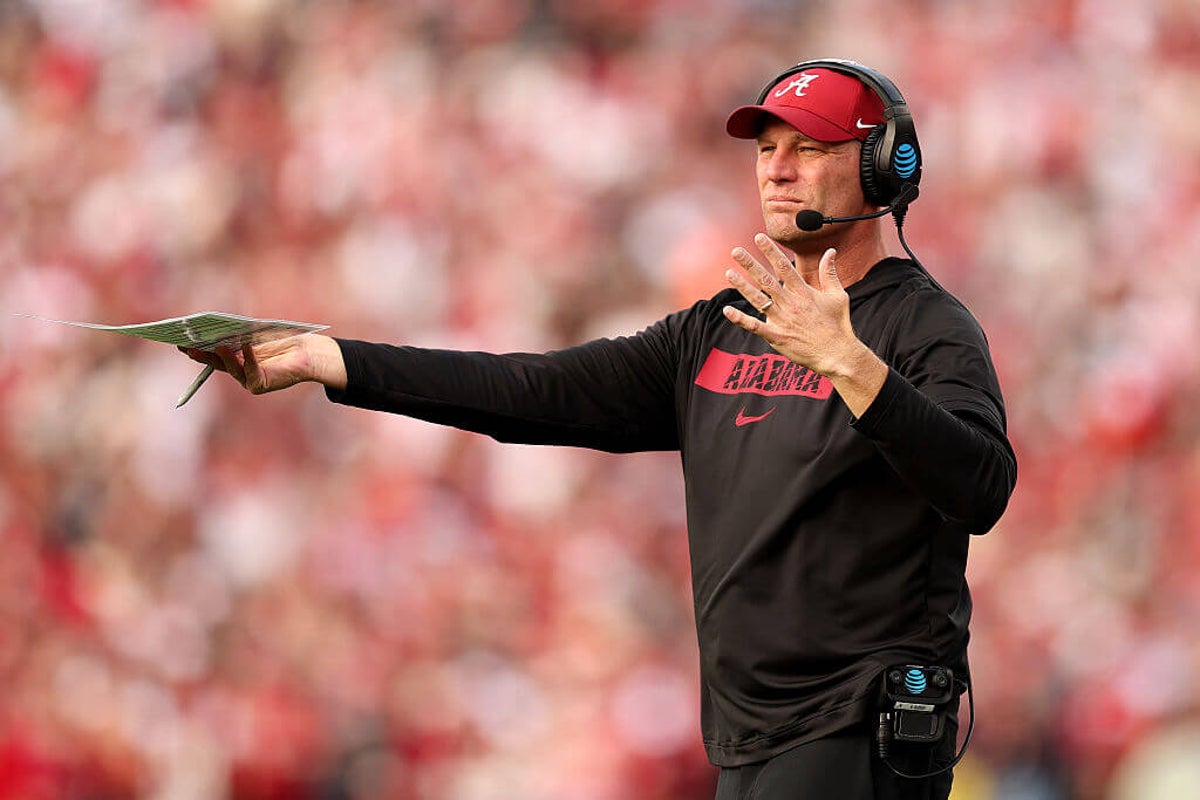
Everyone’s aiming to have an older team now, with Indiana reinforcing that importance. And yet when DeBoer met the media last week at the Senior Bowl, he made clear the Crimson Tide were going in the opposite direction.
It’s not by design: Two years ago, Alabama lost nearly 40 players after Nick Saban’s retirement, then 25 after DeBoer’s first year. This year, the number was down to 22, but that included four starters. And that doesn’t count veteran players such as quarterback Ty Simpson, linebacker Deontae Lawson, defensive tackle Tim Keenan III and offensive tackle Kadyn Proctor.
And though Alabama does add 17 transfers, DeBoer acknowledged many are on the younger side with the aim of developing. In particular, Alabama will have a young offensive line, even with the addition of Mississippi State transfer Jayvin James.
Meanwhile, Alabama did just sign the nation’s No. 2 high school recruiting class — behind only Southern California — a year after signing the No. 3 class. So there will be a hope for younger players improving, with DeBoer mentioning a quartet of rising sophomores: wide receiver Lotzeir Brooks, cornerback Dijon Lee Jr., offensive lineman Michael Carroll and defensive lineman London Simmons. Keelon Russell, one of the nation’s top recruits a year ago, is also expected to compete for the vacant quarterback job.
There’s also receiver Ryan Williams, who looked like a star as a freshman in 2024, didn’t have the expected leap last year but still has immense promise.
“(We’re) probably younger again, but that’s something we got to use as an edge and try to make kind of our thing,” DeBoer said. “Let’s continue to grow up faster.”
That’s an emphasis because being so young last year “probably led to some of the inconsistencies we had at times,” DeBoer said, especially when they were facing older teams. Being young again was not the aim: Alabama tried to get star receiver Cam Coleman, who went to Texas, and briefly had a commitment from running back Hollywood Smothers, who flipped to the Longhorns.
It all paints a worrisome picture, but DeBoer struck an optimistic tone.
“I feel good about the guys that we brought in, and I feel great about the guys that decided to stay, because they really want to be here, and they’re important players,” DeBoer said. “From guys that started to guys that had a lot of extended playing time, that are looking to extend their roles, (I’m) really looking forward to this spring.”
Georgia
Scholarship players added/lost: 9/14
Career snaps added/lost: 7,447/5,273
Career starts added/lost: 102/64
Smart’s offseason was the reverse of DeBoer’s: The high school recruiting class, by Georgia standards, was down, ranking No. 6 with only one five-star. Though the transfer portal class wasn’t star-heavy, the damage was contained.
Georgia focused its dollars on retention, and it worked. The only player it lost, rising sophomore cornerback Dominick Kelly, the team really worked to keep even though Kelly wasn’t expected to start in 2026.
The Bulldogs did make some targeted additions: Receiver Isiah Canion (Georgia Tech’s third-leading receiver), tailback Dante Dowdell (Kentucky’s second-leading rusher), defensive back Khalil Barnes (Clemson starter) and edge rusher Amaris Williams (five-star recruit in the 2024 cycle).
Georgia’s strategy was to hold on to the nucleus of its team, and it did that. The defense, on paper, should be very strong next year, with returning players accounting for 63 percent of tackles, 65 percent of sacks and seven of the nine interceptions.
The offense returns quarterback Gunner Stockton and three offensive line starters. But where Smart and his staff did the most work was with the skill position players. That’s where the test for the overall strategy might lie.
Georgia lost Zachariah Branch, who in his one year on campus set the single-season record for catches. He gave the offense the go-to receiver it lacked in 2024. Rather than splurge for Coleman or another immediate No. 1 receiver, Georgia added Canion, who fills a void at the outside receiver spot.
More interestingly, Georgia spent to keep younger receivers, including Talyn Taylor, Thomas Blackshear, CJ Wiley and Sacovie White-Helton. Between their development, Canion’s addition and the usual array of good tight ends (Lawson Luckie, Elyiss Williams, Jaden Reddell), the coaches hope either a new No. 1 target will emerge or the group will be so deep it doesn’t matter.
As almost a backup plan, Georgia also spent to keep tailbacks Nate Frazier and Chauncey Bowens, and bring in Dowdell. Miami showed you can still win with a good, physical running attack, and it’s a safe assumption Smart would love to win that away again, if possible.
But when he was at the Senior Bowl last week, Smart made clear in an interview on the NFL Network that he knew this was a new era.
“We have to play players faster now. … It’s much closer to free agency in the NFL,” Smart said. “You pay for a player, you have an NIL player, you better get them on the field quick, or they’re going to be gone. We call it use ’em or lose ’em. So if you don’t use them, they’re going to be gone.”
So Georgia will use them. But it will also hope that its retention strategy results in an older, veteran team — much like Indiana, even if the way to get there was different.